
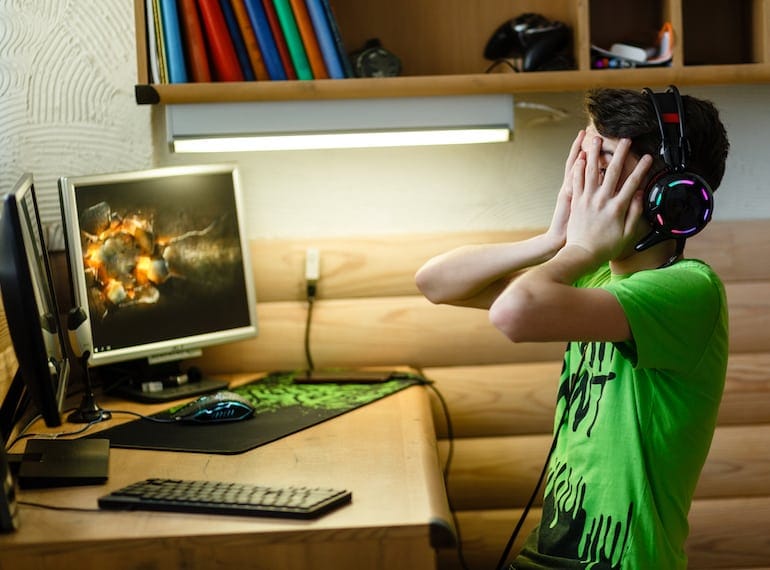

Major technological advances in entertainment and leisure have led to a widespread proliferation of electronic games, especially mobile games, which children of various ages have become infatuated with. Given that most of these games are not Arabic, they distract from other activities and have become the primary preoccupation of children and adolescents, driven by content based largely on excitement, violence, and aggression. The extent of these games’ impact on aggressive behavior in children and adolescents is clear, as children’s use of electronic games contributes to the emergence of violence and aggression, and the acquisition of a range of negative behaviors.
Aggressive behavior is abnormal social behavior of an intentional nature, aimed at inflicting harm and damage on oneself or others, and takes many forms, including:
A- Verbal aggression: This stops at the boundaries of speech accompanying anger, with examples including name-calling, ridicule, and threats, intended to cause harm or create an atmosphere of fear, and it can also be directed at oneself or others.
B- Physical aggression: This refers to harmful physical behavior directed toward oneself or others, with examples including hitting, pushing, kicking, biting, and hair-pulling. These behaviors often accompany intense anger.
C- Self-directed aggression: This aims at self-harm and inflicting injury upon oneself, and takes multiple forms such as a child tearing their clothes, books, or notebooks, slapping the face, pulling hair, banging the head against a wall or bed, scratching the body with fingernails, or biting the fingers.
D- Aggression toward property: This includes attacks on public property, and takes multiple forms such as tearing seats, breaking phones, chandeliers, or similar public or private property.
Scientific studies have confirmed that excessive use of electronic games leads to an increase in behavioral and psychological problems in children and adolescents, including problems with aggressive behavior, violence, hyperactivity, feelings of isolation, poor social interaction, weak social relationships, memory loss, and sleep disorders. It may also lead to physical illnesses such as heart disorders, elevated blood sugar, and severe obesity.
Studies have also shown that there is evidence of a correlational relationship between playing violent video games and committing violent activities and behaviors in reality. Unfortunately, this is evident from what we hear and see in this era regarding violent behavior by children toward members of their own families and even toward their parents.
Studies have confirmed that these electronic games on mobile phones, and the excessive use of mobile phones in general, have a very harmful effect on children who suffer from certain disorders such as attention deficit hyperactivity disorder (ADHD), alongside their impact on healthy children.
How to curb aggressive behavior in children and adolescents:
– Work to discharge physical energy in children and adolescents by practicing physical activities such as running, cycling, and swimming, to reduce the use of electronic games.
– Stop dealing with children and adolescents in a strict and harsh manner, avoid using physical and verbal violence, and work to establish a dialogue with children, discuss their problems, guide them, care for them, and respect their self-esteem and feelings.
– Curb family problems, especially in front of children.
– Agree with children on a daily schedule for their chores, activities, and methods of reward and punishment, while encouraging them and moving away from methods of physical and verbal punishment.
Some therapeutic methods and techniques have proven successful in reducing aggressive behaviors and modifying behavior, including:
Cognitive Behavioral Therapy:
Cognitive behavioral therapy is suitable for use in many fields and is effective and impactful in addressing many problems and changing many negative behaviors. It is used to modify and treat the behavior of children with disorders, hyperactivity, and attention difficulties, as well as those who suffer from aggression and social rejection. Its effectiveness has been demonstrated in reducing the intensity of anger, aggression, and hostile behaviors in children, and it is conducted by a behavior modification specialist.
Play and Art Therapy:
Play is one of the manifestations of human behavior in childhood; it is a way for a child to express their feelings and emotions. Play and art therapy are methods that have proven effective in reducing behavioral and aggressive problems, including:
Educational, movement, and dramatic games, spelling games, singing, and more.
Dr. Hind Mahmoud
Consultant in Speech, Communication, and Mental Health Disorders.



Latest video
تابع معنا تحليل قراءة الصحف اليومية مع الكاتب الصحفي Hany Sallam عبر