
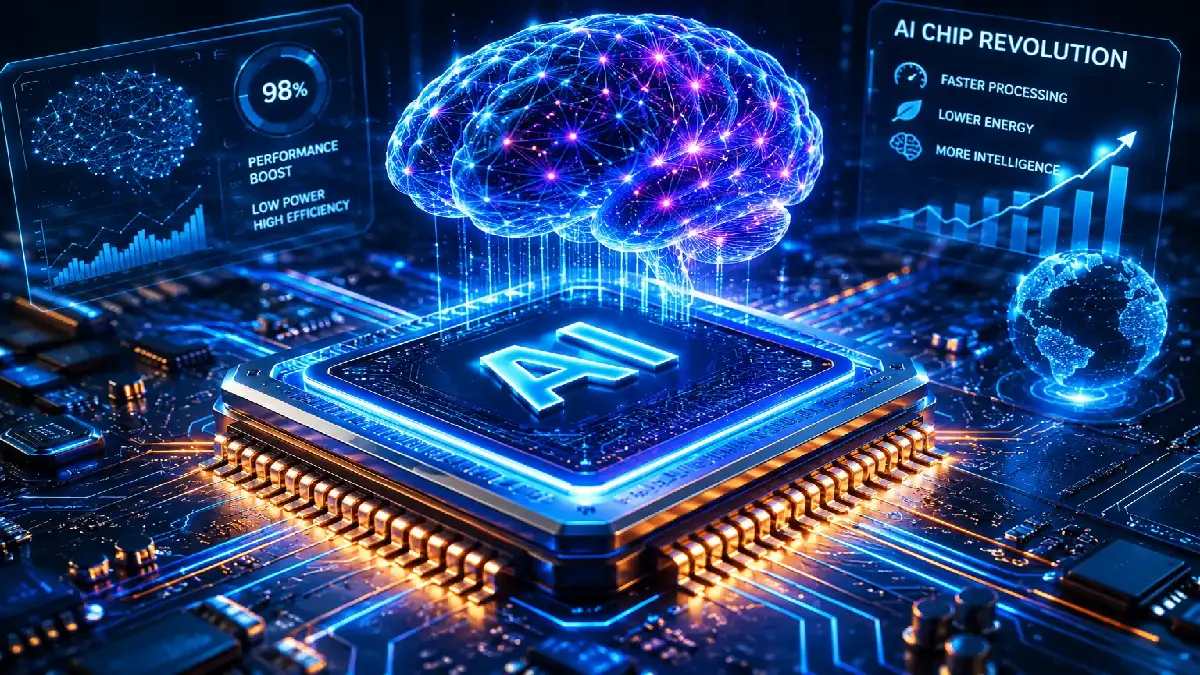

Over recent days, the tech world has seen a fast-paced race among major tech companies to develop a new generation of AI chips in an attempt to increase processing speed and improve energy efficiency within modern smart systems.
This race is no longer just a competition over performance; it has become a real battle over who holds the ability to build the future infrastructure of artificial intelligence.
Why Have Chips Become So Important?
With the massive expansion in the use of artificial intelligence and big data analysis, traditional processors are no longer sufficient to handle huge volumes of calculations.
The new chips rely on a more advanced architecture similar to biological neural networks, allowing them to analyze data and understand patterns much faster.
What Is New in These Chips?
The new generation relies on advanced parallel processing techniques, allowing millions of operations to be carried out in a very short time.
Some companies also use systems inspired by the way nerve cells work inside the brain, known as neuromorphic computing.
Higher Speed
The new processors provide faster response in training smart models.
Better Energy Efficiency
One of the biggest technological leaps is the reduction of energy consumption during processing.
Improved Data Analysis
The chips have become more capable of reading complex patterns within big data.
The Relationship Between Chips, Medicine, and Science
These processors are not only used in technology; they have become an essential part of modern medicine, especially in analyzing cells, biological signals, and genetic data, and in discovering diseases such as cancer.
They also play a major role in space research, the analysis of cosmic signals, environmental studies, and biological systems.
Who Is Leading This Race?
Companies such as Samsung, Nvidia, Google, and Microsoft are pumping billions of dollars into developing these chips, focusing on raising processing speed and improving the autonomous intelligence of systems.
Experts believe that the coming years may see the birth of processors whose efficiency approaches the way the human brain works.
Are We Facing a New Generation of Computing?
With the integration of artificial intelligence, neural networks, and data analysis, the world appears to be nearing a new era of smart computing.
This could change everything, from medicine to space, and from the environment to robotics.
Hany Sallam


Latest video
تابع معنا تحليل قراءة الصحف اليومية مع الكاتب الصحفي Hany Sallam عبر