
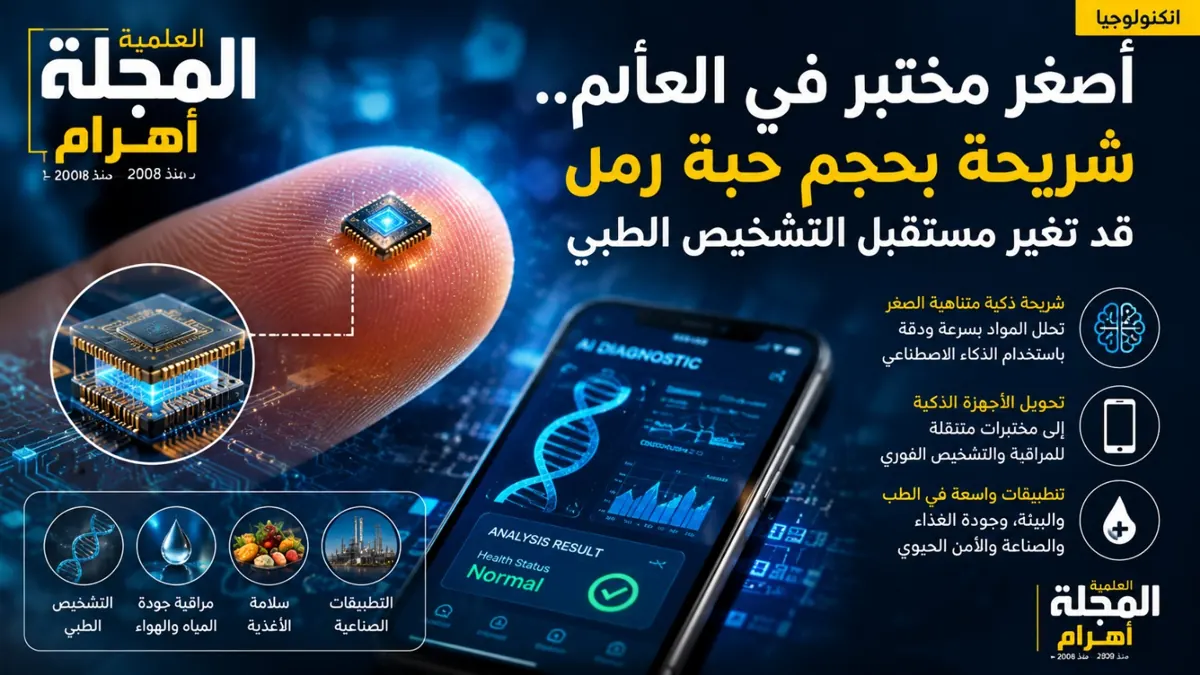

A Tiny Innovation the Size of a Grain of Sand
In a striking scientific achievement, researchers at the University of California, Davis have developed a microscopic electronic chip close to the size of a grain of sand, yet it possesses capabilities that could reshape the future of medical tests and smart devices in the coming years.
The new chip relies on advanced technologies combining precise sensing and artificial intelligence, allowing it to analyze chemical and biological substances faster and at a lower cost than many traditional laboratory devices.
How Does the New Chip Work?
Scientists have developed what resembles a miniature laboratory inside an extremely small chip, capable of capturing and analyzing precise patterns of light and surrounding substances. Afterward, artificial intelligence uses advanced algorithms to interpret the data and extract results in a short time.
The researchers note that the small size of the chip may allow it to be integrated in the future into smartphones, portable medical devices, and even wearable gadgets.
Promising Medical Applications
Experts believe the new technology may open the door to a different generation of medical diagnostic tools. Devices equipped with these chips could detect markers of certain diseases or analyze simple samples without the need for bulky laboratory equipment.
The technology can also be used to monitor water and air quality, analyze food, and detect certain chemical substances in industrial environments.
Turning Smart Devices into Mobile Laboratories
One of the most exciting aspects of this innovation is the possibility of turning everyday electronic devices into mobile analysis platforms. Instead of sending samples to specialized laboratories and waiting for results, testing could take place directly through small devices carried in a user’s pocket.
Researchers believe this trend may help expand healthcare services in remote areas and reduce the cost of preliminary tests in the future.
A Global Race Toward Nanoscale Devices
The world is currently seeing an accelerating race to develop nanoscale electronic devices that combine artificial intelligence and advanced sensing. Universities and tech companies are striving to shrink these systems while maintaining their ability to perform complex tasks.
Specialists view the new chip as an important step toward an era where analysis and diagnostic tools become a natural part of everyday smart devices.
A Future Closer Than We Imagine
The technology is still in the research and development stages, yet its initial results have sparked widespread interest in scientific circles. If future tests succeed, we may see smart devices in the coming years capable of performing precise analyses using chips no larger than a single grain of sand.
Hany Sallam


Latest video
تابع معنا تحليل قراءة الصحف اليومية مع الكاتب الصحفي Hany Sallam عبر