
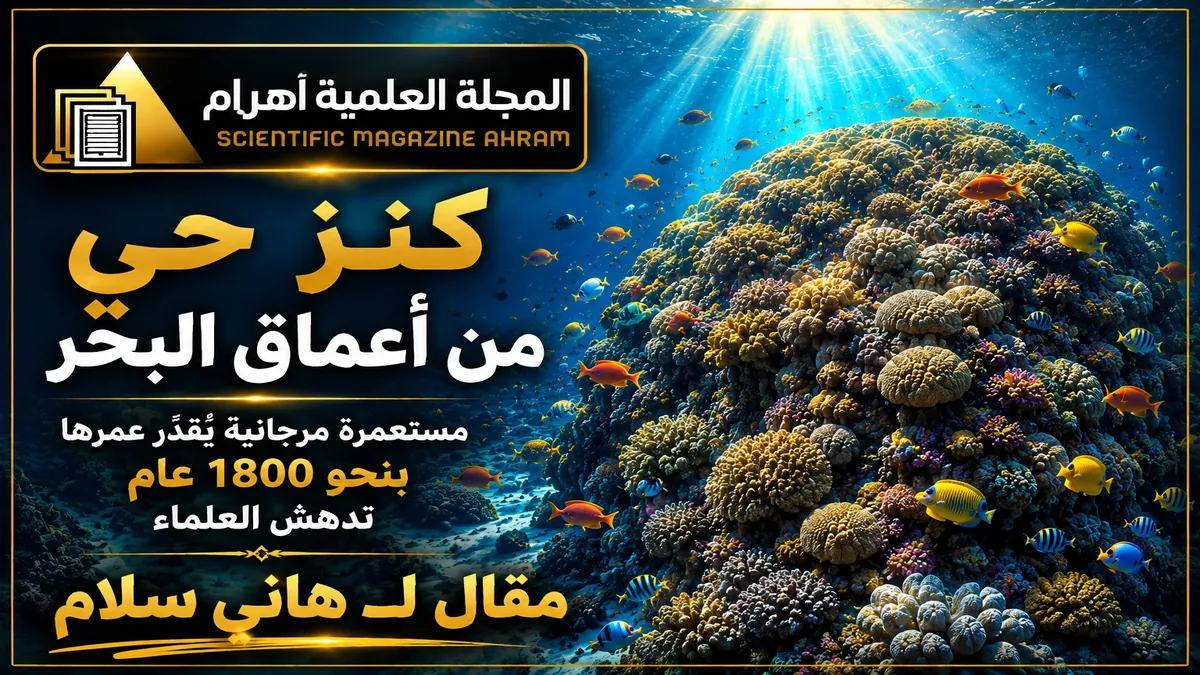

Deep in the Indian Ocean, scientists have discovered a massive coral colony. Its age is estimated at about 1,800 years, making it one of the oldest known living coral colonies on Earth.
The significance of this discovery does not lie only in the size of the colony. It also represents a long-term natural record of the environmental changes the region has witnessed over many centuries.
A Single Colony of Exceptional Size
Coral reefs look like colorful rocks, but the reality is quite different. They consist of millions of tiny living organisms working together to build massive, complex structures.
In this case, researchers discovered an interconnected colony that grew gradually over hundreds of years. As a result, it reached an exceptional size that drew the attention of marine scientists.
Researchers believe this colony belongs to a species known as “Potato Coral.” This species is also distinguished by its ability to grow for long periods under the right conditions.
How Did Scientists Estimate Its Age?
Scientists cannot determine the age of coral reefs with complete precision. Nevertheless, they use several scientific methods for estimation.
These methods include measuring the size of the colony and studying its annual growth rate. Researchers then compare the results with known environmental data.
Based on these calculations, scientists estimated the age of the colony at about 1,800 years, making it one of the oldest known coral colonies to date.
A Living Witness to History
If this estimate is correct, the colony began its life more than 18 centuries ago.
Since that time, it has continued to grow slowly year after year, bearing witness to climate changes, storms, and numerous natural events that have passed through the region.
For this reason, researchers view it as a unique natural archive that can help us understand the history of the marine environment.
Great Environmental Importance
Coral reefs play a vital role in marine ecosystems, providing food and shelter for thousands of species of living organisms.
In addition, these reefs help protect coastlines from the impact of waves and storms.
They also support marine biodiversity, which is why scientists view this giant colony as a true environmental treasure.
Challenges Threatening Coral Reefs
Despite their long age, coral reefs face increasing challenges.
These challenges include rising ocean temperatures, water acidification, and pollution.
Furthermore, certain human activities affect the health of marine ecosystems.
This has led to the decline of many coral reefs around the world in recent decades.
A Message from the Deep Sea
This discovery reminds us that certain living organisms possess an astonishing capacity to survive across time.
While civilizations changed and generations succeeded one another, this colony continued to grow for nearly 1,800 years.
Ultimately, this natural wonder carries an important message: protecting marine ecosystems is not a luxury, but a necessity to preserve the future of life on our planet.
Hany Sallam


Latest video
تابع معنا تحليل قراءة الصحف اليومية مع الكاتب الصحفي Hany Sallam عبر