

Journey into the Depths of Planetary Formation
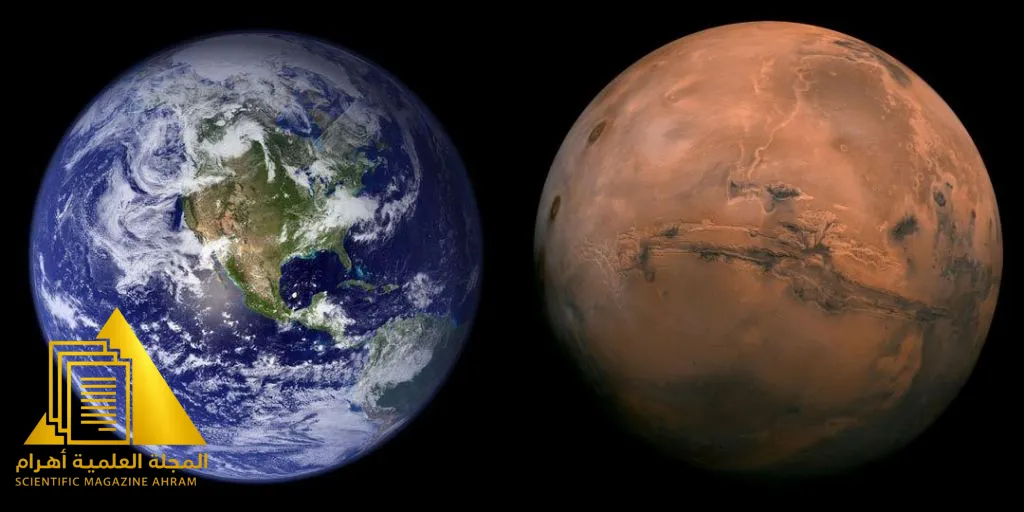
Scientists have long viewed Earth and Mars as solar system “twins” due to their geographic proximity and rocky characteristics. However, a recent scientific study has turned these concepts upside down, confirming that the formative history of each bears completely different physical imprints, which raises new questions about how rocky worlds originated in the inner parts of our solar system.
Divergent Building Processes
Researchers point to the fact that Earth and Mars did not form through the “accretion” of the same materials in space as previously believed. While Earth underwent processes merging diverse and multiple rocky masses under specific thermal and pressure conditions, Mars took a completely different path, appearing to have originated in a faster and less complex accretion environment. This fundamental difference in the formation “recipe” explains the major contrast in the chemical composition of both planets, which changes our view of the evolutionary history of rocky planets.
A Window to Distant Planets
The significance of this study is not limited to understanding the past of our neighbors in the solar system, but extends to being a vital tool in the search for life beyond our borders. By understanding how two rocky planets can form differently despite their proximity to the Sun, astronomers can develop more precise criteria for classifying exoplanets. Now, the question is no longer just “Does the planet lie within the habitable zone?”, but rather “How did this planet form and what materials does it carry in its core?”
The Future of Scientific Research
This scientific discovery represents a qualitative leap in planetary science; it tells us that the universe is more diverse in its building methods than we imagined. As we continue to explore deep space, these results will remain a compass for scientists seeking to unlock the secrets of distant worlds and determine whether we might one day find a “second Earth” that shared the same evolutionary path, or whether every planet in this universe writes its own story from the very first moments of its formation.
By: Hany Sallam
Source: universetoday.com


Latest video
تابع معنا تحليل قراءة الصحف اليومية مع الكاتب الصحفي Hany Sallam عبر