
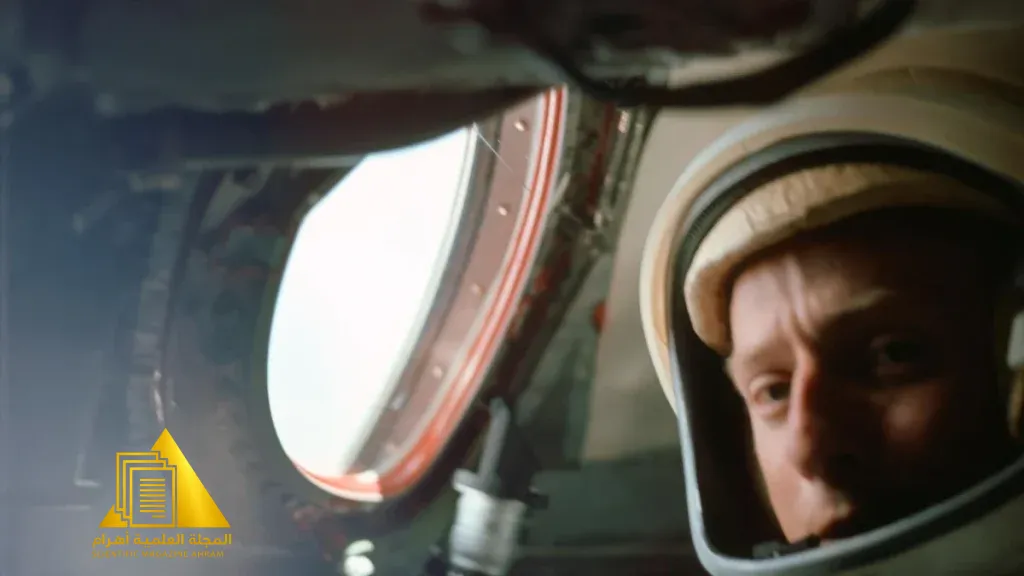

A Window on the World From a 70 mm Orbit
In May 1963, as astronaut Gordon Cooper was orbiting inside his “Faith 7” spacecraft on the Mercury-Atlas 9 mission, he had no idea he was about to revolutionize our understanding of the capabilities of the human eye. While the world watched the unfolding space race, Cooper was watching something else entirely: Earth. Armed with a 70 mm camera, he took 29 color photographs of the planet’s surface. These were not merely visual documentation of Earth’s beauty from above, but an unprecedented scientific experiment to test the limits of human visual acuity from deep space.
Beyond the Limits of Ordinary Vision
The photographs alone were not what astonished people; it was the reports that Cooper
sent back to Earth. The astronaut claimed he was able to distinguish details that seemed impossible to spot from such a towering altitude. He pointed to seeing vehicles moving on dirt roads, smoke rising from steam trains, and even small buildings and structures. This testimony startled the scientific community and prompted the space agency to reevaluate its theories regarding human visual acuity in harsh environments.
The Cooper Effect: Science Tests Human Capabilities
Cooper’s experiment was no accident. These observations served as the cornerstone for a series of studies that sought to understand how the human brain interprets images captured from orbit. How was the astronaut able to pick out fine details amid such extreme contrast between land and space? Scientists discovered that the interplay between light, contrast, and the astronaut’s memory of what things look like (such as the movement of a train) plays a vital role in enhancing visual capacity. These historic moments were not only proof of Cooper’s courage, but our first steps toward understanding how humans can adapt to observing our planet from unfamiliar angles—a technique that later evolved to become the foundation of remote sensing and Earth observation.
An Enduring Legacy
Cooper’s photographs remain a symbol of the beginnings of human exploration, when the astronaut himself was the most precise instrument in space. While we rely today on sophisticated satellites with ultra-high resolution, the challenge Cooper raised in the 1960s remains a powerful reminder of the exceptional capabilities of the human eye and its complex interaction with technology at the heart of the void of space, opening doors to deeper studies on human visual perception.
By: Hany Sallam
Source: NASA


Latest video
تابع معنا تحليل قراءة الصحف اليومية مع الكاتب الصحفي Hany Sallam عبر