
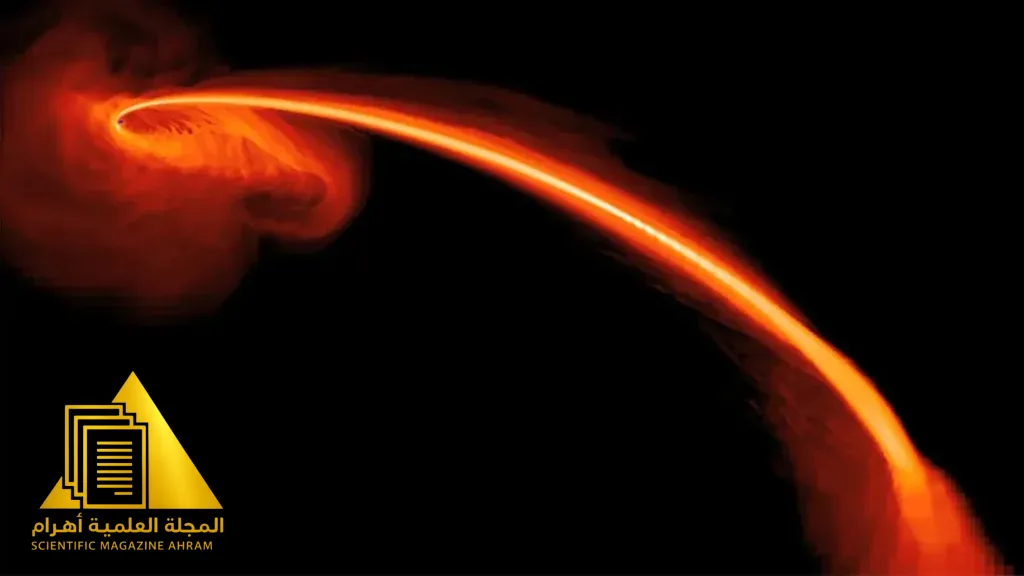

A Dance of Death and Survival in the Heart of the Galaxy
In the depths of the universe, where supermassive black holes rule galactic centers, terrifying events unfold that defy familiar laws of physics. Scientists long believed that any star approaching too close to a black hole would inevitably meet its end, torn to shreds by immense tidal forces. Yet, astronomers have observed a stunning phenomenon: stars that refuse to surrender
, successfully slipping from the grip of the black hole time and time again, leaving behind flashes of light that fade with each approach.
The Secret of Fast Stars
Why are these stars not swallowed entirely? To answer this puzzle, researchers turned to studying stellar rotation speeds. New discoveries indicate that stars spinning at extreme speeds before falling into black hole orbits possess a unique competitive advantage. This high rotational speed not only grants them structural stability that prevents them from breaking apart, but also plays a key role in how they interact with lethal gravitational fields.
Fading Light: The Mystery of Repetition
Scientists noted that the light flashes emitted during each approach gradually begin to fade. Researchers believe that the rapid rotation of the star drains its energy or alters its path in a way that makes its interactions with the matter surrounding the black hole less violent over time. This orbital adaptation explains how these stars remain in very tight orbits without being devoured, changing our understanding of how star systems evolve in extreme galactic environments.
A New Window on the Universe
The ability to track these stars and their repeated interactions with black holes opens up new scientific horizons. Instead of viewing black holes merely as “graveyards for stars,” we have begun to see them as natural laboratories for understanding the dynamics of rotation, gravity, and the evolution of celestial bodies. The survival story of these fast stars is not just a tale of survival, but a lesson in cosmic physics telling us that the universe is far more complex and resilient than we imagined.
By: Hany Sallam
Source: ScienceDaily


Latest video
تابع معنا تحليل قراءة الصحف اليومية مع الكاتب الصحفي Hany Sallam عبر