

Minister of Education Outlines Technical Education Development Strategy Before Parliament’s Education and Scientific Research Committee
Written by Sherine Hamdy
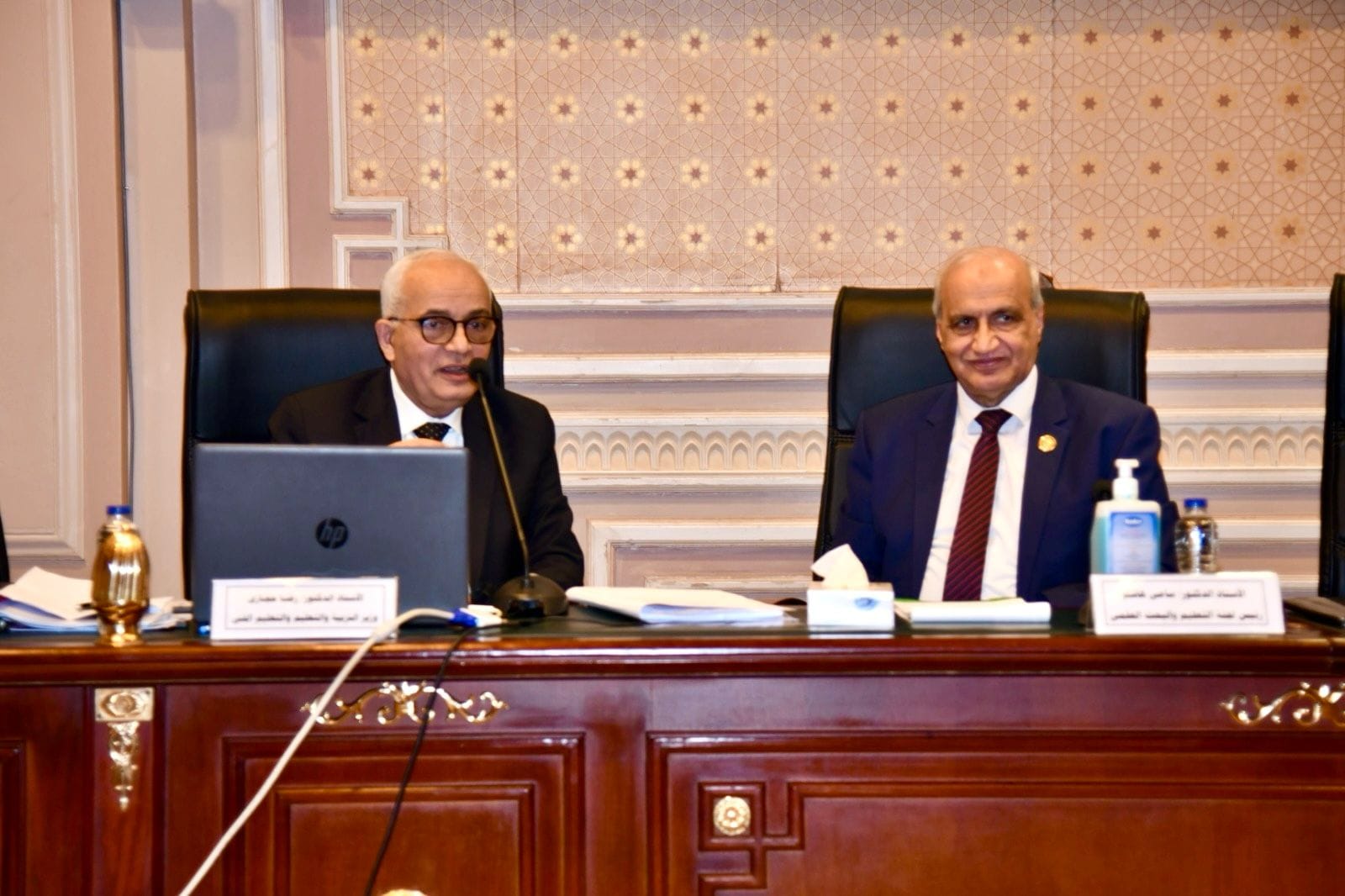
Dr. Reda Hegazy, Minister of Education and Technical Education, reviewed the technical education development strategy and the ministry’s plan to expand applied technology schools before the Education and Scientific Research Committee of the House of Representatives.
The meeting was attended by Dr. Sami Hashem, Chairman of the Education and Scientific Research Committee; Dr. Magda Bakry, Undersecretary of the Committee; Dr. Mona Abdel Aty, Undersecretary of the Committee; Dr. Nesreen Salah, second member of the Committee; Dr. Mohamed Megahed, Deputy Minister of Education for Technical Education; Dr. Mohamed Emara, Head of the Central Administration for Technical Education Schools; Waleed Maher, Director General of the General Administration for Political Communication at the Ministry of Education; and members of the Education and Scientific Research Committee.
At the start of his remarks, Dr. Reda Hegazy expressed his keenness on maintaining ongoing communication through participation in such meetings, noting the role of the House of Representatives in supporting and developing Egypt’s educational system.
The Minister stated that the ministry has completed drafting the 2024–2029 strategic plan through sector analysis, in light of studying challenges. The strategic plan was built accordingly, aligned with the three government programs—building the Egyptian person, employment, and protecting security—as well as the sustainable development goals and the directions of the state and the government.
The Minister explained that the ministry has three strategic goals: access, quality, and sustainability and lifelong learning. The plan also includes four priorities: reach and participation, equity and non-discrimination, quality, and governance and sustainability. In addition, digital transformation, green learning, water security, and other important issues intersect with these priorities.
Dr. Reda Hegazy added that this plan includes the section on developing technical education, confirming his keenness to provide a full explanation and brief parliamentary deputies on all executive measures taken.
Dr. Reda Hegazy reviewed the technical education development strategy and the ministry’s plan to expand the number of applied technology schools and their institutions in a way that ensures their sustainability. He noted that the process began by diagnosing the challenges facing Egyptian technical education to overcome them. These challenges included prioritizing the number of graduates over the quality of their education, the difficulty of transitioning from school to the job market, problems with governance and funding, the closed pathway preventing graduates from entering higher education, and a negative societal image of technical education among students and parents.
The Minister explained that the competency-based methodology adopted in rebuilding technical education curricula is based on sustainable skills, professional skills, and knowledge.
The Minister of Education reviewed the total number of technical education learners in Egypt, which reaches 3 million students, including 2.3 million students across 2,700 schools affiliated with the Ministry of Education and Technical Education. He noted that the students under the Ministry of Education and Technical Education break down into 1.10 million students in industrial education across 1,330 schools, 0.86 million students in commercial education across 970 schools, 0.28 million students in agricultural education across 270 schools, and 0.06 million students in hotel education across 115 schools. He added that the number of students in non-formal technical education under the Ministries of Solidarity, Housing, and Labor reaches 0.4 million students, accounting for 13%, while the Ministries of Trade and Industry, and Health and Population account for 0.3 million students, representing 10%.
Dr. Reda Hegazy pointed to the growth in the number of applied technology schools between 2018 and 2023. In 2018, there were 3 schools; by 2019, the number reached 11 schools; in 2020, it reached 16 schools; in 2021, the number reached 28 schools; in 2022, there were 52 schools; and in 2023, the number reached 71 schools across 18 governorates.
The Minister also explained that the main pillars of the applied technology schools system are the implementation of international quality standards, public-private partnerships, highly trained teachers, productive and globally competitive students, competency-based curricula, a comprehensive student and teacher evaluation system, and practical training aligned with the latest job market developments.
The Minister affirmed that educational development is an ongoing process that needs to combine efforts and shoulder responsibilities to overcome challenges. He pointed to the introduction of new specializations for commercial education that keep pace with job market changes, as well as the focus on technological complexes to educate students under a five-year system, granting them technical diploma certificates that need to be re-valued, providing them with opportunities to study in universities given that their years of study are higher than their peers in the three-year system.
The minister also explained that the ministry’s international partnership with Germany has resulted in students’ certificates being recognized internationally after local accreditation, which has increased their job opportunities in the global market. He noted that the ministry’s strategic plan focuses on developing students’ cognitive, practical, and emotional skills by building their character and fostering lifelong learning to help them develop themselves and keep pace with changing professions around them. He pointed out that education is not just about passing and failing, but rather an evaluation of everything a student has acquired through the learning process. He added that the ministry is keen to encourage the private sector to invest in technical education by opening private technical schools, for example, which ensures the success of these schools as a result of changing the public perception of technical education in Egypt, alongside the intensive use of digitalization in curricula by introducing technology, providing websites, barcodes, and other tools.
The minister confirmed that the ministry has centers of excellence, which serve as one of the mechanisms for developing technical education, noting that the ministry aims to establish 7 centers of excellence linked to technical schools to provide training inside them. He emphasized that some major companies are capable of establishing schools within their premises in addition to providing training inside their factories.
The minister also added that the ministry has an investment portfolio containing a large set of plots of land suitable for building private technical education and applied technology schools.
The session discussed a number of proposals regarding ways to develop commercial education, the capital project within agricultural schools, and the importance of having applied technology schools within the “Future of Egypt for Agricultural Production” project.
At the close of the session, Dr. Reda Hegazy emphasized that focusing on the human element and developing cadres is one of the most important issues the ministry is currently focusing on.


Latest video
تابع معنا تحليل قراءة الصحف اليومية مع الكاتب الصحفي Hany Sallam عبر