
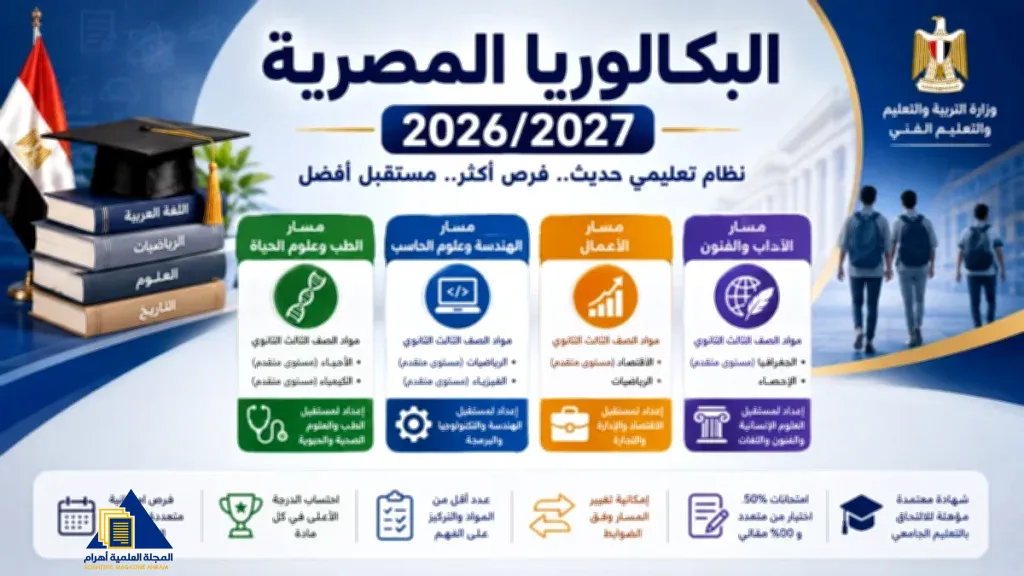

Egyptian Baccalaureate 2026/2027 | Everything You Need to Know in Q&A: Subjects, Tracks, Exams, and Grades
The Egyptian Baccalaureate has become
one of the most prominent topics capturing the attention of students, parents, and teachers as preparations for the 2026/2027 academic year get underway, especially with the system rolling out and details being announced more widely.
But what is the Egyptian Baccalaureate? Is it an alternative to the Thanawiya Amma? What subjects do students study? How do they choose a track? How many times can they take the exam? Can they switch tracks? And what is the difference between it and the Thanawiya Amma?
In this comprehensive guide, we provide clear, straightforward answers to the most important questions that students, parents, and teachers need to know about the 2026/2027 Egyptian Baccalaureate system.
What Is the Egyptian Baccalaureate?
The Egyptian Baccalaureate is an optional secondary education system that runs parallel to the Thanawiya Amma. It aims to offer students a more flexible path by reducing the number of subjects counted toward the total score and providing multiple opportunities to take exams and improve grades.
Students begin studying general subjects in their first year of secondary school (Grade 10), before specialization starts more clearly in their second year (Grade 11) across four main tracks.
Does the Egyptian Baccalaureate Replace the Thanawiya Amma?
No.
is an optional system running parallel to the Thanawiya Amma, meaning its implementation does not cancel the Thanawiya Amma or force all students to enroll in it.
Students and parents can choose the system they consider appropriate, in accordance with the rules and regulations set by the Ministry of Education.
Why Was the Egyptian Baccalaureate Created?
The new system aims to ease academic and psychological pressure on students, reduce the number of subjects included in the total score, and give students a greater chance to improve their results instead of relying on a single exam opportunity.
The system also aims to help students choose the field closest to their inclinations and abilities, and to better connect secondary education with the specialization they wish to study in the future.
When Does Specialization Begin in the Egyptian Baccalaureate?
In Grade 10, students study a set of common general subjects.
Core specialization begins in Grade 11, when students choose one of the four Egyptian Baccalaureate tracks.
What Are the Egyptian Baccalaureate Tracks?
The Egyptian Baccalaureate includes four main tracks:
- Medicine and Life Sciences track.
- Engineering and Computer Science track.
- Business track.
- Arts and Humanities track.
What Do Students Study in Grade 10 Under the Baccalaureate?
In Grade 10, students study a set of common general subjects before moving on to the specialization stage.
The core subjects whose grades count toward the total score are:
- Arabic language.
- First foreign language.
- History.
- Mathematics.
- Integrated sciences.
- Philosophy and logic.
There are also pass-or-fail subjects whose grades are not added to the total score, in accordance with the rules set by the ministry.
What Are the Grade 11 Subjects in the Egyptian Baccalaureate?
All Grade 11 students study core common subjects, in addition to a specialized subject chosen by the student according to their enrolled track.
What Are the Core Common Subjects?
- Arabic language.
- First foreign language.
- History.
The grades for these subjects are added to the total score.
What Is the Specialized Subject in the Medicine and Life Sciences Track?
Students choose one of two subjects:
- Physics.
- Mathematics.
What Is the Specialized Subject in the Engineering and Computer Science Track?
Students choose one of two subjects:
- Chemistry.
- Programming and artificial intelligence.
What Is the Specialized Subject in the Business Track?
Students choose one of two subjects:
- Accounting.
- Business administration.
What Is the Specialized Subject in the Arts and Humanities Track?
Students choose one of two subjects:
- Psychology.
- Second foreign language.
There are also other subjects and activities according to the prescribed curriculum, including financial literacy and physical education.
What Are the Grade 12 Subjects in the Egyptian Baccalaureate?
In Grade 12, students study the main specialization subjects according to their chosen track.
Medicine and Life Sciences Track
- Biology (“advanced level”).
- Chemistry (“advanced level”).
Engineering and Computer Science Track
- Mathematics (“advanced level”).
- Physics (“advanced level”).
Business Track
- Economics (“advanced level”).
- Mathematics.
Arts and Humanities Track
- Geography (“advanced level”).
- Statistics.
What Does “Advanced Level” Mean in the Egyptian Baccalaureate?
An advanced level course means that the material is more focused and specialized to match the track chosen by the student.
The term does not necessarily mean the subject is designed to be impossibly difficult; rather, it relates to the level of specialization required in the final stage.
What Is the Total Score in the Egyptian Baccalaureate?
The Egyptian Baccalaureate system calculates grades based on the second and third years of secondary school, with the final total reaching 600 marks according to announced guidelines.
Scores are calculated from subjects that count toward the total, while other subjects are graded simply on a pass-or-fail basis and are not added to the final score.
Does the Egyptian Baccalaureate Give Students More Than One Exam Opportunity?
Yes.
Multiple exam opportunities and grade improvements are among the most prominent features of the Egyptian Baccalaureate system.
Instead of tying a student’s future to a single exam opportunity, the system provides additional chances according to the schedules, rules, and fees set by the Ministry of Education.
When Are the Second-Year Secondary Exams Held in the Baccalaureate?
According to the published guidelines, there is a primary attempt in May, followed by an optional grade-improvement attempt in July.
The primary attempt is free, while the additional attempt is subject to fees set by the ministry.
When Are the Third-Year Secondary Exams Held in the Baccalaureate?
The primary attempt takes place in June, with another attempt available in August according to established rules.
The additional attempt gives students a chance to improve their results in subjects they wish to retake.
Is the Highest Grade Counted for the Student?
Yes.
One of the main advantages of multiple attempts is that students do not lose the highest grade they achieved. Instead, the highest grade in a subject is counted according to the regulations governing the exams.
Does a Student Pay Fees When Retaking an Exam?
The primary attempt follows the established system with no extra fees, while optional attempts for grade improvement are subject to the fee set by the Ministry of Education.
The ministry has set the fee for the additional attempt at 200 pounds per subject according to the announced guidelines.
How Many Times Can a Student Take the Exam?
The system gives students a number of opportunities during the allotted period, subject to time limits related to the years of study and exam attempts.
Students must follow the rules set by the ministry when applying for each attempt.
Can Students Improve Their Total Score?
Yes.
This is one of the core ideas behind the Egyptian Baccalaureate system.
If students are not satisfied with their grade in a particular subject, they can take the exam again during the scheduled improvement period, and the higher grade is counted according to the governing rules.
Can Students Change Their Baccalaureate Track?
Yes, but under specific rules.
The latest rules allow students in their third secondary year to change tracks, but doing so requires studying the specialized subjects needed for the new track as specified by the ministry.
Therefore, students should not view changing tracks as a simple decision that can be made without studying the required subjects.
Is Choosing a Track a Final Decision?
The first choice is not necessarily the end of the road, because the system includes some flexibility to change tracks according to the rules.
However, it is best for students to choose their track from the beginning after studying the related subjects and university specializations.
What Is the Right Track for a Student Who Wants to Study Medicine?
The Medicine and Life Sciences track is the closest option for students wishing to pursue medical fields and life sciences, especially since biology and chemistry are included among the specialized subjects in the third year.
What Is the Right Track for a Student Who Wants to Study Engineering?
The Engineering and Computer Science track is the closest option for students interested in engineering, computer science, mathematics, physics, and programming.
What Is the Right Track for a Student Who Wants to Study Commerce or Business Administration?
The Business track is more suitable for students interested in economics, accounting, business administration, and related fields.
What Is the Right Track for a Student Who Loves Languages and Humanities?
The Arts and Humanities track is the closest option for students inclined toward humanities, languages, geography, statistics, and related fields.
Is the Egyptian Baccalaureate Easier Than the Thanaweya Amma?
The Egyptian Baccalaureate cannot be simply described as easier or harder than the Thanaweya Amma.
The main difference is that the system redistributes studying, specialization, and exams over a longer period, giving students multiple opportunities to improve their grades.
However, students are still required to study, understand, comply, and pass the required subjects.
Does the Egyptian Baccalaureate Rely Only on Memorization?
No.
The system aims to focus more on understanding, skills, and application, rather than merely memorizing information and recalling it in an exam.
The inclusion of essay questions alongside multiple-choice questions also means students need to understand the material and be able to formulate their answers.
What Will the Egyptian Baccalaureate Exams Look Like?
Beginning in the 2026/2027 academic year, exams for the second and third years of secondary school in the Egyptian Baccalaureate will rely on:
- 50% multiple-choice questions.
- 50% essay questions.
Consequently, students need to prepare for two different types of questions rather than relying solely on memorization.
Are There Any Subjects That Do Not Count Toward the Total Grade?
Yes.
The baccalaureate system includes certain subjects that are mandatory for students, but their grades are not added to the final total, in accordance with approved plans and regulations.
Examples include certain pass-or-fail subjects and mandatory student activities.
Is Religious Education Included in the Baccalaureate Total?
Religious education is a core subject required for students, but its grade is not added to the final total according to announced regulations.
Passing the subject requires achieving the specified percentage of the grade.
Is Physical Education Part of the Baccalaureate?
Yes, physical education is included among the courses and study activities in accordance with regulatory guidelines, and its grades are not added to the final total.
Is Programming and Artificial Intelligence Included in the Baccalaureate?
Programming and artificial intelligence are included among the courses associated with this stage and curriculum, and they appear in a more specialized form within the engineering and computer science track.
Is the Egyptian Baccalaureate Recognized by Universities?
The Egyptian Baccalaureate is an Egyptian secondary school certificate designed for admission to higher education in accordance with coordination and admission rules set by the competent authorities.
The Ministry of Education, in coordination with the Ministry of Higher Education, is working to establish and regulate the rules for transitioning from baccalaureate tracks to various university specializations.
Is the Egyptian Baccalaureate the Same as the International Baccalaureate (IB)?
No.
The Egyptian Baccalaureate is an Egyptian educational system, whereas the International Baccalaureate (IB) is an independent international educational system.
The year 2026 saw cooperation between the Ministry of Education and the International Baccalaureate Organization in areas related to reviewing educational frameworks and assessment methods, but this does not mean the two systems have merged into one.
Can an Egyptian Baccalaureate Graduate Study Outside Egypt?
The Egyptian certificate is designed for secondary education and transition to university education, while admission requirements outside Egypt vary from one country to another and from one university to another.
Therefore, students wishing to study abroad must review the requirements of the university and country where they wish to study when applying.
Are Egyptian Baccalaureate Curricula Available Online?
Yes, the Ministry of Education provides the curricula and educational materials for the Egyptian Baccalaureate through its official electronic platforms.
It is always preferable to obtain books and materials from the ministry’s official sources, because some files circulating on social media may be outdated or fail to represent the approved version.
What Is New in the Egyptian Baccalaureate for 2026?
The Egyptian Baccalaureate system saw several important developments during 2026, as the system transitioned from the initial concept phase to the stage of implementation and detailed organization.
- Updating study and assessment rules.
- Establishing exam mechanisms and additional attempts.
- Enabling grade improvements.
- Determining the highest grade when multiple attempts occur, in accordance with regulations.
- Allowing track changes under specific conditions.
- Developing curricula and textbooks.
- Training teachers and supervisors on the new system.
- Developing assessment methods.
- Making Egyptian Baccalaureate curricula for the 2026/2027 academic year available online.
What Should a Student Know Before Choosing the Baccalaureate?
Before choosing the Egyptian Baccalaureate, students must realize that the system is not simply about having fewer subjects.
Students will need to choose a track that suits their abilities and then study subjects related to that track throughout secondary school.
Therefore, students should ask themselves:
- What subjects do I excel in?
- What field do I want to study at university?
- Do I like medical sciences?
- Do I lean toward engineering, mathematics, and programming?
- Do I like economics and business administration?
- Do I lean toward languages and humanities?
- Can I commit to regular studying?
What Should Parents Know?
The choice of the Egyptian Baccalaureate should not be made simply because the system is new or because some people believe it is easier than the Thanawya Amma.
It is better for parents to participate with the student in reviewing tracks, subjects, and future specializations, and then make a decision based on the student’s abilities and inclinations.
Parents should also continuously monitor the decisions of the Ministry of Education, because the system is still in the phase of implementation and development, and new decisions may be issued to clarify certain details.
What Is the Role of Teachers in the Egyptian Baccalaureate System?
The Egyptian Baccalaureate system requires a role that is more closely tied to understanding, application, and the development of student skills.
For this reason, the Ministry of Education has launched training programs for teachers and supervisors to prepare for implementing the system and improving teaching and assessment methods.
Teachers need to understand the nature of each track, the subjects students study, and the nature of the questions and skills required in exams.
What Is the Difference Between the Egyptian Baccalaureate and Thanawiya Amma?
| Element | Thanawiya Amma | Egyptian Baccalaureate |
|---|---|---|
| System Nature | Traditional Thanawiya Amma system | Parallel, optional secondary system |
| Specialization Start | According to the established academic streams | Specialization begins clearly from the second grade |
| Tracks | Thanawiya Amma streams | 4 main tracks |
| Exam Opportunities | According to Thanawiya Amma rules | Multiple opportunities according to regulations |
| Grade Improvement | According to Thanawiya Amma rules | Additional attempts provided for improvement |
| Tracks | Academic streams | Medicine and Life Sciences, Engineering and Computer Science, Business, Arts and Humanities |
Is the Egyptian Baccalaureate Suitable for Every Student?
Not necessarily.
Every student has different abilities, inclinations, and educational circumstances, so there is no single answer that fits all students.
A student who prefers early specialization and flexibility in improving grades may find the baccalaureate a suitable system, while another student may prefer to continue in the Thanawiya Amma system.
Conclusion: What Is the Egyptian Baccalaureate in Its Simplest Form?
The Egyptian Baccalaureate is an optional secondary system running parallel to Thanawiya Amma. Specialization begins in the second year of secondary school, and the system includes four main tracks: Medicine and Life Sciences, Engineering and Computer Science, Business, and Arts and Humanities.
The system relies on distributing study and specialization across the second and third grades, while reducing the number of subjects counted toward the total score and providing additional opportunities for examinations and grade improvement.
The core idea is that a student’s future should not be tied to a single exam, but rather that they receive more opportunities for improvement while choosing a study track suited to their abilities and future interests.
At the same time, the baccalaureate does not mean that studying has become easy or that achieving a high score is guaranteed. Students will still be required to understand, study, commit, and pass the prescribed subjects.
The most important advice for students and parents: Do not rely on posts circulating on social media when making a decision regarding the Egyptian Baccalaureate. Instead, always follow the latest decisions, curricula, and official regulations from the Ministry of Education.
As the implementation and development of the system continue, official details will remain the primary reference for every student, parent, and teacher.
Hany Sallam


Latest video
تابع معنا تحليل قراءة الصحف اليومية مع الكاتب الصحفي Hany Sallam عبر