
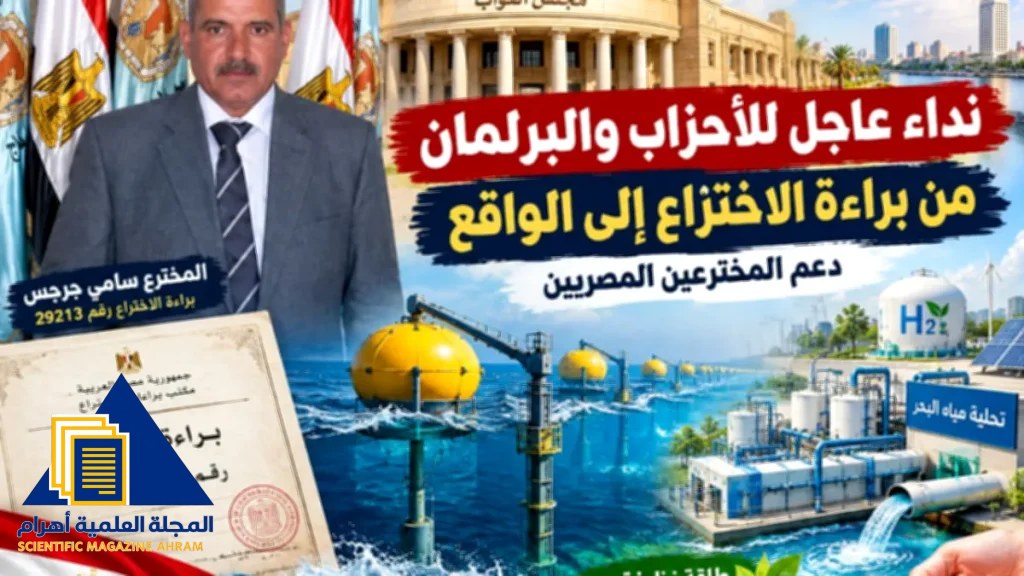

An Urgent Appeal to Parties and Parliament: Egypt’s Forgotten Wealth Is in the Minds of Its People—When Will Patents Turn into Reality? (The Case of Inventor Sami Gerges as a Model)
The true wealth of nations lies not only in their natural resources, but in the minds of their people, who are capable of turning existential challenges into opportunities for growth. When an Egyptian innovator receives a final patent from the Patent Office, this should not be the end of the line or a certificate to hang on a wall; it must be the starting signal for a national project.
Here, the pressing question arises: Where is the role of political parties and the Scientific Research Committee in the House of Representatives in embracing these minds and turning their ideas into tangible reality?
The Indispensable Role of Parties and the Scientific Research Committee
Innovation cannot thrive without a legislative and political umbrella to protect it and drive it toward execution. Political parties and parliamentary committees possess the power and tools to rescue innovations from desk drawers and bring them into manufacturing and production through specific and swift steps:
- Legislative Support: Discussing and passing supportive draft laws, such as the 12-point proposal to protect Egyptian inventors.
- Investment Connections: Creating direct channels of communication between patent holders, investment funds, and sovereign entities to finance industrial prototypes.
- National Sponsorship: Officially adopting effective national initiatives that encourage innovation, such as the “Let’s Encourage Each Other to Innovate” initiative.
- Removing Obstacles: Issuing legislation that obligates institutions and ministries to implement and test prototypes that have secured final patents on the ground.
An Exemplary National Case: Inventor Sami Gerges (Patent No. 29213)
We have a living, practical example that calls for immediate intervention to support him: the Egyptian inventor and technical researcher Sami Gerges, holder of final Egyptian patent number 29213, winner of first place at the international Watrix exhibition under the auspices of official bodies, and winner of the Sohag University Innovation Cup.
This researcher has invented an integrated engineering system that solves three intersecting crises—energy, water, and resources—in a single device, relying primarily on harnessing the continuous mechanical motion of the waves of both the Mediterranean and Red Seas.
How Wave Energy Extraction Systems Work
Innovations in the mechanical extraction of wave energy rely on precise engineering mechanisms to convert kinetic energy into mechanical and electrical energy. Prominent examples include:
- Point Absorbers: Vertical buoys that move up and down with the oscillation of the wave. A vertical piston connects to a hydraulic pump or linear generator anchored to the seabed, directly utilizing this reciprocating motion mechanically.
- Linear Absorbers: Articulated floating units whose parts move with the pitch and roll of surface waves, using hydraulic hinges between them to pump fluids at high pressure to run generators.
The National Benefits of Water Desalination and Power Generation Systems
This innovative system is not just a theoretical idea, but an engineering blueprint published in international scientific journals. Applying it represents an economic and environmental lifeline, and its direct benefits sum up major national goals:
- Providing Renewable Energy: By generating sustainable electrical energy mechanically from sea waves without using any fossil fuels.
- Achieving Water Security: By forcing seawater through reverse osmosis (RO) membranes using wave power to supply pure, fresh water.
- Extracting Mineral Wealth: By efficiently extracting high-value salts and minerals from the brine.
- Creating a Green Environment: Given the complete lack of carbon emissions in this system, providing an ideal infrastructure to produce green hydrogen and green ammonia at near-zero energy costs.
Industrial Integration
Traditional desalination plants consume immense electrical energy to run high-pressure pumps. The genius of this innovation lies in the ability to eliminate this electricity cost through the direct use of wave-driven hydraulic pistons to force water at high pressure into desalination membranes.
This brings the cost of producing a cubic meter of fresh water close to zero in terms of energy consumption costs.
Concluding Message
Honoring inventors at ceremonies and displaying their legislative proposals in party halls—as happened at the Conference Party headquarters—are commendable steps, but they remain incomplete unless crowned with bold executive decisions.
Leaders of political parties and members of the Scientific Research Committee, projects like these are national security projects par excellence. Embrace these minds, provide them with funding and testing, and make Egypt an exporter of clean technology instead of leaving patents locked away in drawers.
Written by: Sami Gerges


Latest video
تابع معنا تحليل قراءة الصحف اليومية مع الكاتب الصحفي Hany Sallam عبر