

Generating Electricity from Renewable Energy
Generation of Electricity from Renewable Energy
(Ocean Thermal Energy & Tidal Energy)

Dr. Hassan Al-Najjar Hassan Ibrahim
PhD in Materials Science
Given the growing demand for electricity in our Arab region as a core pillar of development plans, finding new ways to produce electricity has become an urgent necessity. This is especially true because electricity is a key indicator of societal progress, and because this energy is clean and does not pollute the environment in which we live. Furthermore, the high capital costs of building new generation plants have become a heavy burden and a drain on the national economy.
There are many types of renewable energy, for example:
• Solar energy
• Wind energy
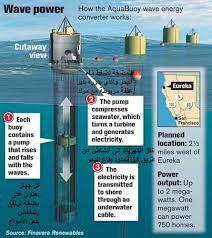
• Wave energy
• Ocean thermal energy
• Tidal energy

With the abundance of solar radiation falling upon it from the sky throughout the year, our Arab world enjoys a major advantage, as the sun is blocked for only a few days—or even just a few hours a day—for a very short period throughout the year, and only during the winter.
For this reason, it is possible to save petroleum from being used as fuel to produce electricity and instead export it to countries that lack solar energy, thereby extending the lifespan of underground petroleum reserves for future generations.
These new and renewable sources of energy also offer significant economic benefits for the development of desert regions and new residential communities. They can also be used for water desalination and for all purposes, including drinking water, agriculture, and industry. In this article, I will attempt to review some examples of new and renewable energy types, without limitation:
• Ocean Thermal Energy
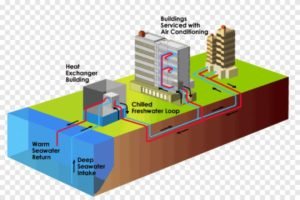
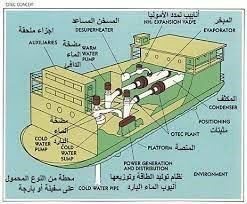
This type of new and renewable energy is produced from the temperature gradient found in oceans (Ocean Thermal Energy Conversion). It uses the temperature difference between deep, cold seawater and warmed or surface warm water to run a heat engine and generate electricity. Among ocean energy sources, ocean thermal energy is an available continuous energy source that can contribute to providing a primary energy source.
The systems are either closed-loop or open-loop. Closed-loop systems use fluids similar to those found in refrigeration circuits, such as ammonia and 1,1,1,2-tetrafluoroethane. These fluids have a low boiling point and are therefore suitable for driving the system’s generator to produce electricity.
• Tidal Energy
This energy is classified as environmentally friendly, as it does not emit any toxic gases or waste. It also takes fish stocks into account; a great deal of research has sought to reduce the risks fish may face when passing near turbines, and the French have indeed managed to reduce the rate of harm to fish from 15% to 5%. The hazards facing passing fish include:
o Low pressure
o Impact with blades
Tidal energy, or lunar energy, is a form of kinetic energy stored in currents naturally generated by the gravitational pull of the moon and the sun, as well as the rotation of the Earth around its axis. Consequently, this energy is classified as renewable.
Many coastal countries have begun utilizing this kinetic energy to generate electricity, thereby easing the strain on thermal power plants and reducing the pollution caused by thermal power plants that run on coal and petroleum.
There are two main methods for generating electricity by harnessing the tide:
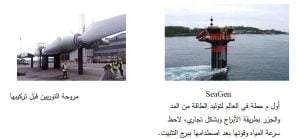
1. The barrage method, as implemented in Rance, France, which was built in 1966 and operates at a capacity of 240 megawatts. This dam was built to control currents generated by the tide and direct them to pass through turbine openings or blades.
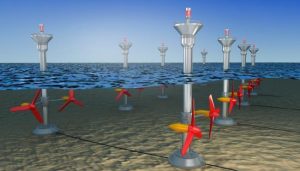
2. The tower method: This method relies on mounting one or two blades on a sturdy tower so that the blades are submerged beneath the water’s surface. Also, in Strangford Lough in Northern Ireland, a new tower called SeaGen was built. The tower has begun producing electricity from marine currents, where water speeds reach 2.5 m/sec and can reach up to 10 m/sec, and it produces 1.2 megawatts.
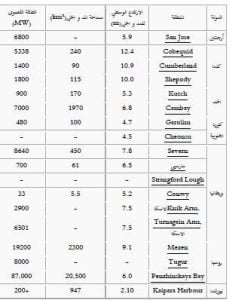
The following table shows the countries that benefit from this energy.
Given the growing demand for electricity in our Arab countries, we can draw on both ocean thermal energy and tidal power as primary sources of renewable energy, as they are clean and environmentally friendly.
References
• Baker, A. C. 1991 ,Tidal power ,Peter Peregrinus Ltd., London .
• Baker, G. C., Wilson E. M., Miller, H., Gibson, R. A & .Ball, M., 1980″ .The Annapolis tidal power pilot project”, in Waterpower ’79 Proceedings ,ed. Anon, U.S. Government Printing Office, Washington, pp 550-559 .
• Hammons, T. J. 1993, “Tidal power ,”Proceedings of the IEEE[ ,Online], v81, n3, pp 419-433. Available from: IEEE/IEEE Xplore. [[[26 July .]4001 ]]
• Lecomber, R. 1979, “The evaluation of tidal power projects”, in Tidal Power and
Estuary Management ,eds. Severn, R. T., Dineley, D. L & .Hawker, L. E., Henry Ling Ltd., Dorchester, pp 31-39.
• Lecture Prof. Hassan Hassan Nasr , Ain Shams university conference 2015


Latest video
تابع معنا تحليل قراءة الصحف اليومية مع الكاتب الصحفي Hany Sallam عبر