
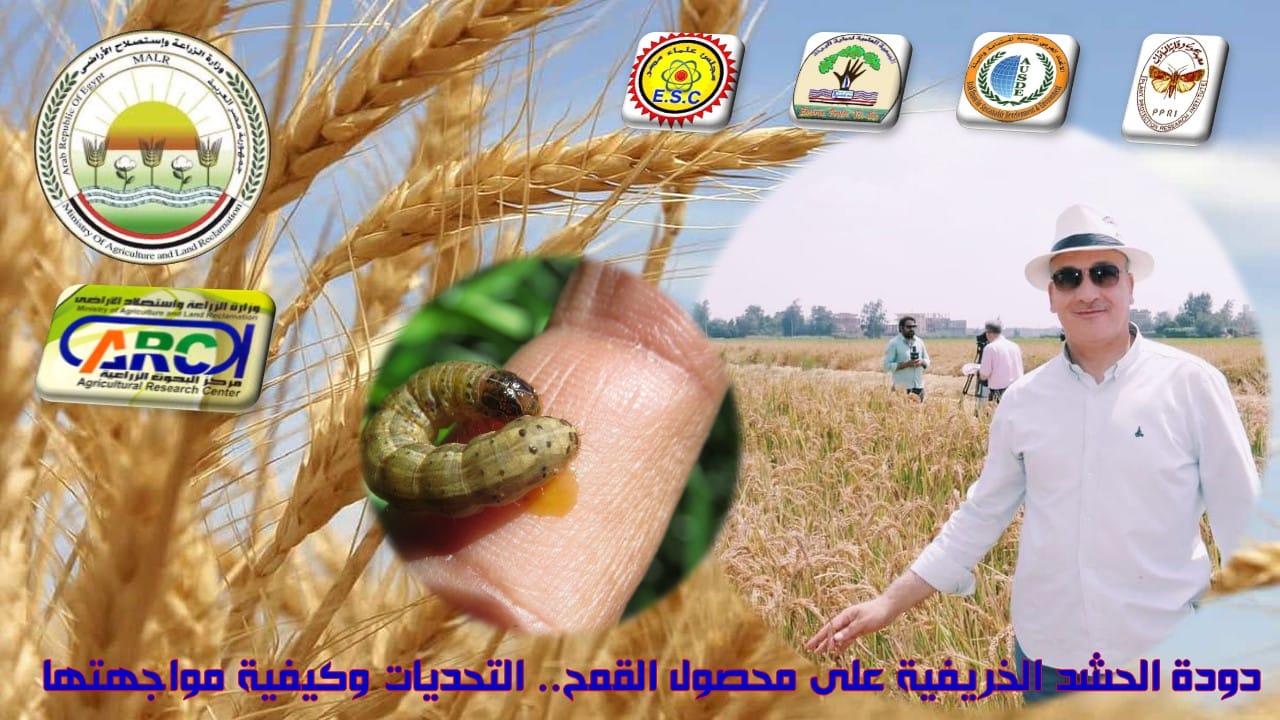

Prof. Magdy Farouk El-Samahy
Wheat is a strategic crop that forms a key part of food security in Egypt. It serves as a primary source of carbohydrates and a staple in the daily diet of Egyptian citizens. With growing demand for this vital crop, protecting it from various threats that can affect its productivity and quality is paramount. Insect and animal pests are among the most prominent threats, potentially causing severe losses in agricultural production.
Pests affecting wheat in Egypt vary. They include insect pests such as sap-sucking insects, which harm plant health by draining plant sap and stunting growth, as well as chewing insects that attack plant parts and reduce yield. Additionally, animal pests such as rodents and birds play a major role in destroying crops before harvest and during storage.
These pests affect not only productivity but also have economic and social impacts on both farmers and consumers. Controlling them requires extra costs for farmers, whether through pesticides or integrated pest management techniques, which ultimately reflects on wheat prices in the market.
Here, we will review a dangerous invasive insect, the fall armyworm, along with its impact and ways to tackle it in wheat crops.
Fall Armyworm
It is called the fall armyworm because the insect tends to attack its host in massive swarms of larvae. After destroying the host, these swarms move to neighboring fields, and its activity is concentrated in the autumn (Figure 1).
The larvae are distinguished by an inverted Y-shaped suture on the head, four crescent-shaped spots on the dorsal segments of the larva, and four black square spots on the second-to-last dorsal segment (Figure 2).
Geographical Distribution:
It is widespread across all continents, most of North, South, and Central America, and most African countries. The insect invaded Africa in 2016, causing major damage to maize crops. Its appearance in Egypt was officially recorded in May 2019, and it favors grass family plants, particularly maize and wheat.
Symptoms of Infestation and Damage to Wheat
A. Windowpane Phenomenon:
Infestation symptoms may appear on young wheat seedlings a week after germination, as the larvae feed on the green tissue while leaving the upper epidermis intact, producing a windowpane-like effect (Figure 3).
B. Irregular Holes:
As the larvae grow older, they become capable of destroying entire leaves by chewing the bases of the plant clumps, causing entire clumps to turn yellow or dry out.
Infested fields showing windowpane symptoms and dead plants must be re-inspected daily and treated immediately. If left uncontrolled, this pest can destroy entire wheat fields within a few days, which may require replanting gaps or starting over completely.
Reasons for the Danger of the Fall Armyworm
*Wide host range (it attacks more than 100 hosts).
*Exceptional reproductive capacity (females lay an average of 1,500 eggs during their lifespan).
*High flight and dispersal capacity (moths are strong fliers and can travel up to 100 km per night).
*Voracious feeding habits (it feeds on all parts of the plant).
*Ability to develop pesticide-resistant strains.
*Short life cycle (approximately 30 days).
Integrated Pest Management for the Fall Armyworm
1. Good soil preparation through deep ploughing to expose soil-dwelling stages to natural enemies and environmental conditions, and avoiding planting on the previous crop’s ridges.
2. Planting at the recommended time.
3. Increasing seeding rates in areas prone to infestation to maintain plant density if an infestation occurs.
4. Removing residues of the previous crop and clearing out infested plants.
5. Following crop rotation and avoiding planting wheat immediately after maize.
6. Increasing nitrogen fertilization rates in fields treated against the pest to encourage the plant to tiller and compensate for the damage.
Pesticide Intervention
The use of various types of pesticides is indispensable in many agricultural and non-agricultural fields, especially amid shifting climate conditions and rising prices for all types of agricultural crops. Therefore, they are a necessary evil that brings much good when recommendations are followed. Adhering to the instructions for each pesticide yields maximum efficiency with minimal harm to humans, the environment, and the crop.
In the event of a fall armyworm infestation in wheat, pesticides are applied when the infestation reaches 2 to 3 active larvae per linear foot of the row, or when 25% to 30% of the plants show windowpane damage.
Pesticides recommended by the Agricultural Pesticides Committee to control the fall armyworm on wheat are shown in the attached table:
Prof. Dr. Magdy Farouk El-Samahy
Professor of Nanotechnology and Plant Protection – Plant Protection Research Institute – Agricultural Research Center
Head of the Kafr El-Sheikh Branch of the Arab Union for Sustainable Development and Environment
Official of the Pesticide Applicators Program in Kafr El-Sheikh Governorate
Scientific Supervisor for the Fall Armyworm in Kafr El-Sheikh Governorate
Board Member of the Egyptian Council of Scientists Association
Member of the Scientific Research Ethics Committee at Kafrelsheikh University
Advisor to the Board of Directors of the Scientific Journal, Ahram Science Section


Latest video
تابع معنا تحليل قراءة الصحف اليومية مع الكاتب الصحفي Hany Sallam عبر