
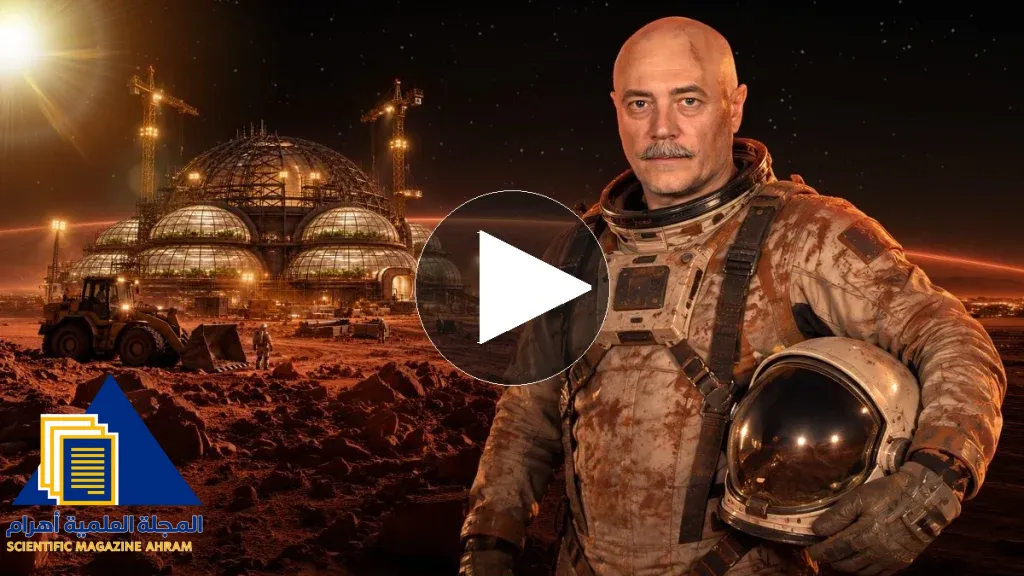

Can Humanity Succeed in Living on Mars? Maslow’s Pyramid Defines the Hurdles
As the world turns its gaze toward the Red Planet, scientists are raising a fundamental question: Can human colonies on Mars or the Moon become self-sustaining without the need for a continuous supply line from Earth? To address this challenge, talking about advanced rockets is not enough; we must return to Maslow’s hierarchy of human needs, which remains the most accurate gauge of what we need to survive and thrive in hostile environments.
The Base of the Pyramid: The Challenge of Survival and Physiological Needs
Maslow’s needs begin with the foundational base: air, water, and food. On Mars, these necessities turn into complex technical challenges. Even in our current space stations, we still cannot recycle all oxygen with absolute efficiency. On Mars, protection against cosmic radiation requires extraordinary measures, such as covering human habitats with a thick layer of Martian soil (regolith) to block radiation, which imposes immense engineering and logistical challenges on any future settlement.
Safety and Stability: Beyond Biological Necessities
Once air and food are secured, we move to the level of safety. Life in a space colony means living under constant pressure; any technical failure in the life-support system could mean the end of the entire colony. This continuous psychological stress weakens the sense of safety, which is the cornerstone of human mental health. How can settlers feel stable knowing they are millions of kilometers away from their home planet in an unforgiving environment?
Purpose and Self-Actualization: The Greatest Challenge
Man does not live by bread alone. Moving to Mars requires a sense of purpose that goes beyond mere survival. Will the first migrants find the psychological and spiritual drive to work in an isolated and confined environment? Psychologists believe that the absence of social and Earthly bonds may erode human motivation, making self-actualization—the peak of Maslow’s pyramid—a near-impossible task amid cosmic isolation. Ultimately, colonizing Mars appears to be as much a test of humanity’s ability to adapt psychological needs to the harshness of space as it is a test of our technological capability.
By: Hany Sallam
Source: universemagazine.com


Latest video
تابع معنا تحليل قراءة الصحف اليومية مع الكاتب الصحفي Hany Sallam عبر