
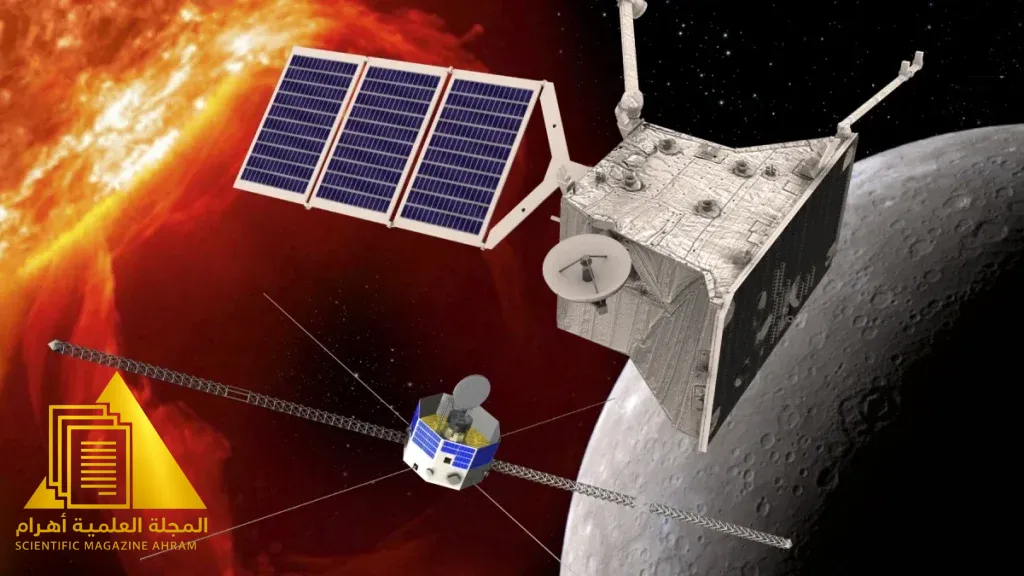

A Decade-Long Journey to the Mysterious Planet
After an epic voyage covering vast distances across deep space, the BepiColombo mission—the fruit of close collaboration between the European and Japanese space agencies—is approaching its moment of truth. Eight years after launch and a series of complex gravitational maneuvers around the planets, the spacecraft is on the threshold of Mercury
; the smallest planet in our solar system and the closest to the sun’s glare, to begin a new chapter of unprecedented scientific exploration.
The BELA Laser: A Precise Eye in the Heart of Hell
At the heart of this mission lies the laser altimeter named BELA. This advanced technological instrument is no ordinary measuring tool, but rather a precise cosmic surveyor. BELA was designed to map the three-dimensional topography of Mercury’s surface with extreme precision, overcoming the planet’s harsh conditions. Thanks to laser pulses, scientists will be able to probe the depths of volcanic craters, map smooth plains, and understand the structural changes that have shaped the surface of this small world over billions of years.
Why Mercury? Uncovering the Secrets of Formation
Mercury is one of the most mysterious planets; it lacks a protective atmosphere and faces direct solar impacts that make exploring it a major technical and scientific challenge. The data provided by the BELA laser altimeter will help us understand the planet’s internal geological processes and how it interacts with the solar wind. This is not simply a journey to capture images, but an attempt to answer existential questions about how rocky planets formed in the early stages of our solar system.
The Future of Space Exploration
As the spacecraft approaches its final orbit, the international science team is preparing to analyze the vast data that will stream from the instrument. The success of this mission will open the door to a new generation of remote sensing technology, confirming that human technology is capable of penetrating the harshest environments in the universe. With every laser pulse that BELA sends toward the surface, we move closer to decoding the secret history of our smallest neighbor in the solar system.
By: Hany Sallam
Source: phys.org


Latest video
تابع معنا تحليل قراءة الصحف اليومية مع الكاتب الصحفي Hany Sallam عبر