
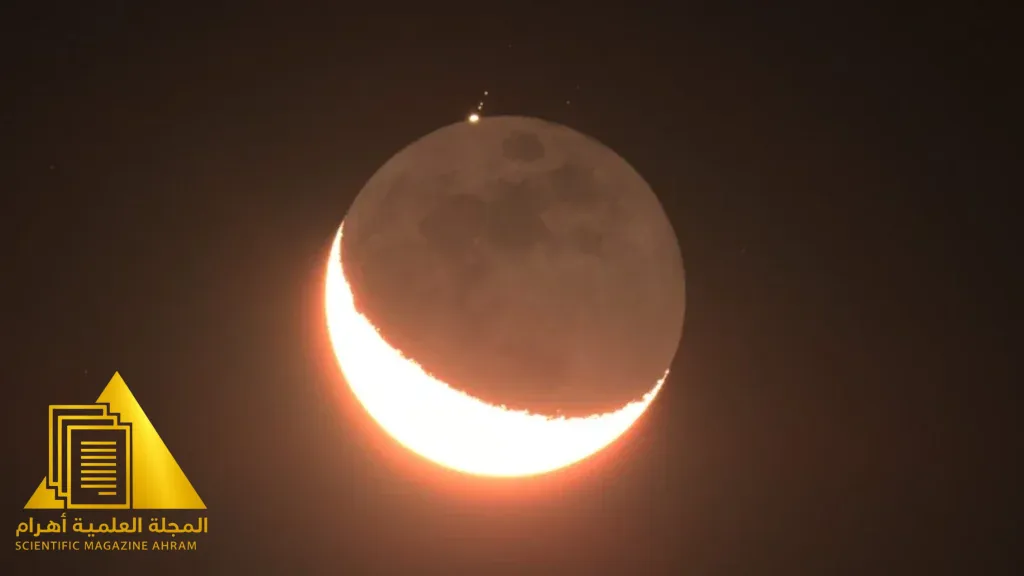

A Cosmic Dance: When the Moon Swallows the Solar System’s Giant
In a majestic astronomical spectacle that drew the gaze of millions of observers, the sky recently witnessed a rare astronomical phenomenon known as the occultation of Jupiter. During this event, the Moon moved along its usual path to stand between Earth and Jupiter, the largest planet in our solar system, causing the massive planet to disappear behind the lunar disk for a full hour in a celestial display that demonstrated the precision of celestial mechanics.
What Is an Astronomical Occultation?
Astronomers define an occultation as a phenomenon that occurs when one celestial body passes in front of another, making it temporarily invisible to an observer on Earth. Although the Moon appears small to us in the sky compared to giant Jupiter, its extreme proximity to our planet makes it look larger, giving it the ability to temporarily “erase” the gas giant from view.
A Live Demonstration of Orbital Mechanics
Astronomers view this phenomenon as more than just a pretty sight; it is a live, direct application of the laws of orbital motion. The precise alignment of the Moon and Jupiter in such harmony reveals the complexities of how celestial bodies move in their orbits around the Sun. For amateur astronomers, the event offered a rare opportunity to observe the giant planet in fine detail just moments before it vanished, as Jupiter approached the edge of the Moon until its reflected light blended in, creating a striking visual contrast.
Global Tracking of a Unique Phenomenon
Although occultation phenomena occur in various locations across the globe, the disappearance of Jupiter behind the lunar crescent was visible most clearly to residents of specific regions in North America and parts of West Africa. The phenomenon provided rich material for astrophotographers, who documented the transition moments as the planet disappeared behind the dark edge of the Moon and reappeared from the opposite side, reminding us that the sky above is never still, but rather a permanent stage for motion and beauty.
By: Hany Sallam
Source: universemagazine.com


Latest video
تابع معنا تحليل قراءة الصحف اليومية مع الكاتب الصحفي Hany Sallam عبر