
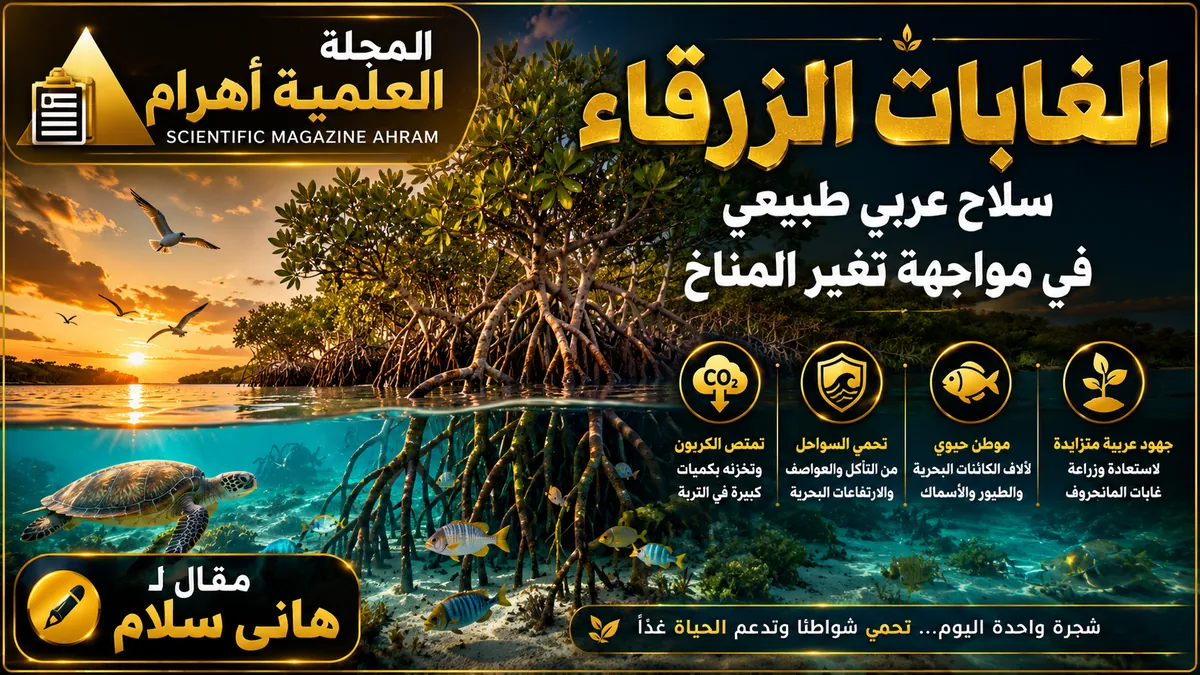

Along the coasts of the Red Sea and the Arabian Gulf, unique trees grow that have managed to adapt to one of the harshest natural environments on Earth. These trees are known as mangroves, or what some scientists call “blue forests.”
In recent years, interest in these forests has increased noticeably. This is due to their major role in protecting the environment, supporting biodiversity, and helping address climate change.
For this reason, several Arab countries have launched broad programs to protect mangrove forests and restore areas where they have declined over past decades.
What Are Blue Forests?
Blue forests refer to coastal ecosystems capable of storing large amounts of carbon. These systems include mangrove trees, seagrass meadows, and certain coastal wetlands.
Mangrove trees are distinguished by their ability to grow in saline and brackish water, which makes them among the plants most adaptable to coastal environments.
Why Do They Attract Global Attention?
These trees play an important role in absorbing carbon dioxide from the atmosphere. They also store large amounts of carbon within the soil for long periods.
Therefore, scientists view them as one of the natural solutions that help curb the impacts of climate change.
Furthermore, these forests contribute to improving water quality and protecting coasts from erosion.
A Natural Shield for Arab Coasts
Coasts in many areas are exposed to the impact of waves, storms, and sea currents. This is where the importance of mangrove trees becomes apparent.
Their complex root network acts as a natural barrier that cushions the force of waves and helps stabilize coastal soil.
As a result, coastal erosion rates drop in areas where these trees thrive.
A Habitat for Thousands of Living Organisms
Mangrove forests do not only provide protection for coasts, but they also represent an ideal environment for many marine organisms.
Many fish, crustaceans, and birds depend on these areas during different stages of their lives.
The water-submerged roots also provide safe havens for juvenile fish away from predators.
Growing Arab Efforts
Recent years have seen a notable expansion in mangrove planting projects across several Arab countries.
These projects aim to restore coastal ecosystems, enhance biodiversity, and support environmental sustainability.
These initiatives also seek to increase coastal green spaces and improve the capacity of marine areas to withstand climate changes.
An Investment in the Future
Experts view the protection of mangrove forests as not merely an environmental project, but a long-term investment in the future of coasts and coastal communities.
Every new tree planted today may help in coming years to protect shores, support marine life, and reduce the impacts of climate change.
For this reason, blue forests have become an increasingly important symbol in environmental conservation efforts across the Arab world.
Hany Sallam


Latest video
تابع معنا تحليل قراءة الصحف اليومية مع الكاتب الصحفي Hany Sallam عبر