
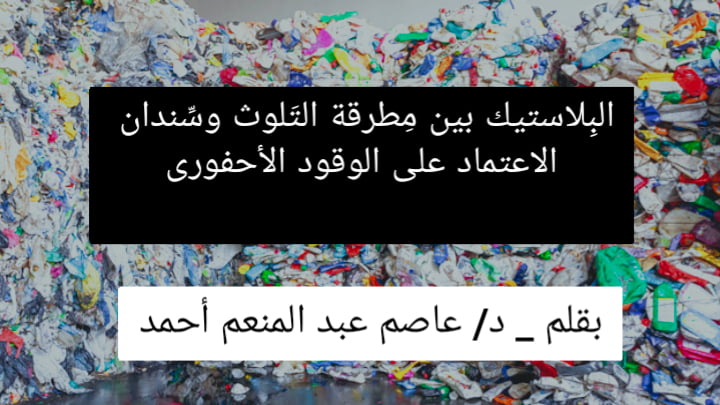

Plastic Between the Hammer of Pollution and the Anvil of Reliance on Fossil Fuels
Plastic Between the Devil of Pollution and the Deep Blue Sea of Reliance on Fossil Fuels

Prepared by
Dr. Assem Abdel Moneim Ahmed
Assistant Professor, Central Laboratory for Agricultural Climate
Agricultural Research Center, 2023
Plastic Between the Hammer of Pollution and the Anvil of Reliance on Fossil Fuels
Pause for a moment and look around you, and you will undoubtedly realize how much we rely on plastic in every aspect of life. Plastic has become an integral part of our lives over the past three decades. According to a report by the United Nations Environment Programme, the world produces about 400 million tons of single-use plastic waste annually, which accounts for about 47 percent of total plastic waste. The same report notes that only about 9 percent of plastic waste is recycled worldwide.
Estimates indicate that the amount of plastic produced between 1950 and 2015 reached approximately 7.8 billion tons. The plastic waste problem has grown alarmingly, moving to the forefront of the 21st-century environmental agenda as one of the major environmental issues that must be addressed with great care, second only to climate change.
Stages of Plastic
Human civilization has gone through many changes, starting from stone to metal, and from metal to non-metal (plastic). The Stone Age is the first stage of human civilization, followed by the Bronze Age, and then the Iron Age; these fall under metals. Today, however, we live in the plastic (non-metallic) age.
Plastic is cheap, convenient, and easy to use, and its arrival changed our lives, making it indispensable. Yet plastic waste poses a real threat to living organisms, especially in oceans and rivers. The word “plastic” is derived from the Greek word “Plastikos,” meaning capable of being shaped or molded. Looking at the atomic structure of plastic, it consists mainly of carbon and hydrogen, which form a strong bond that is difficult to break.
Of course, carbon and hydrogen as individual elements do not cause an environmental problem. The problem lies in the bond between them, which makes plastic non-biodegradable and causes environmental pollution. This is similar to how carbon and oxygen individually do not cause any environmental problem, but when they combine to form carbon dioxide, they cause many environmental hazards.
It is known to some that plants have an exceptional and unique ability to break the bond between carbon and oxygen atoms in carbon dioxide gas, which is the natural way to remove excess carbon dioxide from the air.
Unfortunately, however, no plant, animal, or bacterium has the ability to break the bonds between carbon and hydrogen atoms in plastic monomers. This makes plastic not only non-biodegradable, but also nearly permanent.
Thanks to the natural mechanism of the value chain that God Almighty bestowed upon humanity, and its importance in ensuring that everything in nature is consumed—without which waste would accumulate and the earth would spoil—nature lacks the same mechanism to consume plastic waste. For the first time, the responsibility for managing plastic waste falls upon humans themselves. Instead of caring about this extremely serious problem, people dispose of plastic waste randomly, throwing it into streets, desert areas, and mountainous regions, creating mountains of garbage in the suburbs of major cities, and even exporting plastic waste to developing countries such as China and Indonesia for disposal. When plastic waste filled every inch of the earth, a new dumping ground covering two-thirds of the planet was discovered: the oceans.
Alexander Parkes produced the world’s first man-made plastic in 1862, calling it celluloid or Parkesine, at the London International Exhibition. It was marketed as a substitute for ivory, but it did not receive wide acceptance at the time. In 1916, the famous car company Rolls-Royce began using phenol formaldehyde in car interiors. Overall, major discoveries in the world of plastic emerged during World War I and World War II, with the discovery of cellophane in 1913, polyvinyl chloride in 1927, polystyrene and nylon in 1938, and polyethylene in 1942.
Plastics are manufactured 98 to 99 percent from fossil fuels, yet the economics of plastics are shifting as energy and transport move away from fossil fuels. For many oil and gas producers, plastics appear to represent one of the few opportunities to continue growing and surviving. Some massive new facilities, such as the Zhoushan Green Petrochemical base in China, are converting crude oil directly into chemicals and plastics instead of refining byproducts. This development signals severe danger if plastic production continues to grow in the United States, China, and other industrial countries as industry projects continue. By 2030, carbon dioxide emissions from converting crude oil into plastics may surpass the existing emissions of coal-fired power plants.
Since the 1980s, many countries in the North foresaw the relentless unintended consequences of the long-term use of plastics and began addressing the matter at a slow pace by adopting legal measures, tools, or punitive procedures to reduce the distribution and consumption of plastics within these countries. Some of these countries even started exporting this waste, such as America, Japan, Canada, and others, to developing countries like China, Indonesia, and others. For example, until before 2017, China imported around 7 million tons of plastic waste annually (95 percent of European Union plastic waste in addition to about 75 percent of waste from the United States were exported to China), followed by Malaysia and Indonesia with smaller quantities.
Some of these developing countries woke up to the gravity of their bad action. In February 2017, for instance, China announced the National Sword initiative, which banned the import of 24 recyclable commodities and limits the allowable pollution levels in imported plastic bales and mixed paper, with the law to be enforced starting in January 2018.
Following the implementation of this initiative, the wealthy woke up to some harsh facts that no one wants this plastic waste, as everyone has enough refuse, especially after plastic waste shipping vessels were turned away from many other countries such as Malaysia or Indonesia after the pollution and environmental sabotage they caused in those countries.
What Should We Do?
It is important to leave the principles of the linear economy in this massive industry and transition as quickly as possible to a circular economy. To accelerate the transition to a circular plastic economy, stakeholders need to work with a variety of organizations (international, regional, local, civil society, governmental, non-governmental, cooperative, and others) side by side, because the current approach to managing plastic waste globally, especially on the African continent, is still absent and insufficiently coordinated. Governments in particular at the level of the African continent need to do more to provide the appropriate infrastructure for the transition to the circular plastic economy, with more support and incentives provided to companies operating in this sector, working to change consumption habits of communities within the African continent, and expanding the market for circular plastic products.
References
- Philippe Chalmin, “The history of plastics: from the Capitol to the Tarpeian Rock”, Field Actions Science Reports, Special Issue 19 | 2019, 6-11.
- Global Online Training: Strategies to End Plastic Pollution materials- Centre for Science and Environment, December


Latest video
تابع معنا تحليل قراءة الصحف اليومية مع الكاتب الصحفي Hany Sallam عبر