

The Proton Mystery: Was Our Model of Matter Wrong?
For many years, physics classrooms taught us that a proton consists simply of three fundamental particles called quarks, held together by other particles known as gluons. However, a recent study conducted using the Relativistic Heavy Ion Collider (RHIC) has turned this traditional view on its head, revealing that the internal structure of the proton is far more complex and profound than we imagined in even the most optimistic theories.
The Gluon Connection: The Hidden Component
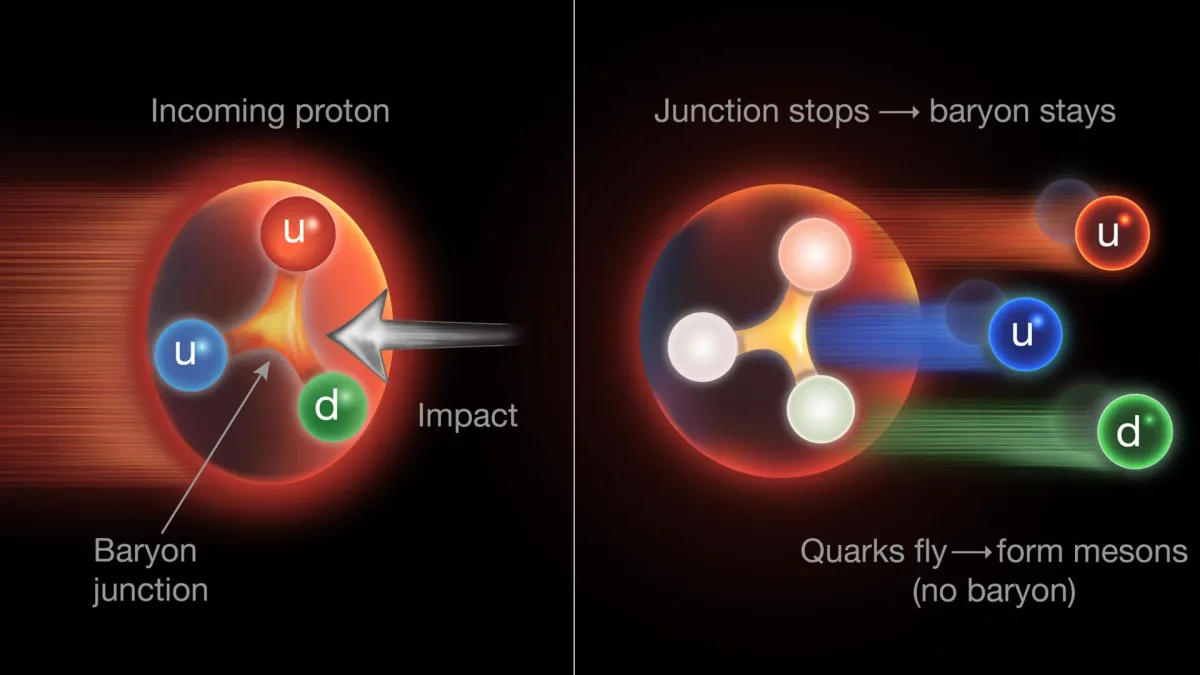
Recent collision data showed that what is known as baryon number—a fundamental property of matter that ensures the stability of protons—is not carried by the three quarks alone. Instead, scientists discovered a Y-shaped structure of gluons linking these quarks together. This discovery is like finding a hidden backbone inside the simplest building blocks of matter that we did not realize was there.
Rewriting Physics
This result is not just an extra technical detail; it is a direct challenge to the Standard Model of physics as taught in universities for decades. If this hidden structure is responsible for the stability of matter, our understanding of how the universe formed and held together in the first moments after the Big Bang needs a careful review. The stability of the matter we touch and see every day depends on these subtle forces, and we now have a new key to understanding this delicate cosmic balance.
What Does This Mean for the Future?
While these discoveries raise questions about the accuracy of current school curricula, they simultaneously open broad horizons for a new generation of physicists. We are now moving from understanding matter as static entities to understanding it as complex, dynamic networks of forces. It may sound complicated, but it brings us one step closer to answering the age-old question: Why does matter behave the way we know it does?
By: Hany Sallam
Source: ScienceDaily


Latest video
تابع معنا تحليل قراءة الصحف اليومية مع الكاتب الصحفي Hany Sallam عبر