


The Role of Robots in Chinese Factories

By: Ayman Shaaban
Mobile Software Designer
Factories in China are increasing robots while reducing human labor.
China has set a goal to dominate industrial automation, having installed numerous robots in its factories, which has accelerated the push toward robotics and reinforced its manufacturing dominance even as its working-age population shrinks.
Shipments of industrial robots to China rose by 45% in 2021 compared to the previous year, reaching more than 243,000.
China accounted for just under half of all heavy-duty industrial robot installations last year, cementing the country’s status as the number-one market for robot manufacturers worldwide. Data from the IFR shows that China has installed nearly twice as many new robots as factories across the Americas and Europe combined.

Part of the explanation for the acceleration of automation in China is that it is simply catching up with more powerful peers in the field, such as the United States, and industrial powerhouses like Japan and Germany.
The United Nations expects India to surpass China as the world’s most populous country as early as next year. UN projections indicate that China’s population aged 20 to 64—the main part of the workforce—has already peaked and is expected to decline sharply after 2030 as China’s population ages and birth rates remain low.
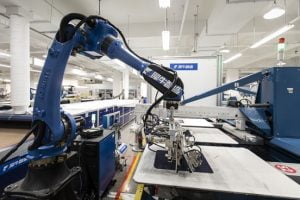
Chinese factories are accelerating their push to use robots while downsizing their workforces.
Industrial automation has risen as the country tries to expand its manufacturing dominance despite labor challenges.
The automotive sector showed an increase of nearly 90% last year.
By adopting more robots, Chinese factories can bridge a widening gap in the labor market and keep costs low, making the relocation of production to other emerging markets or their home countries less appealing than it is for Western companies.
Because China can no longer rely on an expanding workforce to drive economic growth, automation represents the safest path, according to many economists, because it boosts worker productivity.
Data from the Conference Board shows that output per work hour in China in 2021 was a quarter of the average for the Group of Seven advanced economies and a fifth of the level in the United States. Moreover, productivity growth in China has slowed in recent years. After rising by an average of 9% annually between 2000 and 2010, output per work hour in China grew by 7.4% annually in the following decade.
Andrew Harris, deputy chief economist at Fathom Consulting in London, pointed to this, saying: “You cannot wait until you run out of people to start dealing with robots.”
Despite trade tensions with the United States and growing Western anxiety over a perceived overreliance on Chinese manufactured goods, China remains the world’s factory, accounting for 29% of global manufacturing, according to UN data.
Robots can help Chinese factories focus more on high-end manufacturing tasks that require precision.
Many young workers avoid factory work to get more flexible jobs in China’s expanding service sector. There were about 147 million people working in manufacturing in China in 2021, according to International Labour Organization estimates, down from a peak of 169 million in 2012. During the same period, employment in the service sector rose by 32% to an estimated 365 million, according to the ILO.

In addition to helping ease the pressures resulting from those shifts, robots can help Chinese factories focus more on advanced manufacturing tasks that require greater precision than most humans can manage, while the robots themselves are becoming cheaper and more adaptable.
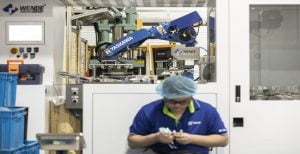
Dobot, a Chinese manufacturer of small robotic arms used in industry and education, has developed an automated system for a client in China that manufactures wireless earphones for Apple Inc.
The system uses robotic arms to install magnets in earphone cases, a task that previously required four workers. While a human team can complete about 650 units an hour, the robotic arms can manage 800 units an hour, said Xie Junjie, product manager at Dobot.
IFR data show that global industrial robot installations jumped 27% in 2021 from 2020, reaching 486,800. Shipment growth in 2020 changed very little compared to the previous year as the pandemic impacted investment.
Sources:
THE WALL STREET JOURNAL:


Latest video
تابع معنا تحليل قراءة الصحف اليومية مع الكاتب الصحفي Hany Sallam عبر