

A scientific investigation into a new hypothesis explaining water sequences
Diagram Explanation: Two Different Water Movement Mechanisms
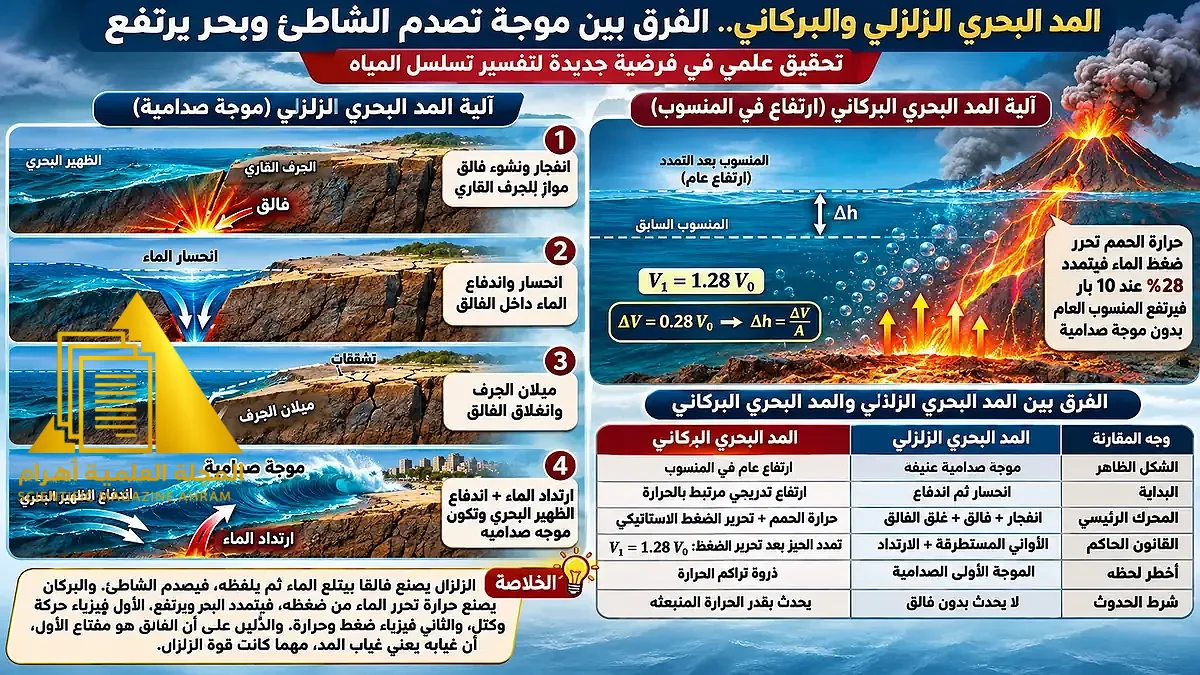
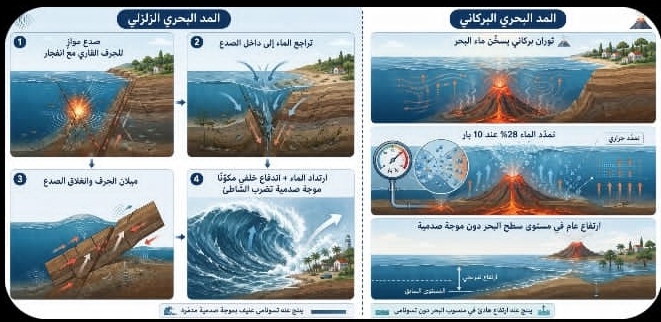
Diagram explanation: On the left, the fault mechanism in 4 stages: 1- an explosion and the creation of a fault parallel to the continental shelf, 2- recession and water rushing into the fault, 3- tilting of the shelf and closure of the fault, 4- water rebound + the surge of the offshore rear and the formation of a shock wave. On the right, volcanic tide: the heat of the lava releases water pressure so it expands 28% at 10 bar, raising the general level without a shock wave.
When the sea hits the shore, it does not strike in a single way. There is a fundamental difference, according to the proposed hypothesis, between a seismic sea surge that arrives as a violent shock wave and a volcanic sea surge that arrives as a general rise in water levels without a shock wave in the same sense. The difference lies not only in shape, but in the mechanics driving the water.
First: Seismic Sea Surge.. Recession First, Then the Strike
The story begins, according to the suggested geological interpretation, from the Earth’s interior. With rising pressure and the boiling of the Earth’s core, a massive explosion occurs whose energy is estimated to be equivalent to:
And since:
Then:
This energy is sufficient, in this conceptualization, to lift the Earth’s crust and generate a seismic sea surge.
Yet the scene does not begin with the wave, but with its reverse: recession first, then a violent surge. The sequence of water movement reveals the mechanism, as the diagram illustrates in its four stages:
1. Creation of a Fault Parallel to the Continental Shelf
The explosion leads to the creation of a fault in the Earth’s crust parallel to the continental shelf. The proposed evidence for its existence is the appearance of lava alongside the seismic sea surge.
2. Tilting of the Continental Shelf and Shoreline Cracks
The continental shelf mass tilts forward under its own weight, closing the fault again in rapid succession. Cracks appear on the shore as a result of this tilting.
3. Recession Water Rushing into the Fault
Before the fault closes completely, the receding water rushes into it. Here, a difference in water levels arises across three zones:
- The zone between the shore and the fault
- The fault zone itself
- The offshore rear behind the fault
4. The Law of Communicating Vessels and Rebound
By the principle of communicating vessels, the higher-level offshore water rushes toward the shore to equalize the levels:
When the fault closes, the trapped receding water rebounds, bringing both surges together in a single moment. The result: an increase in the violence of the first shock wave, which is the most dangerous wave in a seismic surge.
In short: recession is not a fleeting retreat, but a phase of charging the fault, and the closure is the trigger for the water explosion.
Second: Why Does Not Every Offshore Earthquake Cause a Sea Surge?
This is the crux of the matter, and the decisive proof of the fault hypothesis.
If sea surges resulted from vibration alone, every strong offshore earthquake would be sufficient to generate a sea surge. Yet reality says the exact opposite: many offshore earthquakes of tremendous force pass without any notable sea surge.
This apparent contradiction can only be resolved by the presence of an additional element, which is the fault.
The equation thus becomes:
Offshore earthquake + fault parallel to the continental shelf = seismic sea surge
Offshore earthquake without a fault = vibration only, no surge
Why?
Because vibration alone moves water in an oscillating horizontal motion that quickly dissipates within the ocean mass. The fault, however, does something entirely different:
1. The Fault Creates a Void to Receive Water
Without a fault, there is no place for the receding water to rush into. Without the receding water rushing in, there is no difference in levels $h_1 \neq h_2 \neq h_3$, and consequently no opposing surge from the offshore rear.
2. The Fault Creates the Recession Phase
The recession preceding a seismic surge is not a coincidence, but the fingerprint of the fault. When the fault opens, water is drawn into it, causing the shoreline to recede. Earthquakes that do not produce a fault are not preceded by recession, nor are they followed by a surge.
3. The Fault Creates the Moment of Closure and Rebound
The true violence of the first wave does not come from the earthquake itself, but from the fault closing on the water trapped inside it. This moment combines the surge from the offshore rear and the rebound of the receding water into a single blow.
Therefore, we can establish a new diagnostic rule:
If you see a recession, know that a fault has opened. If no recession occurs, know that the earthquake has not produced a fault, and no surge will happen.
This also explains why seismic surges are always accompanied by the appearance of lava and shoreline cracks in some cases; these are all signs of the same geological event: the opening of a fault.
The earthquake is the spark, but the fault is the engine. Without the fault, the energy of $7.53 \times 10^{20}$ joules dissipates as vibration. With the fault, that same energy transforms into recession, and then into a shock wave.
Third: Volcanic Sea Surge.. A Rising Sea, Not a Striking Wave
In contrast, a volcano does not produce a shock wave through the same mechanism; instead, it generates a rise in the level of the sea or ocean, as shown on the right side of the diagram.
Here lies the ambiguity that has puzzled many: why does the level rise so significantly when the amount of lava is limited?
The proposed answer lies in the limitations of Pascal’s physical principle when applied to water under pressure and heat.
The field experiments referred to prove that water under pressure:
When this pressure is released, its volume increases by:
That is:
According to the hypothesis, the heat of the lava releases the static pressure of the water. If the affected volume of water is $V_0$, the increase in volume is:
Over a given basin area $A$, this expansion translates into a rise in water level:
The governing equation here is therefore not a wave equation, but a heat equation:
This means the rise in water level is directly linked to the amount of heat the volcano dumps through its lava. The more heat that is released to relieve the pressure, the greater the expansion and the higher the water level.
The Difference Between Seismic Sea Waves and Volcanic Sea Waves
| Comparison Point | Seismic Sea Wave | Volcanic Sea Wave |
|---|---|---|
| Apparent Shape | Violent shock wave | General rise in water level |
| Onset | Recession followed by a surge | Gradual rise linked to heat |
| Main Driver | Explosion + fault + fault closure | Lava heat + release of static pressure |
| Governing Law | Communicating vessels + rebound | Volume expansion after pressure release: V_1 = 1.28 V_0 |
| Most Dangerous Moment | First shock wave | Peak of heat accumulation |
| Condition for Occurrence | Does not occur without a fault | Occurs according to the heat emitted |
Conclusion
An earthquake creates a fault that swallows water and then expels it, striking the shore. A volcano generates heat that releases water from its pressure, causing the sea to expand and rise. The first is the physics of motion and mass, while the second is the physics of pressure and heat. The proof that a fault is the key to the first is that its absence means no tsunami, regardless of how strong the earthquake is.
Author
Yehia Arafa Moussa


Latest video
تابع معنا تحليل قراءة الصحف اليومية مع الكاتب الصحفي Hany Sallam عبر