
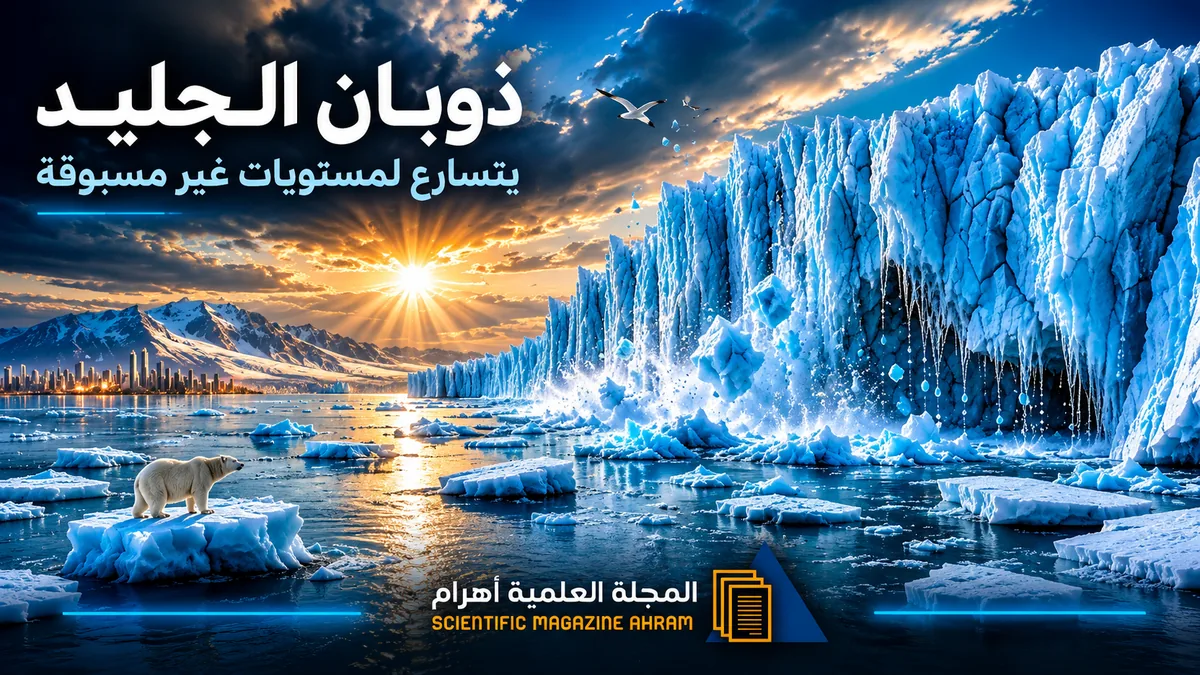

An international team of scientists has revealed concerning signs of accelerated melting beneath ice shelves in East Antarctica, a discovery that may change how scientists understand future sea level rise over the coming decades.
The new study relied on advanced satellite data and radar to monitor areas that could not previously be monitored accurately. The results showed that warm water has begun to infiltrate beneath massive ice sheets, causing them to erode slowly from the inside.
Unseen Melting Raises Concern
For many years, researchers believed that East Antarctica was more stable than the western regions. However, recent measurements revealed that some ice shelves there have begun to lose thickness at a faster pace than expected.
Scientists fear that the continuation of this melting could lead to an accelerated slide of massive ice masses toward the ocean, which may raise global sea levels and threaten coastal cities in the future.
Why Is This Discovery Important?
The danger lies in the fact that ice shelves act as a natural barrier preventing continental ice from flowing into the sea. When these barriers weaken, glaciers begin to move more quickly.
Researchers note that the problem is not limited to surface melting, but involves hidden melting taking place beneath the ice away from view, which makes monitoring it more difficult.
Satellites Revealed the Surprise
Scientists used modern radar technologies to draw precise maps of melting rates beneath the ice. The data showed the existence of “hot spots” experiencing continuous erosion due to warmer ocean currents.
The study also pointed out that some older climate models may have underestimated the speed of the real impact of this phenomenon.
Direct Threat to Coastal Regions
If current melting rates continue, coastal cities around the world may face a notable increase in flood risks and rising water levels during this century.
Climate experts see these results as a new warning bell for the world, especially with the increase in global heatwaves and rising ocean temperatures year after year.
Although the changes are taking place in a remote and isolated region, their impacts may reach millions of people around the world through changes in the shape of coastlines and the global climate.
Hany Sallam


Latest video
تابع معنا تحليل قراءة الصحف اليومية مع الكاتب الصحفي Hany Sallam عبر