


Reporting by Mahmoud Hussein
A Breakthrough in Making Photovoltaic Panels

Engineers at Rice University say they have solved a long-standing dilemma in making stable, efficient solar panels. A cell like this will convert more sunlight into electricity than any other panels, with better stability and a longer lifespan.
Chemical and biomolecular engineer Aditya Mohite and his lab at Rice’s George R. Brown School of Engineering reported in Science on their success in building 3D and 2D thin-film solar cells that deliver a power conversion efficiency of 24.5%.
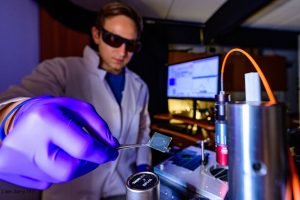
These are crystals with cube-like lattices known as efficient light harvesters, but the materials tend to degrade under light, moisture, and heat. Mohite and many others have worked for years to make perovskite solar cells practical.
This leads to very high efficiencies because now, for the first time in this field, we are able to create layers with tremendous control, as it allows us to control the flow of charge and energy not just for solar cells, but also for optoelectronic devices and LEDs.
Mohite said that the efficiency of test cells exposed in the laboratory to the equivalent of 100% sunlight for more than 2,000 hours “does not degrade even by 1%.”

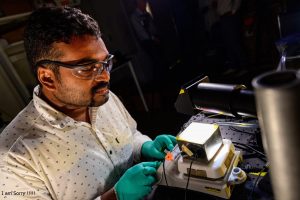
Mohite said: “This has implications not only for solar energy but also for green hydrogen, with cells that can produce energy and convert it into hydrogen.” “Off-grid solar power can also be enabled for cars, drones, building-integrated photovoltaics, or even agriculture.”
Adapted from:
ScienceDaily news site
https://www.sciencedaily.com/releases/2022/09/220923090907.htm


Latest video
تابع معنا تحليل قراءة الصحف اليومية مع الكاتب الصحفي Hany Sallam عبر