
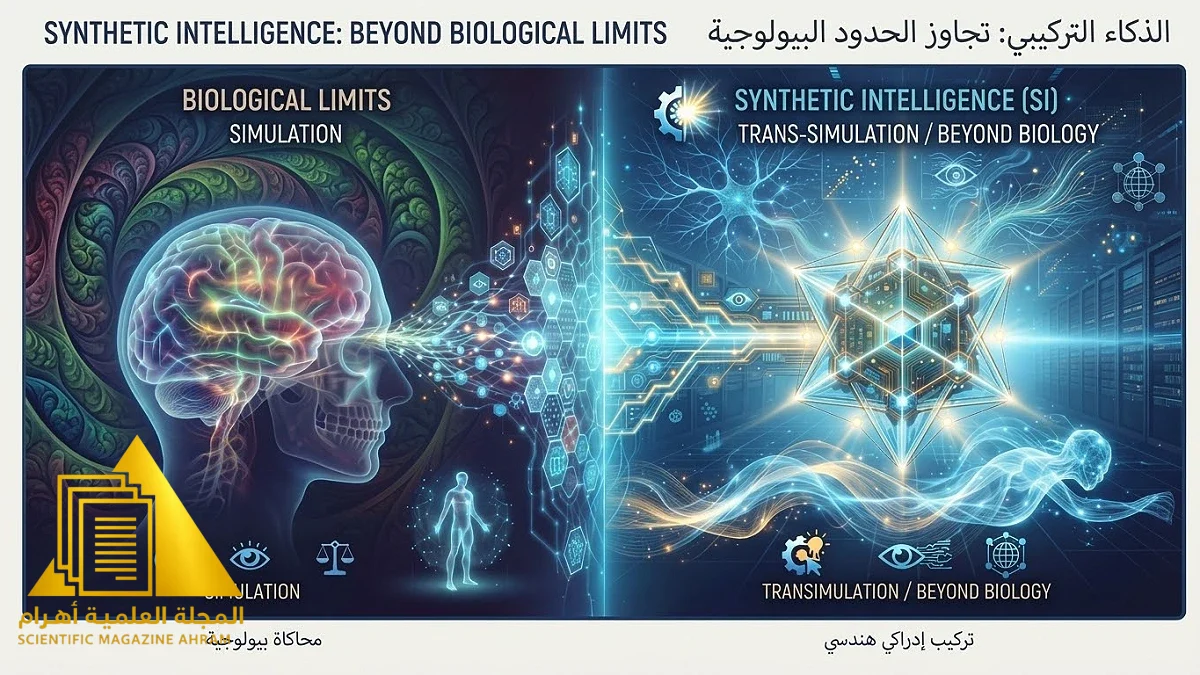

When Cognition Is Designed to Go Beyond Biological Limits: From Biological Brain Limits to the Horizons of Digital Networks
Synthetic Intelligence (SI):
By Dr. Ola Mahmoud Moawad
University Lecturer and Consultant in Artificial Intelligence, Information Technology, and Geographic Information Systems
In the development of intelligent systems, the human mind has served for decades as the starting point and primary reference, with much effort directed toward simulating human behavior or mimicking natural thinking mechanisms. However, as computer systems grow more complex and modeling, logic, and software engineering capabilities expand, synthetic intelligence (SI) emerges as an advanced vision that moves beyond “imitation” toward “synthesis”: designing and constructing intelligence and cognitive systems through software and engineering to generate new forms of understanding, inference, and decision-making. Rather than simply mimicking the human brain, SI seeks to go beyond biological limits and constraints through computational and logical architectures specifically designed for the purpose.
The Core Idea: From Behavior Simulation to Cognitive Synthesis
The difference between building a system that mimics humans and constructing a new cognitive structure is the difference between functional replication and foundational engineering:
- Simulation: Focuses on reproducing the way the brain works or its external responses, making human behavior the primary benchmark for comparison and evaluation.
- Synthesis: Views cognition as a system that can be built and shaped from the ground up according to mathematical, logical, and engineering rules, so that reasoning structures and cognitive representations are designed to suit the nature of the issue, data volume, and operational environment, rather than merely matching the human path.
In this sense, synthetic intelligence is not viewed as a digital copy of humans, but as an independent cognitive pattern synthesized carefully to perform analytical and inferential functions that may not be available with the same speed, accuracy, or dimensions within the natural limits of biology.
Why Does Synthetic Intelligence Seek to Go Beyond Biological Limits?
Living organisms operate within specific natural biological limits, such as nerve signal speed, limited working memory, and susceptibility to stress or cognitive biases. Meanwhile, software-designed computational and logical architectures open up different operational spaces:
- Processing Complex Dimensions and Dense Data: The ability to link multiple variables, test alternatives, and perform parallel computations with high efficiency in wide or rapidly changing environments.
- Engineering Flexibility and Scalability: The ability to modify models, restructure logical frameworks, and update algorithms according to new requirements without waiting for slow biological evolution paths.
- Suitability for Environments Unfamiliar to Humans: Building perception and analysis systems designed to handle complex networks, advanced simulation systems, or operational environments that require disciplined and continuous response.
Requirements for Discipline and Governance in Synthetic Systems
As synthetic systems become more capable of generating unconventional inferences or operating with greater autonomy, engineering, ethical, and institutional aspects become a critical element in their success:
- Explainability and Transparency: Providing clear mechanisms to understand how a system reaches its conclusions and recommendations, particularly in sensitive contexts or high-impact decisions.
- Alignment with Human Goals and Values: Adjusting governing standards and constraints so that system outputs remain consistent with beneficial purposes and legal and ethical controls.
- Governance and Accountability: Clearly defining roles and responsibilities when relying on advanced systems to support decision-making or operate vital processes.
Ultimately, synthetic intelligence (SI) represents a qualitative shift in how to think about cognition itself: from being a phenomenon restricted by a single biological model to a structure that can be designed and synthesized through software and logic to serve more complex goals and problems. As the scope of these systems widens, linking the power of computational design with sound governance will remain the foundation that makes going beyond biological limits a genuine added value.


Latest video
تابع معنا تحليل قراءة الصحف اليومية مع الكاتب الصحفي Hany Sallam عبر