
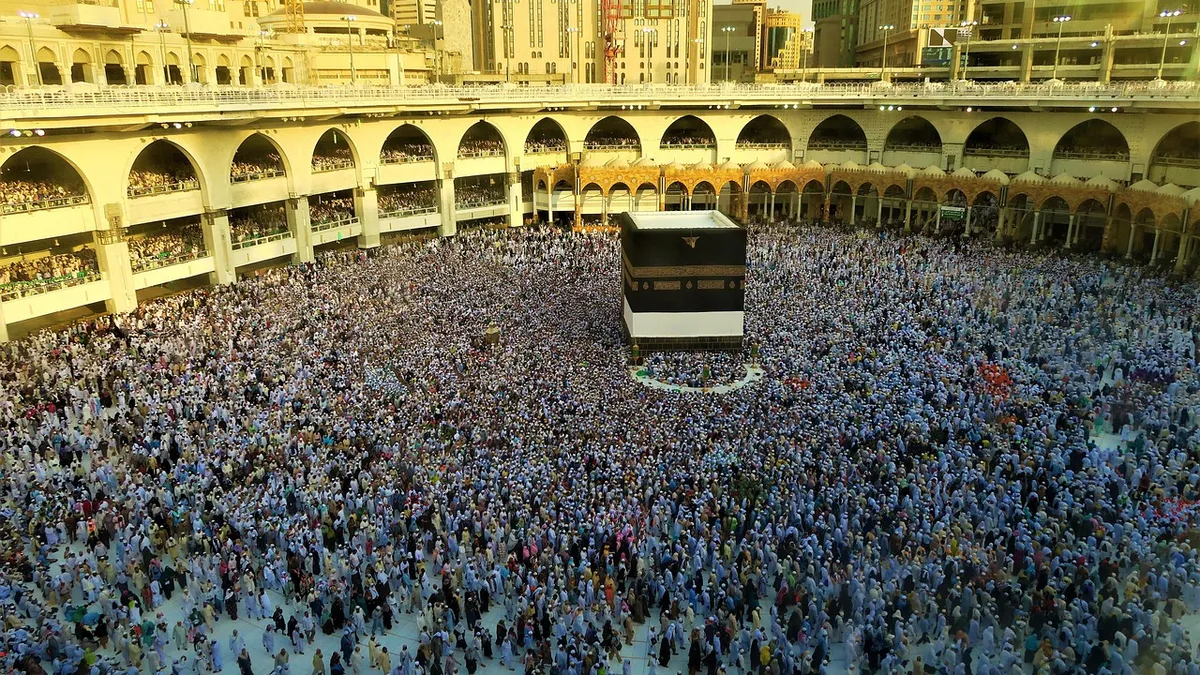

Under its founder, King Abdulaziz Al Saud, Saudi Arabia adopted a unique approach to serving pilgrims visiting the Sacred House of God by empowering every group of pilgrims coming from a specific country with their own guide (*mutawwif*) to oversee their affairs so they could perform their Hajj rituals and return home. Since that era, the profession of pilgrim guiding (*tawafa*) has become one of the most important services provided during Hajj. Through these mutawwifs, more than two and a half million pilgrims coming from Arabic-speaking and other Islamic countries are served. The profession has also evolved into an institute for teaching foreign languages to mutawwifs who interact directly with pilgrims from Asian, African, and even European countries. Discussing the stages of tawafa, the changes it has undergone, and prominent mutawwifs, Dr. Mohammed Al-Marhoumi—former head of maritime transport operations, former assistant head of the Hajj delegation sector, a mutawwif with the Turkish Pilgrims Foundation, and head of Al-Marhoumi Group of Commercial Companies and Al-Fayez Tourist Services Company—says: “Tawafa, with which God has honored us, placed upon our shoulders, and entrusted us with the great responsibility of serving the pilgrims of His Sacred House, is a profession inherited by ancestors long ago, and they are the ones who passed it down to the sons who carry its banner today with full competence and vigor, numbering more than 20,000 mutawwifs.”
Mutawwif Dr. Mohammed Al-Marhoumi continues: “As for me, ever since I was a child, my brother and I used to accompany our father and grandfather before their passing. At first, we were entrusted with minor tasks, which gave us instructional doses in how to manage Hajj and serve pilgrims—especially since in those days the number of guests of God was small compared to today, reaching about five thousand pilgrims. Consequently, when the number of pilgrims to serve was smaller, the training doses were more intensive and easier to understand.” He pointed out that among the most enjoyable moments were the arrival of pilgrims, helping them, distributing water to them at the holy sites, and solving their problems. He also noted that serving pilgrims equipped him and many other mutawwifs working in the profession with numerous skills, particularly linguistic ones, explaining that he acquired several living languages in addition to Arabic, as he speaks Turkish, some French, and Russian due to his constant contact with these groups of pilgrims throughout his career as a mutawwif. Between the past and the present, the profession of tawafa has undergone many changes and developments in how services are provided to pilgrims. Mutawwif Dr. Mohammed Al-Marhoumi says: “Most certainly, every era has its people. Tawafa of some 40 years ago is not the tawafa of today. Here I am speaking about differences in methodology and service delivery, but the core pillars have not changed. As is known, tawafa is ‘an honor, a service, and a trust.’ Every mutawwif keeps this motto before his eyes, and no mutawwif can deviate from these foundations. What has changed, however, is the pattern in which services are delivered. In the past, what concerned us as mutawwifs most was simply how to arrange housing and food for the pilgrim, which was all the pilgrim wanted. Of course, transportation was not a concern for the pilgrim, given that the holy sites were very close to one another, before any expansion work took place. Pilgrims performed their Hajj rituals on foot, and some even preferred walking over boarding the vehicle we provided for them.” Mutawwif Dr. Mohammed Al-Marhoumi adds: “Every year, something new is introduced into the work of tawafa, and naturally the new is harnessed to serve the pilgrim, until we now provide advanced services, such as SIM cards and mobile devices so pilgrims can contact their families back home, and gifts upon their arrival and departure. In addition, we provide them with luxury accommodations close to the Grand Mosque, and food and beverages served according to their requests, matching the meals they eat in their home countries.”




Latest video
تابع معنا تحليل قراءة الصحف اليومية مع الكاتب الصحفي Hany Sallam عبر