

By Mohamed Shaker
The educational process faces many crises, and here we briefly review the most important ones.
First: Electronic Exams :-
– Parents and students live in a state of suspense and confusion amid uncertainty about what lies ahead. This is especially true after what happened a few days ago during the first-year high school exam, when the system crashed disastrously at the start of the test, prompting the ministry to divide the country’s governorates into two groups to ease the load on the exam system. Even so, some students still struggled to take their exams. This issue is nothing new; over the past two years, students have worried about nothing except whether they would manage to take and submit their exam or whether the system would crash.
We ask: will the student’s fate be lost between the Ministry of Education and the Ministry of Communications, as each shifts the responsibility onto the other in a torrent of exchanged accusations over who is to blame for the system crash?
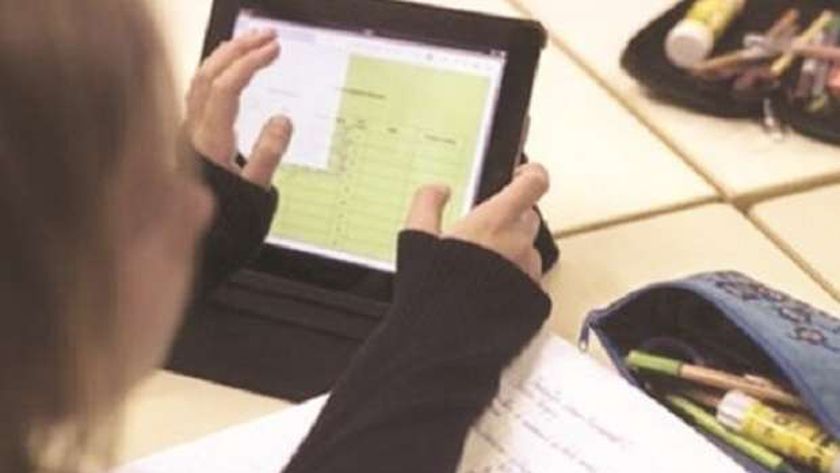
We are not against using technology in education, but many crises have occurred and will continue to occur as a result of using tablets in exams, and I will mention some of them:
– The network cannot handle students logging in simultaneously, just as happened in past days during the promotion exams for the first and second years of high school, and as the Ministry of Communications acknowledged. This experiment has been tried repeatedly, and students were unable to take all the mock exams at the same time. The ministry resorted to holding offline exams on school internal networks, and the results were poor as well.
– At any moment, a student is at risk of being logged out of the system during the exam. This poses a grave danger, as they will find themselves stumbling and unable to complete the test. What happens in that case? Everything might be over for the student, since they would receive an average score in a subject where they might otherwise excel, losing many points. Or will the ministry grant the student full marks in the subject because they made no error, and we must not shoulder them with the blame?
– Quite simply, a power outage could occur at the school, affecting not just one or two students, but everyone in the building.
Therefore, demanding paper exams is no longer a luxury for students, but has become imperative.
Second: The Unified Exam and Equal Opportunities
– In previous years, students had nothing to distract them; everything was clear: the type and nature of the exams, and the model papers published by the ministry to help students.
We can imagine that only three months remain until the general high school exams, yet no official decision has been issued by the ministry concerning the tests and their organization. We can also imagine that the Ministry of Education and Technical Education issued model papers for all promotion grades across all basic education stages, but did not issue any for high school.
– The unified high school exam, according to the current education law, is the only way to guarantee equal opportunities and fairness among students, because exams vary in difficulty and standard. We saw this in past years, with some exams being extremely difficult and others exceedingly easy. Notably, the ministry did not publish the promotion exams from previous years for this cohort because it knows for certain that those exams were neither balanced nor equal in difficulty.
Furthermore, no one is capable of setting exams of equal difficulty; that seems like a figment of the imagination. In addition, non-unified exams will open the door to gossip about favoring certain students by giving them simpler tests according to individual student codes, meaning the idea that exams are based on learning outcomes may involve several complications.
To rid ourselves of all these problems, exams must be paper-based and unified to achieve fairness, preserve the principle of equal opportunities, and avoid system crises.
Third: Platforms and Learning Resources :-
A student in the third year of Thanawiya Amma finds themselves in a genuine crisis. There is an ocean of sources: the Knowledge Bank contains a parallel curriculum that differs entirely from the standard syllabus available on the Ministry’s website in PDF format, which itself differs completely from what is inside the Knowledge Bank. Add to this the educational platforms and Nagwa’s content, and the student becomes like a child who has not learned to swim, facing drowning alone in an ocean of information they cannot possibly master. The multiplication, diversity, and discrepancies of these sources have led to a state of distraction and frustration. Should the student resort to private tutoring centers to study the standard curriculum? Or turn to the Ministry’s platform? Or head to the Knowledge Bank, or to Nagwa’s content announced by the Ministry? The student does not know where to obtain the information because they cannot cope with all these sources, especially since the curricula are very large and have not been lightened, unlike the previous year due to the coronavirus pandemic. The inevitable result of all this is a state of frustration and despair dominating the student, alongside the conviction that they will not be able to process this massive amount of information.
Fourth: Non-additive Subjects :-
These subjects and their exams represent a new burden added to Thanawiya Amma students. Why were they not canceled, or handled like last year by taking them from home to help students focus on what remains, alongside reducing the number of students heading to schools to take exams, since a new wave of the coronavirus is expected to emerge, according to announcements by the Minister of Health?
Fifth: The Expected University Admissions (Tansik) Crisis and the Overlap Between the Old and Current Cohorts :-
What has been presented so far points in one direction, while the university admissions crisis points in another.
University admissions are a highly volatile bomb that will detonate in the faces of the tablet cohort, destroying whatever remains of their hopes of securing a decent future. Let us review the following:
– More than 100,000 students deliberately postponed their exams last year when Dr. Tarek Shawky, the Minister of Education, announced that grades for the tablet cohort would drop sharply and would not exceed 80%, and perhaps even lower.
– A very large number of last year’s students took exams in 5 subjects, and some in 6 subjects, leaving the vast majority with just one or two subjects remaining. According to their plan, they have guaranteed themselves an advantage over all students in the tablet cohort, because most of them achieved top scores in those subjects. It is no secret to any of us that the questions were direct and simple, unlike the current system, which relies on learning outcomes. A severe disparity is expected between the results of students who split their subjects and the students of the tablet cohort, which will lead to the virtual absence of competition, allowing those who planned to split their subjects to achieve their goals, while leaving only scraps of college seats for the current cohort.
– There must be a way to preserve equal opportunities for all parties. The solution is for those who split or postponed certain subjects to have a different admissions process with flexible percentages compared to the current cohort, or to use the same admissions rules as last year, because part of the evaluation differs between the two cohorts. How can we equate a student who takes all exams under a new and difficult system where it is hard to earn grades with a student who took some exams under an old, familiar system that yields far more grades than the new system without effort? Combining two systems will expose the entire academic year to legal problems.
– Looking at the numbers simply: if the number of students who split their subjects—most of whom took exams and already have grades banked—alongside students who failed, exceeds 100,000 and is growing significantly; and the number of top college seats, from medicine to veterinary medicine and engineering, accepts top students each year in descending order, ranging from 25,000 to 27,000 students at best, will there be any chance for the tablet cohort to compete for places in top colleges with modest scores—scores that, no matter what, will not match those of a student who took subjects in a system that helped them accumulate grades without facing any pressure? Did the student who wanted to postpone choose to do so knowing for certain they would outperform everyone? Are top college seats logically reserved in advance for the old cohort? Statistics and logic say there is no fairness in unifying the admissions process for both cohorts.
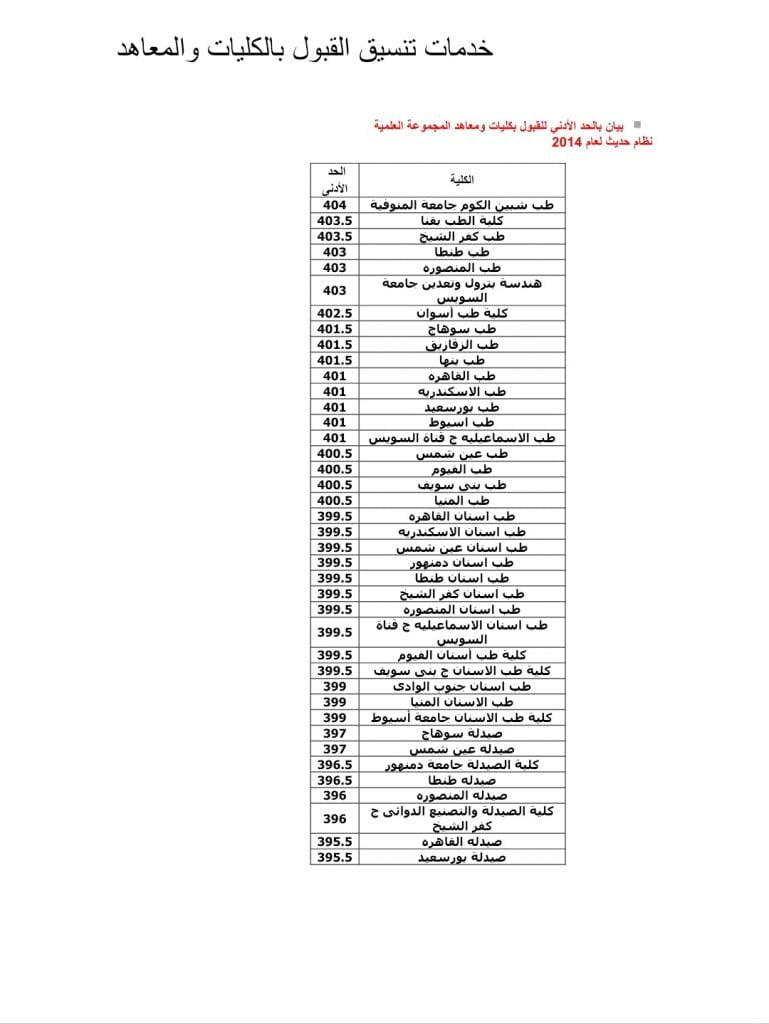
– Having two different admissions processes for Thanawiya Amma is not a new invention; it happened before when there were two admissions processes for the 1996/1997 cohorts due to educational system changes and improvement efforts, and it happened again in 2014/2015 (a portion of the 2014 admissions and the presence of two tracks is attached) when the system changed from two years back to a single-year system. Moreover, there were different exams as well, so fairness must be achieved among all students.
– Looking at the attached report, we find two admissions processes for 2014 despite the very minor disparity in grades. What about now, when there will be a tremendous disparity in grades that necessitates reciprocal treatment and a different admissions process?
– Seat allocations and flexible percentages apply to Egyptian students who obtain their high school diplomas from abroad. An equivalency process is conducted for them due to the differences in exams and their level of difficulty between Egypt and abroad, and this is applied annually as a recognized practice.
Sixth: Cheating
The cheating crisis is not new and used to be more widespread in villages and hamlets, and we noticed entire examination committees where students obtained identical scores. This phenomenon is expected to continue given electronic exams for students who are skilled at handling technology and exploiting loopholes in tablet devices through social media, as students send the exam to people outside the committee to help them with the answers, in addition to students communicating with each other inside the committees. Here the important question arises: if the ministry takes measures to prevent social media applications from running on the tablets, who is bypassing those loopholes and enabling the use of these applications while the tablets remain within the ministry’s system?
Who is responsible for this? Doubts continue to cross my mind regarding the answer to this question.
Seventh: Sample Models
In previous years of Thanawiya Amma, we were accustomed to sample models issued by the ministry for students so they could become familiar with the exam format, question types, and the nature of those questions, especially since this year features a new system and questions in a different format.
Here the thought occurs: why hasn’t the ministry created sample models until now? The ministry has issued sample models even for fourth-grade primary students; why doesn’t it make sample models for Thanawiya Amma?
Will students be surprised by a strange type of question?
Will there be essay questions?
Will all the questions be multiple-choice?
And if the questions are all multiple-choice, how will science and mathematics students cope? Since mathematics questions of all kinds are based on steps, and previously every step was awarded points, what happens when the answer is merely a final choice?
Many questions, and we find no satisfying answer to any of them.
From the foregoing, we review the following summary:
- A unified paper exam
- Taking exams for subjects not added to the total score at home
- Streamlining curricula and combating the phenomenon of cheating
- The presence of a separate admissions coordination process for the tablet cohort
- Sample models and questions that are not impossibly difficult
Attachments:
Part of the 2014 admissions coordination under the old and new systems



Latest video
تابع معنا تحليل قراءة الصحف اليومية مع الكاتب الصحفي Hany Sallam عبر