

By: Prof. Dr. Zeinab El-Nagdy, Former Director of the Central Laboratory for Aquaculture Research
The word “piranha” translates literally to “fish with teeth” in the Tupi language of Brazil.
The piranha is any of a number of freshwater fish species in the family Serrasalmidae, or the subfamily Serrasalminae within the characin family, Characidae, of the order Characiformes.
It is believed that there are about 30 to 60 different species of piranha.
Environment
– Piranhas are native to South America.
– The piranha is a freshwater fish, spending most of its life in freshwater habitats such as lakes and rivers.
– Piranhas are commonly found in the Amazon River, specifically the Amazon basin, which covers an area of about 35% of South America. They are non-migratory, meaning they do not travel around the globe and usually stay in one area.
– Piranhas swim in groups that are not very large, yet they live in shoals of up to 1,000 fish as a form of self-defense. This is because they make an ideal meal for other river inhabitants such as caimans, river dolphins, turtles, birds, and even otters.
External Description, Age, and Weight
All piranha species have a sturdy, deep, and thick body that is compressed laterally, with keel-like ridges running along the upper part of the body from the head to the dorsal fin, and along the lower part over the belly. Combined with a large, powerful tail and a body covered in very small scales, their streamlined bodies make them extremely fast and agile swimmers. The oddity of the family in shape is *Serrasalmus elongatus*, the elongated piranha or pike piranha. This species has a salmon-like body—elongated and slender—yet possesses the same powerful, well-developed tail, making it the fastest of all piranha species.
Piranhas possess a small adipose fin between the tail and the dorsal fin. This feature is characteristic of the characin family (catfish have an adipose fin as well).
They have large eyes, reflecting their predatory lifestyle, and a large snout with big nostrils to maximize water flow. They have a very acute sense of smell: in their natural environment—the murky rivers of South America, made even darker by overhanging vegetation—smell is their primary way of tracking prey.
Size and Teeth
Piranha size varies by species. Typically, piranhas grow to about 5–10 inches (12–25 cm). However, red-bellied piranhas (*Pygocentrus nattereri*) can grow slightly larger, with some reaching about 35–40 cm.
In most cases, their weight is less than 2 pounds (0.9 kg), though some larger species may weigh slightly more than 3 kg.
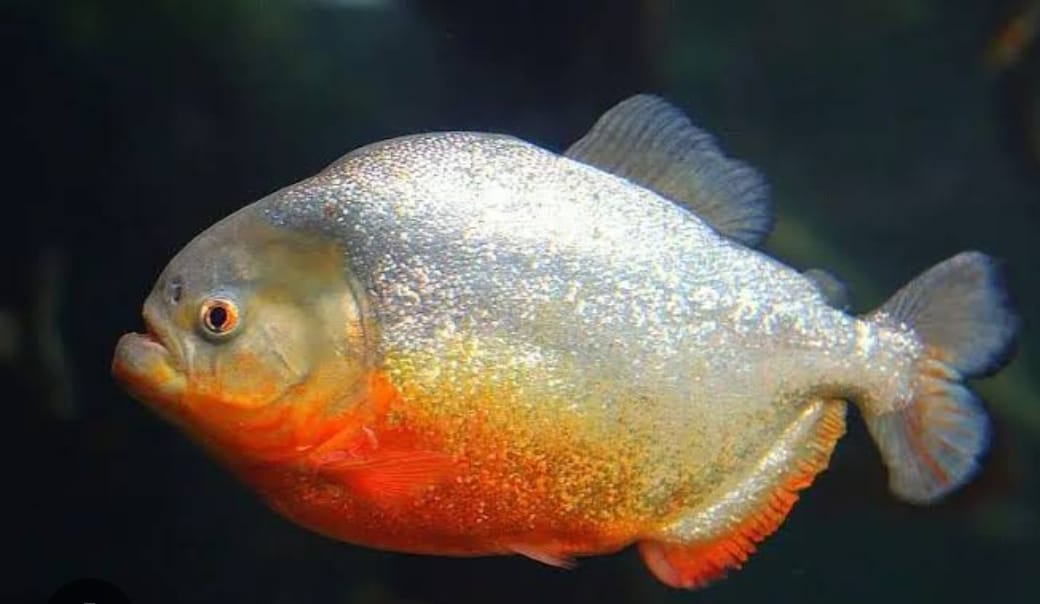
These fish display a variety of patterns and colors, including the red-bellied piranha, which features shiny silver scales, a bright reddish-orange belly, and sharp teeth.
– Piranhas have about 10 extremely sharp teeth, measuring 4 mm across, in each jaw.
The interlocking teeth are sharp enough to reach bone when biting. Throughout a piranha’s life, it loses its teeth just like many other fish. However, piranhas replace their teeth in sections. It takes about 100 days for a piranha to completely replace its set of teeth, and it continues this process throughout its life.
Diet
– Piranhas are omnivorous, meaning they eat a mix of plants and animals. In fact, some piranha species are also herbivorous. A typical piranha diet includes seeds, insects, and fish. Younger piranhas may feed on crustaceans, while some adult piranhas have been found with parts of birds and snakes in their stomachs. In some cases, piranhas may also feed on fins bitten from the tails of larger fish.
– Piranhas do not eat human flesh unless a person is already dead and drowned. In some cases, piranhas bite people when the fish feel threatened.
Sex Determination, Maturity, and Spawning
Determining the sex of a piranha is very difficult due to the lack of visible differences between males and females (in other words, piranhas are not sexually dimorphic). The only way to determine a piranha’s sex is by observing it during spawning. It is true that mature female specimens tend to be thicker because of the eggs they carry; however, this is an unreliable way to tell the sexes apart, as well-fed males are often just as thick. The only known exceptions to this sexual variation are the wimple piranha (*Catoprion mento*), where males and females are easy to distinguish, and possibly the five-cusped piranha (*Pygopristis denticulata*).
– Piranhas reach sexual maturity at about one year of age.
– Piranhas reproduce during the rainy season, a period that typically lasts for two months (from December to March). The fish swim in circles. Spawning piranhas turn a lighter color, while their bellies become redder.
– The female lays between 1,000 and 5,000 eggs in shallow nests on the riverbed or lakebed. The male then deposits sperm over the eggs to fertilize them. Both male and female piranhas guard the fertilized eggs.
– The fertilized eggs hatch within two to three days, depending on the water temperature. After hatching, the fry stay at the bottom, hiding among the plants.
Defensive Mechanisms
– Piranhas produce sounds when facing a confrontation to warn their group, ask an adversary to back away, or issue a threat.
– They produce these sounds by contracting and expanding their swim bladder—which keeps them buoyant—and by grinding their teeth. Because the waters of the Amazon basin are extremely murky, these barking sounds serve as another way for piranhas to signal food sources and approaching predators to others.
Sources:
https://www.bristolaquarium.co.uk/animal-stories/6-facts-you-need-to-know-about-piranhas
. https://sciencing.com/life-cycle-piranha-6731041.html
https://aquainfo.org/general-information-about-piranhas/
Pygocentrus nattereri – Red Bellied Piranha


Latest video
تابع معنا تحليل قراءة الصحف اليومية مع الكاتب الصحفي Hany Sallam عبر