
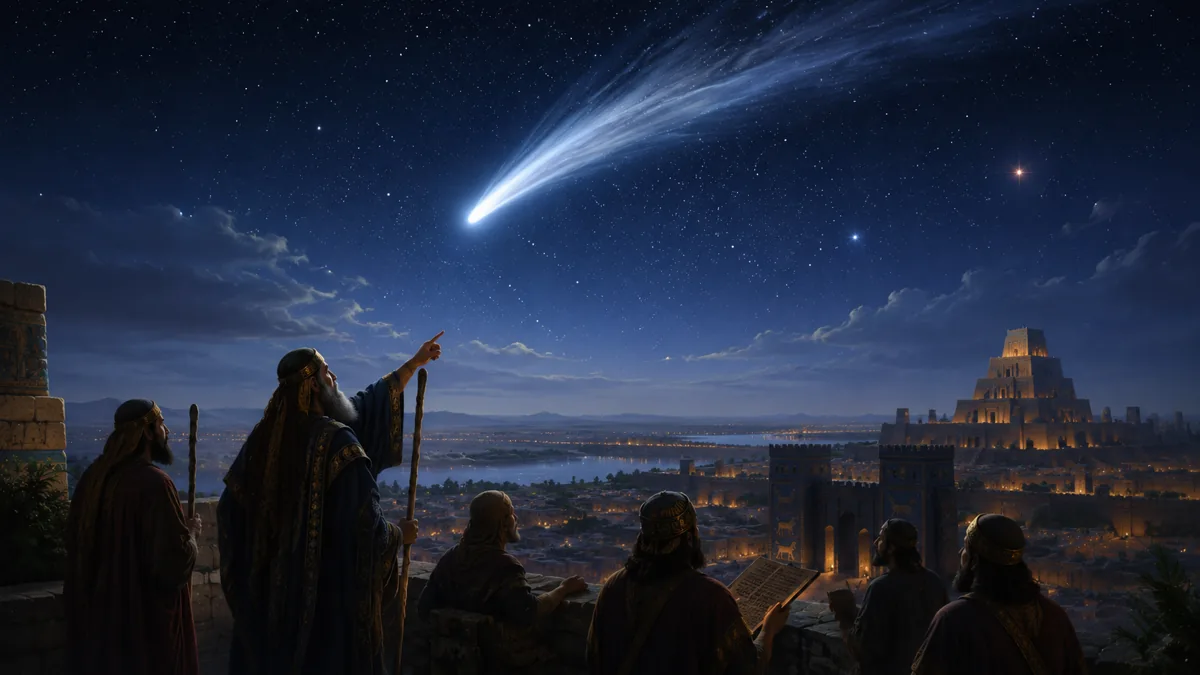

In ancient times, the sky was not merely a tranquil scene decorating the night, but a world filled with cryptic messages and frightening omens. The appearance of comets was among the phenomena that most struck terror into human hearts.
When that luminous body with its long tail suddenly appeared in the sky, without a clear schedule or understandable explanation, people felt that something unnatural had approached Earth.
For this reason, comets were associated for centuries with wars, famines, the downfall of kings, and major disasters.
The Unannounced Guest
Comets differ from ordinary stars that appear fixed in their positions every night. They show up suddenly, then move slowly across the sky before disappearing for years or centuries.
This strange behavior was enough to give them an aura of awe and mystery. Ancient humans loved order in the sky, whereas comets arrived to suddenly break that order.
In many civilizations, people viewed a comet as a heavenly message warning of an impending major event.
Comets That Altered the Fate of Kings
In ancient Europe, stories spread linking the appearance of comets to the deaths of rulers or the outbreak of wars. Even emperors and kings sometimes consulted astrologers to interpret their appearance.
In ancient China, astronomers recorded comets with great precision, yet they also viewed them as signs connected to political shifts or natural disasters.
In some civilizations, people believed that a comet’s tail carried poisons or vapors that affected Earth and humanity.
The Comet That Terrified the World
Haley’s Comet is perhaps the most famous comet to stir panic in history. When it approached Earth in 1910, rumors spread in many countries that the toxic gases in its tail might kill humans.
The fear reached the point where some people bought strange masks and medicines to protect themselves from “comet air.”
Yet nothing catastrophic happened, and the comet passed as it always does, leaving behind human wonder more than fear.
What Does Science Say Today?
Scientists now know that comets are not messages of heavenly wrath, but icy and rocky bodies orbiting the Sun in vast paths.
When they draw near the Sun, the layers of ice on their surface heat up, releasing gas and dust to form the luminous tail we see from Earth.
Despite their beauty, comets indeed carry a fraction of past dread. Some scientists believe that massive collisions of celestial bodies with Earth played an important role in the history of life on our planet.
However, the probabilities of a major catastrophe caused by a comet remain very rare compared to what ancients believed.
The Ancient Wonder of the Sky
Human fear of comets may not have been merely scientific ignorance, but rather the reflection of a deeper feeling before a vast universe whose secrets cannot all be predicted.
As ancient humans looked at that strange light cutting across the dark sky, they felt they were witnessing an event that completely surpassed their understanding.
Even today, comets retain a part of their ancient magic. Whenever a bright comet appears in the sky, people pause to lift their eyes toward the night, just as humans have done for thousands of years.
Hany Sallam


Latest video
تابع معنا تحليل قراءة الصحف اليومية مع الكاتب الصحفي Hany Sallam عبر