

By Hagar Mohamed Moussa
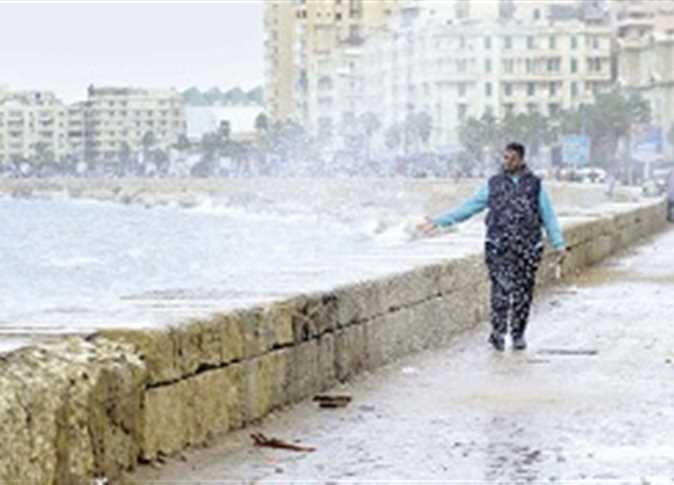
Alexandria—built by the Greek king Alexander the Great nearly 2,400 years ago, Egypt’s second-largest city, a place of immense historical importance, and home to the country’s largest port—faces the risk of a portion of its land sinking due to rising sea levels. Bounded by the Mediterranean Sea on three sides with a lake to its south, Alexandria is vulnerable to flooding driven by global warming, particularly because it is one of the lowest-lying coastal regions, according to international reports and indicators.
The world was surprised by statements at the COP26 climate summit in Glasgow when the British prime minister announced that one-third of Alexandria would sink underwater or become uninhabitable by 2050. This would put a quarter of its six million residents at risk of having to leave their homes, and its ancient ruins and historical treasures might not escape the danger either.

In fact, hundreds of Alexandrians abandoned their homes after their walls were compromised by the advance of water and torrential rains in 2015, and they faced the same danger again in 2020.
The Mediterranean Sea level is expected to rise by one meter over the next three decades, according to the worst-case projections of the United Nations Intergovernmental Panel on Climate Change. UN experts note that the level of the Mediterranean will rise faster than almost anywhere else in the world. If the sea level rises by half a meter, 30 percent of Alexandria may flood, leading to the displacement of roughly 1.5 million people or more from their homes.
Similarly, the 2021 Human Development Report issued by the Egyptian Ministry of Planning in cooperation with the United Nations Development Programme projects that by 2050, the Mediterranean sea level may rise by one meter due to global warming. This may result in the submersion of historically significant coastal cities such as Alexandria, where the 15th-century Qaitbay Citadel stands as one of the archaeological sites most vulnerable to the danger of flooding. This prompted the Egyptian government to surround the citadel with 4,700 concrete blocks to protect it from rising water levels. Water hazards also threaten archaeological sites in various areas, such as the Catacombs of Kom el-Shoqafa dating back to the third century AD, which were flooded in 2015 and subsequently restored. The Mex district—an archaeological area that is home to the Alexandria Lighthouse site, which has become restricted to visitors due to the danger of rising sea levels around the lighthouse—was also hit by floods in 2015.
It is worth noting that Alexandria experiences severe climate fluctuations, ranging from intense heat in the summer to bitterly cold temperatures in the winter, accompanied by torrential rains and sometimes snow, which increase in intensity every year and which the government cannot manage.
All of this is due, on the one hand, to the depletion and limited nature of environmental resources, and on the other, to environmental problems such as pollution and degradation.
The depletion of fossil fuels and non-renewable energy sources in Alexandria causes air pollution, which is a factor in rising temperatures, climate volatility, and ozone depletion. Poor fishing practices and a failure to protect Alexandria’s coastline—aggravated by ships carrying petroleum and toxic waste passing along the city’s shores—have left the city surrounded by all types of pollution at sea and in the air, amid a lack of government oversight of these practices or policies and mechanisms to prevent them. Environmental security is one of the most important ways to protect citizens from emergency risks caused by pollutants and climate change, which we must all acknowledge and confront to save the city of Alexandria.


Latest video
تابع معنا تحليل قراءة الصحف اليومية مع الكاتب الصحفي Hany Sallam عبر