
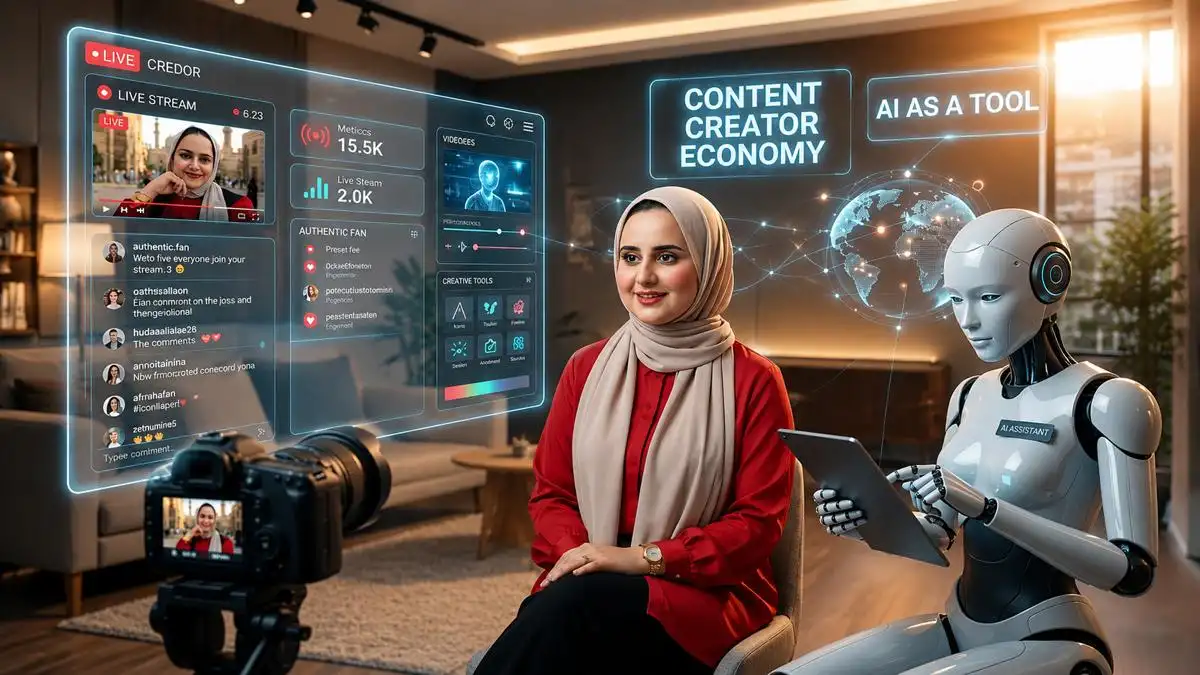

How Is “Authenticity” Reshaping the Rules of Marketing and Work?
By Dr. Ola Mahmoud Moawad
Digital Transformation, Spatial Analysis, and Artificial Intelligence Consultant
Business Information Systems Lecturer at Universities
We live today in an era where anyone with a smartphone can build a global audience and establish what is known as a “one-person business.” This shift has created the creator economy, a multi-billion-dollar market reshaping how companies relate to consumers. Yet, as artificial intelligence steps in as a key player generating text, images, and videos at the press of a button, this economy faces an existential challenge: how to maintain authenticity and reliability in a world crafted by algorithms.
Modern consumers no longer trust massive TV ads or traditional marketing campaigns that feel artificial and solely aimed at selling. Instead, consumers look for authenticity; they want to see a real person share honest experiences with a product, flaws and all. This is where micro-influencers gained power, as companies realized that a content creator with thousands of loyal followers sometimes holds more influence than multi-million-dollar celebrities, because the relationship here rests on trust and virtual friendship rather than the false glitter of fame.
Even so, this surge toward authenticity hit a major dilemma with the spread of generative artificial intelligence tools. The ability to produce hundreds of articles or videos daily through complete automation threatened to flood the internet with repetitive, soulless content. Companies that rushed to use these tools simply to cut costs and boost volume quickly discovered that audiences possess a sixth sense for spotting machine-written content lacking a human touch, leading to customer alienation and declining brand trust.
This challenge imposed new rules in marketing. Smart companies and professional content creators learned not to fight technology, but to embrace it as a behind-the-scenes assistant. Smart use means leaving tasks like brainstorming, organizing ideas, and heavy data analysis to the machine, while final drafting, storytelling, and the emotional touch remain purely human. Full automation of responses and deepfake videos means the death of authenticity, whereas blending artificial intelligence with a human presence ensures both efficiency and appeal.
Amid this fast-paced digital transformation, new work ethics governing digital honesty have emerged in the markets. Companies and content creators must now transparently disclose when they use generative technologies in their work, while respecting the intellectual property rights of creators whose work trains the algorithms. Commitment to avoiding distorted facts or generating fake product reviews has become the primary standard for evaluating any company’s credibility in the modern market. In conclusion, the challenge in the new digital era no longer lies in how to produce content, but in how to keep it human and authentic. The companies and content creators who win in the future will be those who harness technology and automation to speed up their operations while keeping honesty, transparency, and genuine human relationships at the forefront to appeal to consumers’ hearts and minds.
Read also: New Space Data Centers Pave the Way for the Extraterrestrial AI Era
Read also: Britain Warns of Risks Posed by Artificial Intelligence Models


Latest video
تابع معنا تحليل قراءة الصحف اليومية مع الكاتب الصحفي Hany Sallam عبر