

The World’s First Nuclear Clock Starts Operating Officially: Will It Change How We Understand Time?
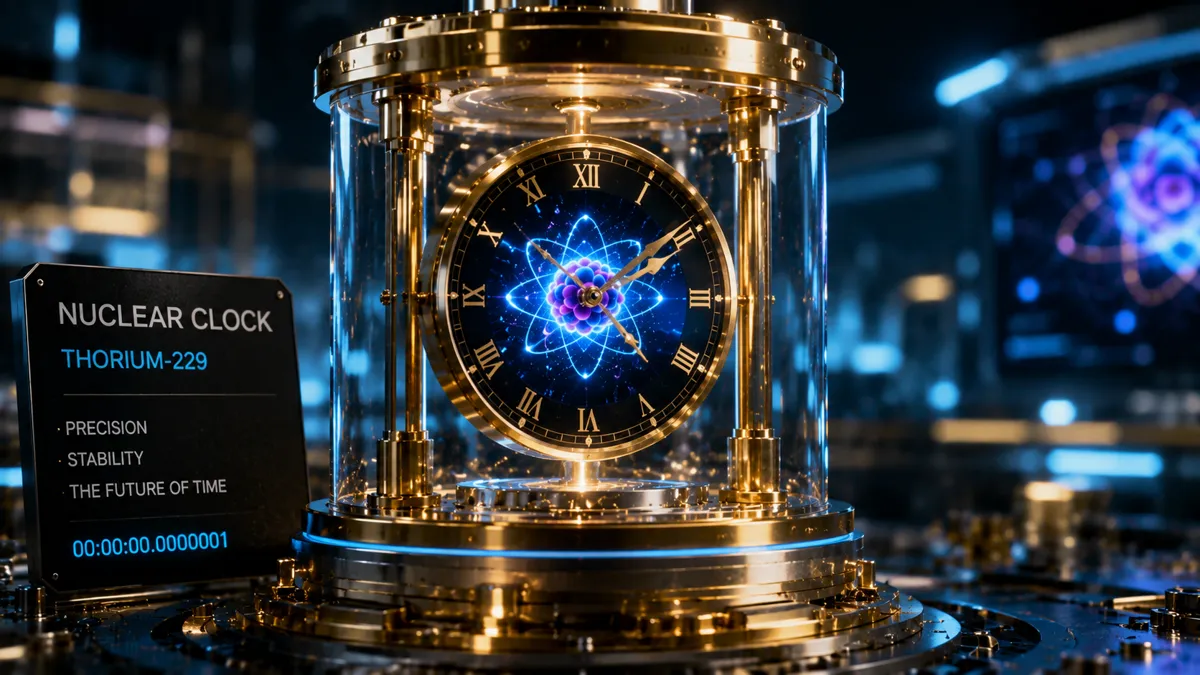
In an unprecedented scientific achievement, two research teams have announced their success in operating the world’s first practical nuclear clock, using the nucleus of the thorium-229 element instead of the traditional electrons used in atomic clocks. Scientists describe this development as a step that may completely redefine the concept of timekeeping.
Read Also: Scientists Close In on Breaking Most Dangerous Equation in Pancreatic Cancer Treatment
Current atomic clocks rely on the vibrations of electrons inside atoms to measure time, and they are already extremely accurate. However, the new nuclear clock relies on vibrations inside the atomic nucleus itself, which is more stable and less affected by external factors such as magnetic fields and heat.
Why Is This Discovery Important?
Scientists believe that the nuclear clock may outperform the best current atomic clocks by up to 10,000 times in terms of precision.
Measuring Time with Unprecedented Precision
This achievement may allow for more sensitive time measurements than ever before.
This technology could revolutionize space navigation systems and global positioning systems.
Searching for Dark Matter
One of the most exciting applications is the possibility of using it to detect very subtle changes that may reveal the presence of dark matter or new physical forces.
How Does the Nuclear Clock Work?
Researchers embedded thorium atoms inside a calcium fluoride crystal, then used an ultra-precise laser to stimulate the nuclear transition inside the nucleus, which allowed the nuclear oscillation to be measured practically and continuously for the first time.
What Is Next?
The technology is still in its infancy, but scientists believe that the next generation of these clocks may help test the constants of nature and possibly answer some of the biggest mysteries of modern physics.
Conclusion
If the atomic clock changed the world previously, the nuclear clock may be the start of a new era of scientific precision, and perhaps the key to understanding the secrets of the universe and time itself.
Hany Sallam
Read Also: Giant Observatory Approaches Solving One of Universe’s Greatest Mysteries
Read Also: Does the Universe Birth Its Black Holes from Hidden Crystals?
Read Also: Is the World Nearing the Eradication of Cancer? New Drug Opens Door of Hope
Read Also: Assassinating Innovation via Certificate Protein
Read Also: India Bans 16 Drug Formulations Due to Lack of Medical Justification


Latest video
تابع معنا تحليل قراءة الصحف اليومية مع الكاتب الصحفي Hany Sallam عبر