


By Dr. Eng. Hisham Saad El-Sherbini

In previous articles, we discussed the general shift in the steel industry toward electric induction technology, starting from scrap melting and moving through steel stirring in treatment furnaces, known as the “bosh”. In this article, God willing, we turn to the use of induction technology in the continuous casting stage, which begins with the tundish unit, or intermediary vessel. Electromagnetic induction has been introduced to help steelmakers produce clean steel and pursue higher quality, productivity, and profitability.
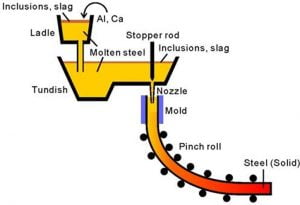
The Tundish and Its Role in Continuous Casting
Continuous casting is a widely used process and a vital step in steel production. The share of steel cast using continuous casting worldwide has increased significantly since the process was introduced in the 1950s. Today, this share reaches about 97%. However, alongside this increase in use, strict quality requirements have become essential to meet the gradually increasing productivity of continuous casting machines and the larger dimensions of cast products.
It is fair to say that electromagnetic induction technology enhances quality, productivity, and profitability in several ways. In addition to improving the removal of non-metallic inclusions in liquid steel and achieving clean steel production, it also provides temperature uniformity and stability across all areas of the liquid steel inside the tundish. This reduces reliance on the “superheat” technique and promotes temperature consistency across different liquid steel zones. Consequently, operational continuity and reliability improve overall, and costs drop by reducing the consumption of refractories and other parts needed for continuous casting in the tundish.
Likewise, non-metallic inclusions in steel exert a harmful effect on mechanical properties and increase problems in the subsequent rolling stage. Besides this, these inclusions can cause clogging in continuous casting pathways. Furthermore, non-metallic inclusions can help clog the nozzle during casting, leading to non-uniform mechanical properties in the steel product and defects in the final product that emerge during rolling.
It is worth noting here that electromagnetic induction technology features an important property—non-contact operation—which extends equipment lifespan. As a result, almost no maintenance is required, keeping in mind that using electromagnetic induction in the tundish is preferred in casting machines with more than two strands. Results show that the maximum temperature difference between each strand from the tundish can drop to less than 4 degrees Celsius when used, compared to 10 degrees Celsius in traditional casting machines.
Electromagnetic induction technology also provides several new functions, including flexibility in controlling stirring force and direction, flow field control, and complete melting degree control within the tundish. This means steelmakers do not have to rely solely on the limited capacity of liquid steel guides inside the tundish to control liquid steel flow, since dead zones frequently lead to temperature variations and prevent the removal of non-metallic inclusions, while also resulting in a degraded metal flow effect.
References
Chrome extension://efaidnbmnnnibpcajpcglclefindmkaj/https://kth.diva-portal.org/smash/get/diva2:1229627/FULLTEXT01.pdf
https://www.mdpi.com/2075-4701/11/7/1075/htm
https://www.ispatguru.com/tundish-and-its-role-in-continuous-casting/


Latest video
تابع معنا تحليل قراءة الصحف اليومية مع الكاتب الصحفي Hany Sallam عبر