

Eng. Hesham Saad1*, Dr. Mohamed Gamal Khalifa2, Dr. Abdelrhman Ibrahim Hassan2 and Dr. Taha Mattar2,3
1Arabian Steel Industries, Ain Sokhna, Suez, Egypt
2Tabbin Institute for Metallurgical Studies (TIMS), Tabbin, Cairo, Egypt
3 Central Metallurgical Research and Development Institute (CMRDI), Cairo, Egypt

Eng. Hesham Saad
Key words: continuous casting, steel billet, billet casting, near net shape casting, standalone rolling mill
Background
Continuous casting is a key step in a steel plant for converting liquid steel into solid slabs or billets/blooms. The success of continuous casting has a significant impact on the economy and quality of steel products. New technologies have been actively developed in this process over the past few decades to increase productivity and lower operating costs.
Today, the continuous casting machine can also be considered a second turning point in the transformation from a standalone rolling mill to a standalone mini mill or endless rolling mill, where the rolling mill is merged directly with the steel melt shop (SMS). The major benefit is that a steel billet reheating furnace unit is no longer needed, as the continuous casting machine merges directly with the rolling mill stands through an induction heater.
The recent work investigates the development of the endless rolling mill as a third turning point for the continuous casting machine. This is based on a central question: can we maximize benefits so that the roughing stand stage of the rolling mill is no longer needed? We study various factors affecting the minimum round cross section of a carbon steel billet produced by a continuous casting machine to feed the intermediate stands stage directly.
The present work aims to investigate how best to utilize and optimize the merging of best available techniques to serve the targeted transformation of standalone production and manufacturing units, complying with sustainable development goals with a focus on consumption and production, and ensuring sustainable consumption and production patterns.
Introduction
“Worldwide consumption and production — a driving force of the global economy — rest on the use of the natural environment and resources in a way that continues to have destructive impacts on the planet. Economic and social progress over the last century has been accompanied by environmental degradation that is endangering the very systems on which our future development — indeed, our very survival — depends.”
These are the Sustainability Matrix elements declared in SDG 12.
Based on that, we can define the three main elements of the sustainability matrix as environment, economy, and society. The economic element concerns the transformation from a linear economy to a circular or green economy. The environmental element concerns the transition from social justice to environmental justice. The social element concerns accounting for social costs.
A fourth important element that can be added is technology, which can be defined as the application of scientific knowledge for practical purposes. Technology can also be classified into six main categories: construction, transportation, communication, bio-related, energy, and manufacturing. The primary role of technology should be to facilitate rather than complicate. Transforming traditional technology into sustainable technology is the primary responsibility of all researchers, specifically R&D personnel.
The elements of the traditional technology matrix can be defined as product, production/manufacturing, and process. Similarly, the elements of the sustainable technology matrix include GLC technology: Green products, which apply the 4 Rs (reuse, reduce, recycle, and recovery) or the zero-waste rule; Lean production/manufacturing, which applies the make-to-order principle; and Clean processes, which apply the zero-emissions rule.

Methods
In 2010, a major technology supplier introduced a new technology called “Endless Casting and Rolling,” which marked a decisive change in the steel midstream—comprising steel melting and casting—and the downstream stage, which includes steel hot rolling. In other words, these two stages were merged into one.
This merger combines the production unit of the continuous casting machine (CCM), which handles the transformation of liquid steel into semi-finished products (slabs, blooms, and billets) operating on a make-to-stock basis, with the hot rolling (HR) manufacturing unit, which transforms semi-finished products into final products like re-bars and profiles and operates on a make-to-order basis.
The most significant result of this merger is the removal of the reheating furnace unit from the hot rolling mill process. This makes the new hot rolling approach a sustainable technology because it avoids the emissions generated by the reheating unit from fuel combustion—amounting to 30 cubic meters per ton of billet—and also prevents a 2 percent loss due to oxidation during the heating process.
Furthermore, this transformation ultimately affects both operating expenses (Opex) and capital expenditures (Capex) simultaneously. Regarding Opex, it eliminates losses from oxidation, emissions from fuel combustion, and the storage costs of semi-finished products. Regarding Capex, the transformation avoids the cost of the reheating unit, the land required to build it, and the handling equipment needed to operate it. In this research, the proposed development aims to maximize the benefits of this transformation by studying the possibility of removing the roughing stage of the rolling mill and replacing regular electrical energy with renewable energy sources.

with renewable energy sources.
Finally, this shifts the focus from achieving production capacity to achieving product mix variety, which is a major element of the 4 Ps of the marketing matrix (place, promotion, price, and final product). To support this, we propose a new vision for the CCM design that allows for casting in two directions at 180o, known as the ATUM design.

Results
Regarding time management (utilized time factor, UTF), efficiency and effectiveness serve as the primary parameters for evaluating the proposed solutions. “Efficiency and effectiveness are not the same thing. Efficiency is defined as the ability to accomplish something with the least amount of wasted time, money, material, and effort, or competency in performance. Effectiveness is defined as the degree to which something is successful in producing a desired result.”
Overall Equipment Effectiveness (OEE) is a proven approach for measuring overall equipment performance, focusing on time management, improvement, and autonomous maintenance, which are two key activities for enhancing equipment performance.
In addition, shifting to the Sustainable Manufacturing Process Effectiveness (SMPE) methodology adds a measure of how eco-friendly the process is. The implementation of lean production and clean processes further enhances the environmental performance of the operation. The operational process effectiveness is sufficiently high for sustained capacity planning, and a social cost framework is proposed for implementing the SMPE methodology to boost overall process performance.

Regarding material management (yield percentage), traditional technology depends on the dimensions of the semi-finished product—in our case, the billet length—where the material yield percentage can start from 91%, whereas applying endless technology can reach up to 88%.
Regarding environmental management, the development addresses two factors. The first is avoiding fuel combustion emissions; for example, in a reheating furnace, producing one ton requires 28 cubic meters of natural gas under optimum operating conditions, which can rise to 40 cubic meters. The second point is that, based on the best available technology updates, the entire process (melting, casting, and rolling) can be powered entirely by renewable energy through a step-up substation, thereby fully achieving the zero-emissions target.
Discussion
Today, key innovative technologies include induction heating, induction stirring, induction melting, and electromagnetic stirring (EMS). We will focus on the induction heating furnace, which is the key technology that enables the merger of CCM and HR.
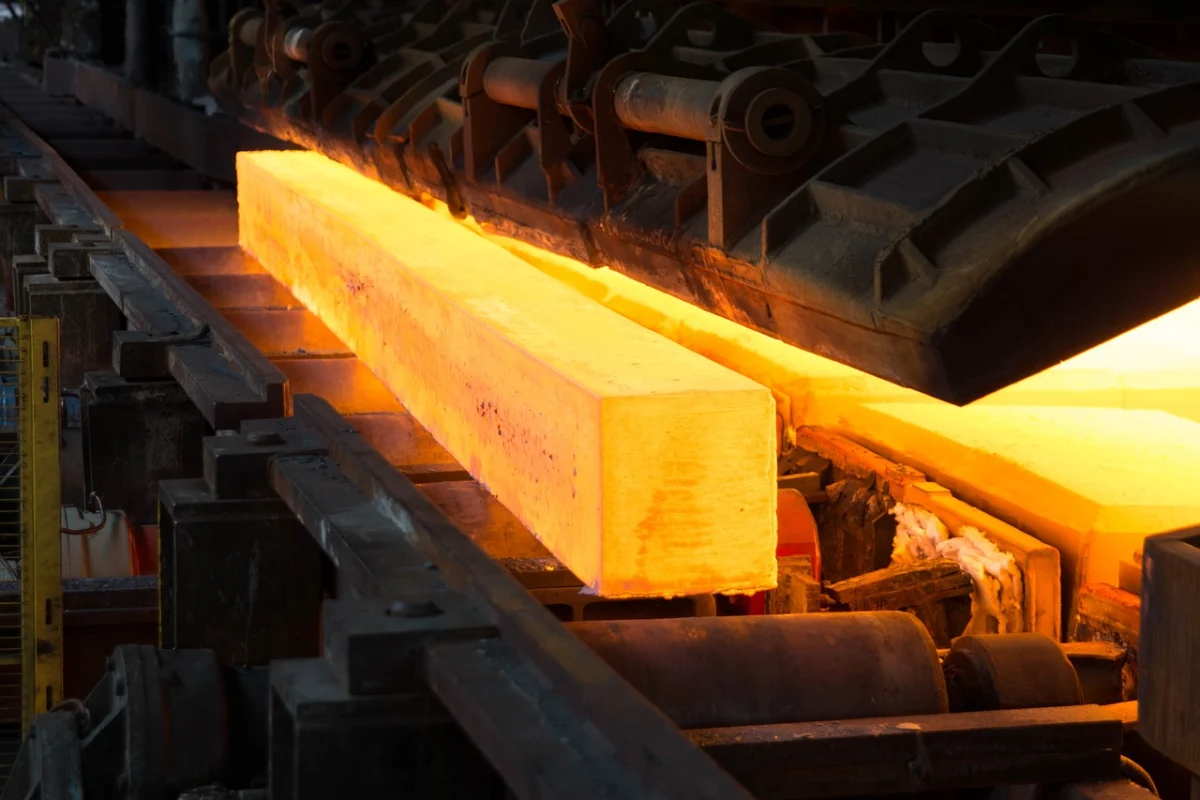
Normally, the CCM unit is fed with liquid steel, and the cast semi-finished products can be classified into slabs, blooms, and billets depending on their cross-section. The final product reaches full solidification at 900 Co, at which point the process experiences energy waste due to the storage stage, where the material cools down to atmospheric temperature.
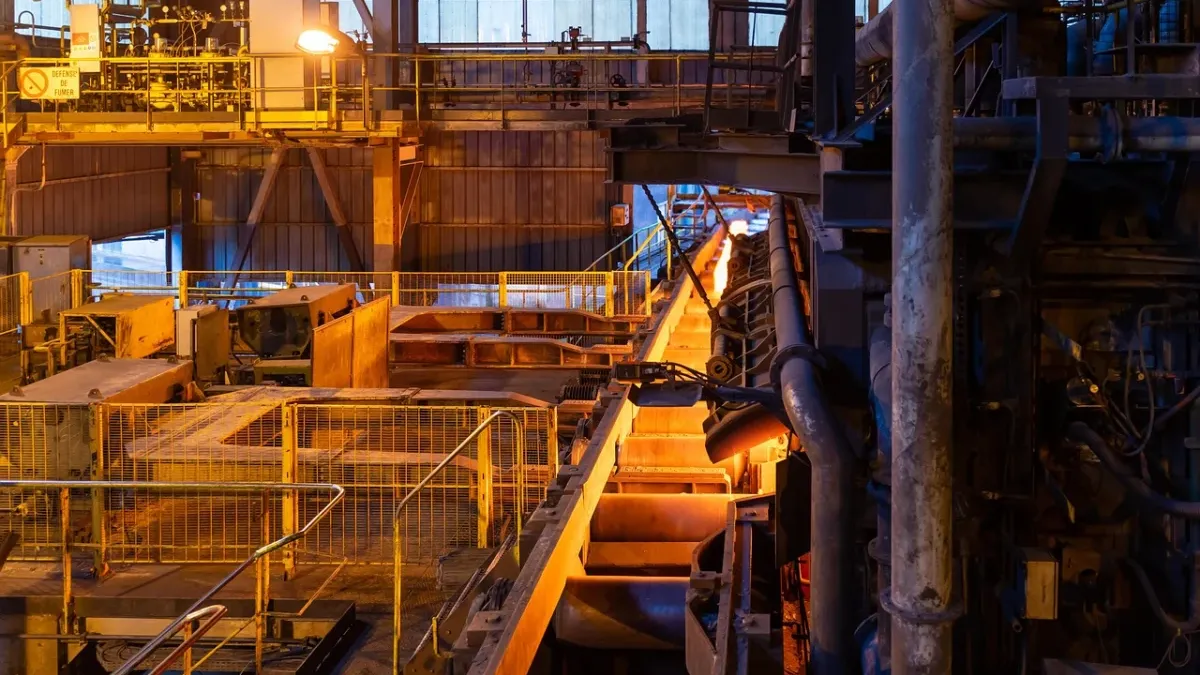
Typically, hot rolling manufacturing consists of a reheating unit, rolling stand units (roughing, intermediate, and finishing stands), and a cooling facility. Endless casting and rolling replaces the traditional reheating unit with an induction heating unit. The traditional reheating unit was capable of being fed cold billets (cold charge) or hot billets (hot charge).
Based on traditional hot rolling basics and carbon percentage, a steel billet, for example, needs to be reheated from atmospheric temperature up to 1100 Co for the process to complete the hot rolling stage.
In endless technology, induction heating raises the temperature from just 900 Co up to 1100 Co. Therefore, we can feed the square cross-section steel billet directly into the first stage of the rolling stands—the roughing stands—

and in the research proposal, the feeding billet is fed with a round cross section directly into the intermediate stands.

According to initial calculations, process productivity could reach 10 tons per hour with a single-strand continuous casting machine (CCM), which can be duplicated up to 30 tons per hour with a two-strand CCM operating in two 180° directions.

Finally, to obtain a clean product and minimize billet defects, electromagnetic stirring (EMS) technology can be applied for the mold, strand, and finish stages (M-EMS, S-EMS, and F-EMS).
The last technology that could be considered is direct rolling and bundling (DRB) technology, which transforms the cooling bed from a traditional setup to an improved one by omitting cold-shear equipment and limiting the cooling bed length to just 24 meters.
Conclusion
The technologies required to implement the targeted sustainability conditions are available and could be considered the best available technology (BAT). These include induction heating, electromagnetic stirring, and direct rolling and bundling. Additionally, the proposed new CCM design will let an endless concept come into play regarding performance effectiveness and operational efficiency.
Focusing on the present work, it concluded that increased casting productivity—especially with the introduction of high-speed billet casting (HSBC)—re-emphasized the importance of high-performing mold electromagnetic stirring (M-EMS) in attaining target productivity and product quality. To provide operating flexibility and enhance metallurgical performance, adapting the M-EMS design to the requirements of casting practice with either open-stream pouring or submerged entry nozzles (SEN) has become critical. In that context, it is especially important to assess the effects of EMS design parameters, as control is key to EMS compatibility with continuous casting practice and its high metallurgical performance.

Finally, merging the continuous casting unit as a make-to-stock production unit and the hot rolling mill unit as a make-to-order manufacturing unit will lead to achieving lean production and manufacturing, which is the third element of the technology matrix.
References
https://www.ispatguru.com/basics-of-continuous-casting-of-steel/
https://www.ispatguru.com/defects-in-continuous-cast-steels/
https://link.springer.com/content/pdf/10.3103%2FS0967091214120109.pdf
https://link.springer.com/article/10.1007/BF03398119?noAccess=true
https://www.ispatguru.com/heat-transfer-during-continuous-casting-of-steel/
https://link.springer.com/article/10.1007/s11015-014-9818-1
https://www.sciencedirect.com/science/article/abs/pii/S0924013615001259 https://www.mdpi.com/2075-4701/11/9/1380/htm https://professor.luzerna.ifc.edu.br/charles-assuncao/wp-content/uploads/sites/33/2016/07/Improvement-in-secondary-cooling-of-continuous-casting-of-round-billets-through-analysis-of-heat-flux-distribution.pdf
https://www.mdpi.com/2075-4701/11/9/1380/htm
https://www.nipponsteel.com/en/tech/report/pdf/124-17.pdf
https://link.springer.com/article/10.1007/s00339-022-05257-x
https://onlinelibrary.wiley.com/doi/full/10.1002/srin.201400281
https://www.ispatguru.com/alloying-elements-and-their-influence-on-properties-of-steel/


Latest video
تابع معنا تحليل قراءة الصحف اليومية مع الكاتب الصحفي Hany Sallam عبر