
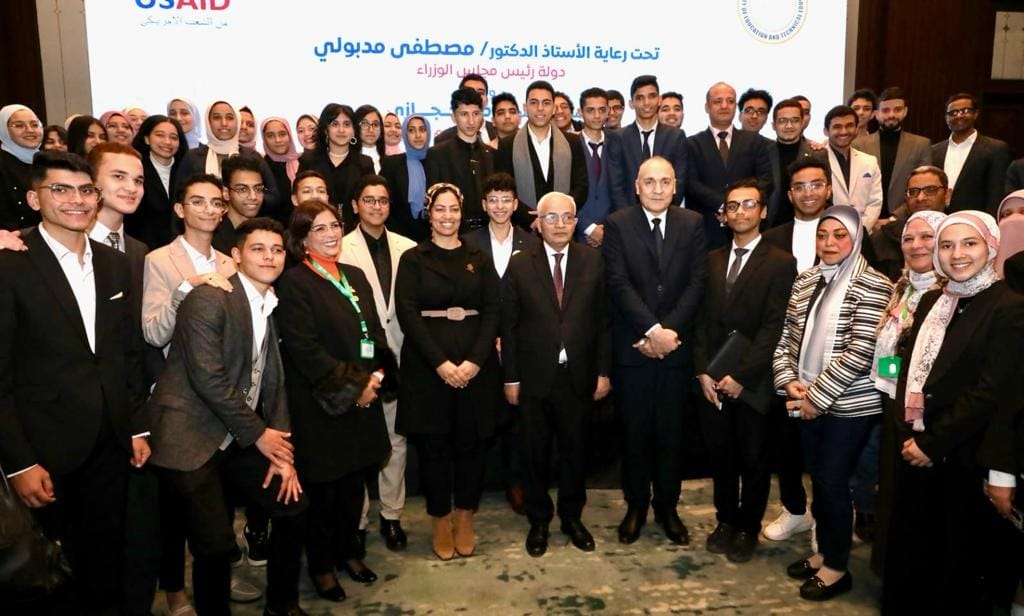

Education Minister Announces Recommendations of STEM Egypt Education System Conference Under Banner of Reality and Ambitions
Written by Shereen Hamdy
Dr. Reda Hegazy, Minister of Education and Technical Education, attended the closing session of the conference on the Egyptian STEM education system, held under the banner of “Reality and Ambitions” and sponsored by Prime Minister Dr. Mostafa Madbouly, running from January 29 to 30, 2024.
Dr. Reda Hegazy reviewed the key recommendations resulting from the events, which included considering expansion and sustainability in supporting STEM schools as a national project for the Ministry of Education and Technical Education, to be adopted with the participation of public, private, and non-profit universities, industrialists, and civil society to enhance human investment in the New Republic. He pointed to the fact that the STEM model has proven that school is the true venue for education and learning, and therefore the conference emphasizes drawing upon this model to develop general education, and building genuine and effective partnerships between these schools, civil society, research institutions, industrialists, universities, and all relevant bodies.
Dr. Reda Hegazy also announced, as part of the recommendations, the establishment of a permanent, documented database of STEM school graduates since their inception in the nation’s memory, the creation of a YouTube channel dedicated to STEM school activities and projects, the establishment of repositories to publish capstones and research by students of these schools and linking them to search engines, as well as the founding of academic guidance entities in STEM schools, ensuring this is added to teacher and school leadership preparation programs across the five universities participating in the project, and giving supportive consideration to the humanities, arts, literature, philosophy, and history to instill values of national belonging alongside science, technology, engineering, and mathematics (STEAM). In addition, regular meetings are to be held with STEM students and graduates to exchange experiences and benefit from the life skills and scientific experiences that have helped them in research, innovation, and self-reliance.
The recommendations also included cooperation and integration between the Ministry of Education and Technical Education and the Ministry of Higher Education and Scientific Research in supporting the STEM model and maximizing the benefits of its outputs, following up on the implementation of the protocol signed during the conference between the Ministry of Education and the Fund for Supporting Innovators and Talents, and periodically announcing competitions for innovative students sponsored by the Ministry of Higher Education and Scientific Research through the Fund.
The recommendations also featured cooperation between the Ministry of Education and the Ministry of Higher Education to grant STEM schools in particular, and general secondary schools, the appropriate opportunity to learn about academic programs and specializations within universities to help them choose the academic path suited to their inclinations and capabilities, increase available scholarship opportunities in public, non-profit, and private universities, provide a supportive climate to invest in the creativity and innovations of STEM students, and develop their awareness of entrepreneurship and establishing small businesses suited to the demands of the local, regional, and international labor market through an integrated system to which the Ministry of Higher Education, the Ministry of Labor, and industrialists contribute.
The Minister continued: “Expanding STEM schools requires increased attention to existing preparation programs for teachers and leaders of these schools, and strengthening the relationship between the Ministry of Education and Technical Education and the faculties implementing these programs to meet the growing demand for this category of teachers. This entails the continuous improvement of pre-service preparation programs and in-service training programs, exploring how to prepare and train humanities, arts, and literature teachers to qualify them to work in these schools, preparing academic guidance cadres and other requirements of STEM school workflows, and monitoring and addressing the challenges facing the expansion and sustainability of STEM schools, represented by funding for accommodation, boarding, laboratory setup, infrastructure, and teacher preparation through well-studied initiatives and proposals that preserve the success and distinction of the model.”
During the closing session, Dr. Reda Hegazy responded to questions and inquiries from attendees regarding the Egyptian STEM education system and the challenges it has faced, affirming that the primary goal of education within these schools is the production of knowledge and information. This is the core idea behind STEM schools, as a system based on producing knowledge and practicing activities to sort out thinkers, the gifted, and innovators, alongside research projects, capstones, and the integration of subjects.
The Minister also added that the ministry is keen to develop values of loyalty, belonging, the emotional dimension, and creativity (the humanization of education), and the STEM system achieves this strongly.
The minister noted that the main challenges facing this system are the high cost of establishing these schools, pointing to the role of the United States Agency for International Development in cooperating in this area. Teachers also need continuous training, particularly given their lack of information sources and their role in guiding students toward learning outcomes. He noted that partnerships exist between faculties of education to prepare these teachers, alongside another challenge related to the cost of student accommodation. He affirmed that the state is keen to support high-achieving students because they make a difference, and praised the role of business figures, faculties of education, and private and non-profit universities in providing scholarships for high-achieving students.
Regarding how to benefit from this experience in public education, the Minister of Education affirmed that the ministry sought to integrate initiatives into its strategic plan, especially the STEM education system, and learn from lessons such as the capstone project, problem-solving, and skills development to achieve sustainable development. Therefore, research projects have been introduced starting from the sixth grade of primary school through the second year of secondary school. The research is conducted by groups of students focusing on projects and challenges facing the state, and this counts as passing rather than testing.
The minister added that entrepreneurship has been embedded in the new curricula from the fourth to the sixth grade of primary school across all subjects.
The minister explained that government policy relies on cooperation and integration among ministries, and noted successful partnerships with the private sector through providing facilities and scholarships for high-achieving students, pointing to applied technology schools as a successful model.
The minister pointed out that the ministry’s strategic goal is to establish a STEM school in every governorate, and then expand the model by establishing two schools in each governorate.
At the close of his remarks, the minister expressed his thanks and appreciation to the Minister of Higher Education and Scientific Research, the Minister of Water Resources and Irrigation, the Minister of Labor, the Director of the United States Agency for International Development, the Director of the Bibliotheca Alexandrina, representatives of the Education Committees in the House of Representatives and the Senate, the Youth of Parties and Politicians Coordination, the Secretary-General of the Supreme Council of Universities, experts from the Innovators Support Fund, the Egyptian Space Agency, representatives of public, private, and non-profit universities, civil society representatives, and industry leaders from prominent private-sector companies. He also thanked STEM school students, graduates, parents, and everyone who contributed to the conference.


Latest video
تابع معنا تحليل قراءة الصحف اليومية مع الكاتب الصحفي Hany Sallam عبر