


Egypt Economic Conference 2022: A Roadmap for a More Competitive Economy
Reporting by Al-Shaimaa Mahmoud Helmy
Pursuant to the directives of President Abdel Fattah El-Sisi, President of the Republic, instructing the Egyptian government to organize the conference, the New Administrative Capital hosted the event over three days from October 23 to 25, 2022. The conference discussed numerous economic issues and files concerning the current situation and future of the Egyptian economy, with the attendance of ministers and government officials, alongside wide participation from leading economists, thinkers, and experts.
Conference Workstreams:
- First Workstream: Macroeconomic policies.
- Second Workstream: Empowering the private sector and creating a business-friendly environment.
- Third Workstream: A roadmap for priority sectors in the national economy.
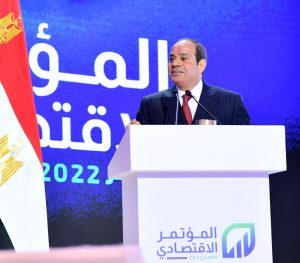
During the opening session of the first day of the conference:
Prime Minister Dr. Moustafa Madbouly delivered a presentation titled:
(The Egyptian Economy Over Forty Years and What Lies Beyond)
He noted that this conference comes amid a global crisis unlike any the world has seen since the Second World War 80 years ago. He pointed out that anyone following current global developments can see that all advanced and economically strong governments, as well as emerging countries, are struggling to survive and ensure the stability of their nations. Egypt is not isolated from these conditions and has been classified by all international institutions as one of the countries most affected by this major global crisis.
The Prime Minister pointed out that the political leadership recognizes the importance of jointly developing a roadmap for the future of the Egyptian economy, formulated by the government alongside experts, specialists, the business community, and political parties. He also touched on the current situation and future of the economy, aiming to produce a clear roadmap for it in the coming period.
This roadmap needs to include two parts:
First: Recovering from the short-term global crisis.
Second: Formulating solutions to some of our chronic problems that require action over the medium and long term.
We also see the objectives of the Economic Conference:
- Addressing the challenges imposed by economic crises.
- Developing a roadmap to advance Egyptian industry.
- Outlining the general features of the state ownership policy document and competitive neutrality.
- Discussing mechanisms to boost the role of the non-banking financial sector.
- Examining the state’s urgent plan to empower the private sector in economic activity.
- Exploring opportunities and prospects for partnership with international and regional financial institutions.
- Developing a roadmap to increase private sector participation in the healthcare sector.
- Examining state efforts to maximize the benefits of real estate wealth.
- Formulating a future roadmap for the energy sector.
- Reviewing the roadmap to maximize high-tech exports.
- Laying out the contours of a roadmap to maximize agricultural production and enhance self-sufficiency levels.
- Reviewing available opportunities for private sector participation in the transport sector.
- Providing a major opportunity for non-attendees to express their views through the website, alongside launching a mobile app for the conference.
- The primary goal of the conference is to listen to the largest possible number of ideas and perspectives from everyone, reflecting openness and the government’s eagerness to benefit from both attendees and non-attendees without missing any opportunities related to the conference.
- Producing a roadmap for action to advance the comprehensive development that is already underway in Egypt over the past 8 years, and continuing it at higher rates.
The results and outcomes of the Economic Conference represent the pillars and foundations of the reform path.

We also note the key recommendations of the conference:
Recommendations for developing the industrial sector:
- Swiftly finalizing the integrated vision for the national industry strategy, utilizing priority industries, and deepening local manufacturing.
- Developing industrial exports through programs such as export subsidy repayment, registering procedures for entering new markets, and activating the role of commercial representation offices and international exhibitions.
- Enhancing the role of the Ebda initiative in supporting the industrial sector.
- Activating the law prioritizing local products to promote them in national state projects.
- Turning industrial zones into integrated residential cities and working to provide housing for workers to lower commuting costs or grant land to factories.
Recommendations for Priority Economic Sectors:
- Unifying the entity responsible for collecting fees from tourism investors.
- Speeding up the issuance of executive regulations for Law No. 8 of 2022 on hotel and tourism establishments.
- Expanding domestic manufacturing of railway rolling stock, electric traction units, and spare parts to build a reliable industrial base and save foreign currency.
- Involving the Egyptian and foreign private sector in managing and operating all transport facilities to transfer expertise, ensure good service for users, and maintain the facilities, while working to amend the governing legislation, laws, and regulations.
References:
Information and Decision Support Center of the Cabinet, Egypt Economic Conference 2022 page info@eec2022.gov.eg


Latest video
تابع معنا تحليل قراءة الصحف اليومية مع الكاتب الصحفي Hany Sallam عبر