
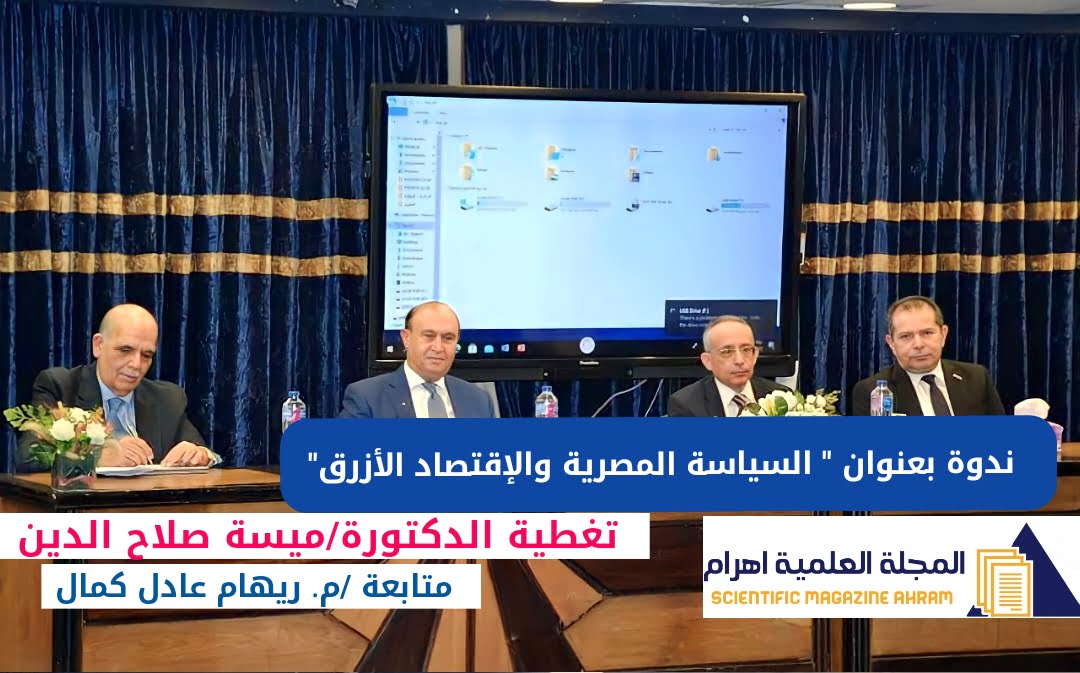

Seminar Entitled “Egyptian Policy and the Blue Economy”
Coverage by / Dr. Maysa Salah El-Din
Follow-up by / Eng. Reham Adel Kamal
Under the patronage of Dr. Abdel Aziz Konsowa, President of Alexandria University, the Faculty of Economics and Political Science held a seminar titled “Egyptian Policy and the Blue Economy” yesterday afternoon, Tuesday, December 6, 2022, in cooperation with the Egyptian Maritime Salon at the main conference hall in the faculty’s headquarters.

The seminar was attended by Admiral Mohab Mamish, Advisor to the President of the Republic for Ports and the Suez Canal Axis; Dr. Mohamed Ali Ibrahim, Professor of Logistics and Advisor to the President of the Arab Academy for Science, Technology and Maritime Transport; Dr. Ashraf El-Ghandour, Vice President of the University for Graduate Studies and Research; Dr. Ahmed Wahban, Dean of the Faculty; Ambassador Mazid Al-Houshan, Consul General of the Kingdom of Saudi Arabia; His Grace Bishop Abraam Emile, Deputy of the Patriarchate in Alexandria; members of the Senate; several former navy commanders; thinkers of the Egyptian Maritime Salon; representatives of Alexandria civil society; and faculty members and students.
During the seminar, which was moderated by Dr. Mamdouh Mansour, Head of the Political Science Department at the faculty, Admiral Mohab Mamish emphasized the importance of the Suez Canal in global trade as the most important waterway connecting the East to Europe. He discussed its history and the major international crises and conflicts it has weathered, and spoke about recent development projects carried out under the directives of President Abdel Fattah Sisi, President of the Republic. These projects included the duplication of the canal, development initiatives for the adjacent economic zone, and efforts to modernize Egyptian seaports and raise the efficiency of the maritime transport sector.
Admiral Mohab Mamish: “The Suez Canal is the lifeline of the Egyptian national economy; our ancestors dug it with their blood so that future generations would benefit from it.”

- He noted that: “Regarding the New Suez Canal, we decided to develop ourselves. The idea was Egyptian, President Abdel Fattah Sisi’s decision was Egyptian, and the planning and execution were Egyptian. We Egyptians are capable of developing ourselves without seeking help from anyone. Everyone who manages the canal is Egyptian, and they manage it with great efficiency.”
- He said: “There was a problem in the Suez Canal, where the northbound convoy used to meet the southbound convoy head-on, and one of them had to wait for 11 hours. After digging the new canal, each convoy travels in a different direction, and there is no waiting time at all. We calculated the canal’s revenues after the opening of the new canal and reached figures we never dreamed of, and its profits will reach $8 billion by the end of 2023.”
- He continued: “The funds collected to dig the Suez Canal—their profits were distributed on schedule every 3 months and were never delayed on any day. At the end of the period, people got their money back in full, and the matter was very clear. We implemented many projects in the region with Egyptian money.”
In his speech, Dr. Ashraf El-Ghandour conveyed the greetings of Dr. Abdel Aziz Konsowa to the meeting’s guests, expressing his happiness at participating in this scientific seminar. The event sheds light on key development projects in maritime transport and the blue economy through the sustainable use and preservation of water resources—namely oceans, seas, lakes, and rivers—with the aim of directing economic growth, improving livelihoods, and creating jobs while ensuring respect for the environment, cultural values, and biodiversity.
Dr. Ahmed Wahban, Dean of the Faculty, pointed to the importance of the seminar’s topic in opening new horizons of knowledge for the faculty’s students and researchers regarding the blue economy, which involves the proper management of water resources and reliance on seas and oceans for sustainable development, poverty eradication, and food self-sufficiency.
Meanwhile, Dr. Mohamed Ali Ibrahim, Advisor to the President of the Arab Academy for Maritime Transport, pointed to the emergence and development of the blue economy concept and the role of maritime transport in economic development and the global economy. He reviewed several development projects carried out in Egypt and Arab countries, particularly in the Arabian Gulf and Southeast Asia, in the field of maritime transport.


Latest video
تابع معنا تحليل قراءة الصحف اليومية مع الكاتب الصحفي Hany Sallam عبر