

Written by Prof. Manar El-Sayed Abdel-Raouf
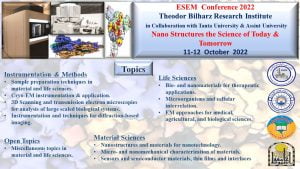
The 2022 conference of the Egyptian Society for Electron Microscopy has concluded, held in cooperation with Tanta University, the Theodor Bilharz Research Institute, and Assiut University. The conference was chaired by Prof. Soheir Moursy, President of the Society and Professor of Pathology and Electron Microscopy at the Theodor Bilharz Research Institute, with Prof. Naglaa Sarhan, Secretary General of the Society and Professor of Histology and Cell Biology, serving as secretary under the title: Nanostructures: The Science of Today and Tomorrow.
Nanostructures: The Science of Today and Tomorrow
The conference was organized virtually via the Webex platform under the patronage of Prof. Mahmoud Zaki, President of Tanta University; Prof. Hanan Farouk, Acting President of the Theodor Bilharz Research Institute; and Prof. Ahmed El-Menshawy, Acting President of Assiut University, with follow-up from Tanta University’s technical support team. The conference opened with a speech delivered on behalf of the President of Tanta University by Prof. Kamal Okasha, Vice President of Tanta University.
A large number of researchers from various universities and research institutes across Egyptian governorates, alongside several Arab and foreign countries, followed the conference. The event featured scientists speaking from the Theodor Bilharz Research Institute, Assiut University, Damietta University, Delta University, the National Research Centre, the Petroleum Research Institute, and the Research Center of Excellence for Multidisciplinary Sciences at Assiut University, as well as from the United States and the Netherlands. The conference sessions were chaired by professors from Benha University, Mansoura University, Sphinx University in Assiut, Zagazig University, Ain Shams University, and the Radiation Technology Department of the Atomic Energy Authority, who work in and care about the field of electron microscopy.
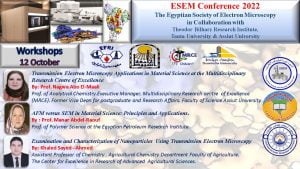
The conference proceedings featured several distinguished sessions and lectures on the uses and importance of electron microscopy in nanotechnology.
The conference stood out by including three workshops broadcast from the Research Center of Excellence for Multidisciplinary Sciences at Assiut University, the Petroleum Research Institute in Cairo, and Damietta University, covering how to pass and examine nanostructures and providing an overview of these specialized centers.
These workshops took place on the second day of the conference. They began with a workshop organized by the Research Center of Excellence for Multidisciplinary Sciences at Assiut University on the role of the transmission electron microscope in materials science. The workshop was chaired by Prof. Nagwa Abou El-Maaly, Executive Director of the Center, and featured a video presentation on the preparation of nanosheets carried out by Assoc. Prof. Mohamed Abdel-Majeed, Dr. Hany Abdel-Hamid, and Dr. Asmaa Yahya. The second workshop, broadcast from the Petroleum Research Institute, included a valuable lecture delivered by Prof. Manar El-Sayed Abdel-Raouf, Professor of Polymer Chemistry at the Petroleum Research Institute, in cooperation with assistant researcher Alaa Ibrahim, on atomic force microscopy, which is one of the latest scanning microscopes used to visualize and characterize nanostructures and study their electrical and magnetic properties. Prof. Manar Abdel-Raouf explained that this microscope was purchased through a research project funded by the Science, Technology and Innovation Funding Authority, and noted that this instrument is the only one of its kind in Egypt. The lecture included a practical explanation of how to use the device and its importance, and displayed a number of images captured by the device to compare its output with that of electron microscopes. Prof. Manar Abdel-Raouf recommended documenting cooperation between electron microscope units, activating the role of the atomic force microscope, and raising awareness of its importance in materials science.
The third and final workshop was presented by Prof. Khaled Ahmed, Supervisor of the Center of Excellence for Advanced Research in Agricultural Sciences at Damietta University, on the uses of electron microscopy in agricultural sciences, with assistance from Engineer Ola Adel and Engineer Shaimaa Kamel, regarding the importance of the transmission electron microscope in preparing and characterizing nanostructures in agriculture.
Among the most important recommendations of the conference, delivered by conference president Prof. Soheir Moursy, was the need to focus on investing in electron microscopy science due to its tremendous impact on technological progress. It has achieved massive progress over the past few years, with an impact that extends not only to clarifying the underlying cause of epidemics or health-threatening diseases, but also to its importance across various research and development sectors. Therefore, investing in this field in terms of technology transfer, expertise, equipment, and maintenance to narrow the gap between us and developed countries has become a necessity.
It is important to realize that diagnosis using an electron microscope is a science and not merely a tool. With this rapid technological development, we need to enhance the specialization of electron microscope examination and build a specialized team. Continuous development and raising the efficiency of professionals in this field have also become essential.
The transmission electron microscope plays a critical role before and during the outbreak of infectious diseases.
The Egyptian Society for Electron Microscopy will discuss in its upcoming board meeting the possibility of offering a series of training and study courses in the field of electron microscopy, with an accredited certificate granted in cooperation with an Egyptian university.


Latest video
تابع معنا تحليل قراءة الصحف اليومية مع الكاتب الصحفي Hany Sallam عبر