

Prepared by: Prof. Osama Maher Hussein – Professor of Curriculum and Foundations of Education – National Center for Educational Examinations and Evaluation – Cairo.
Recently, the Minister of Education in the new Egyptian government, Dr. Mohamed Abdel Latif, launched a whirlwind tour of most of Egypt’s governorates in search of urgent solutions to classroom overcrowding and teacher shortages before the start of the new academic year.
These efforts reflect the ministry’s growing concern over the challenges facing the educational system, yet they raise questions about the effectiveness of these moves if they are not accompanied by fundamental changes.
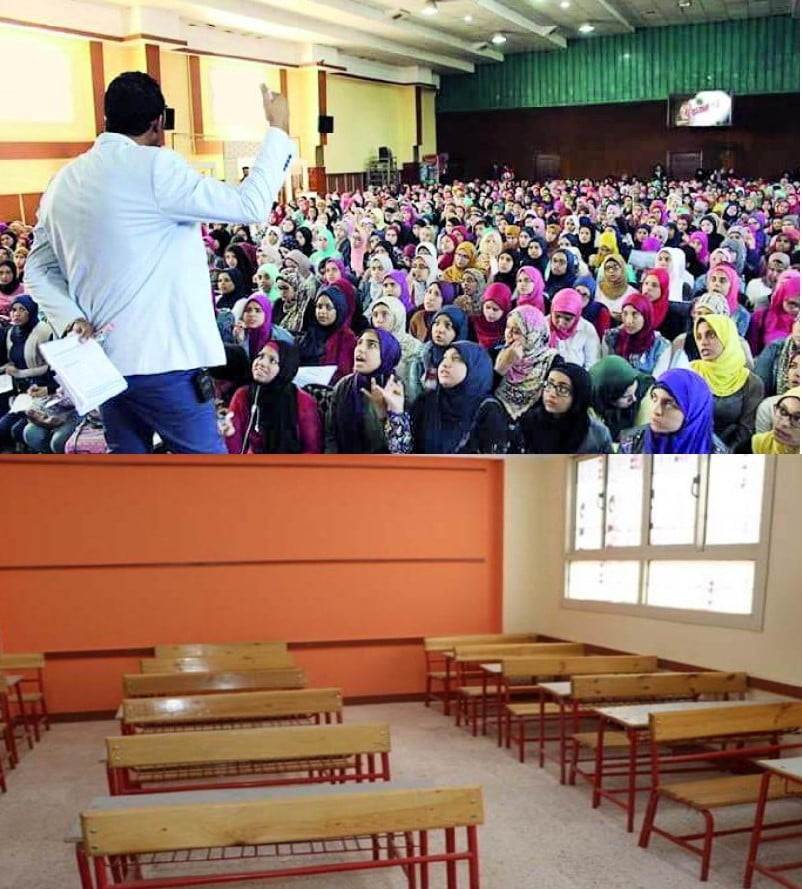
On the other hand, we are witnessing a peculiar phenomenon manifested in the heavy influx of students into educational centers, known as private tutoring centers. In these centers, poorly equipped halls accommodate 150 male and female students in a single lecture, and yet not a single student shows any distress. On the contrary, everyone is joyful and interacting with the teacher and friends, and the teacher is in an excellent mood despite the large number that the ministry is scrambling to find urgent solutions for.
This stark contradiction raises an important question: Where is the flaw? Why do these centers overflow while classrooms empty out just one week after the school year begins?
First: The Crisis of Empty Classrooms
As the academic year begins, classrooms quickly empty out of students, especially in basic education and public certificate stages. This reality forces us to question the effectiveness of the current educational system and its ability to meet the needs of students and parents. Empty classrooms reflect a deeper problem regarding the quality of education and the extent to which students engage with curricula and teachers inside schools.
Second: Analyzing the Phenomenon from a Multidimensional Perspective:
1- Ideological Factors:
o Loss of trust in the formal educational system.
o Parents’ desire for their children to receive a better education, even at a high cost.
o Spread of a culture of “achievement” rather than a culture of “learning.”
2- Economic Factors:
o Rising cost of education in private schools.
o Weak purchasing power among some families, forcing them to rely on private tutoring as a cheaper alternative.
3- Educational Factors:
o Shortage of qualified teachers.
o Poor state of school infrastructure.
4- Psychological and Social Factors:
o Students feeling bored with the curricula and teaching methods practiced inside school classrooms.
o Students’ desire for extra support and greater interaction with teachers.
o The impact of social pressures on parents to push their children to take private lessons.
5- Negative Parental Interference in the Educational Process:
Ever since parents began interfering negatively in the educational process, noticeably influencing educational decision-making, and directly pressuring public opinion through various media channels—most notably and famously social media—the level of education has deteriorated beyond what it was before 2011. This occurs through:
• Practices that hinder teachers’ work:
o Some parents interfere with teachers’ work by questioning their abilities or criticizing their methods, which hinders their work and affects their focus.
• Psychological pressure on students:
o Some parents exert psychological pressure on their children to achieve excellent academic results, which negatively affects their mental health and reduces their motivation to learn.
• Politicization of the educational process:
o Some parents attempt to use the educational process to achieve political or ideological goals, leading to community division and student distraction.
• Public opinion influence on educational decisions:
o Some parents pressure public opinion through social media to influence educational decisions, which may lead to decisions inconsistent with the best interests of students.
Third: The Economic Crisis and Its Role in Students Shunning School Attendance:
“The economic crisis significantly affects parents’ decisions regarding their children’s education. General price rises force many families to cut back on expenses, and education becomes one of the priorities they can compromise on. Instead of paying hefty school fees, higher daily transportation costs to school, and the cost of daily meals, some families find that sending their children to educational centers near home is a more economical solution, as they can save on transport and school meal expenses. Private tutoring also offers greater flexibility in scheduling and suits the busy work schedules of some families.”
Fourth: Urgent reform steps for the educational process to address this crisis and contribute to building a strong educational system that meets students’ needs.
1- Reform steps at the government level:
• Improving teacher salaries and providing them with social and health care:
o Significantly improving teachers’ salaries is the first step to elevating their status and motivating them to work better. To this end, a percentage of the profits of companies and institutions that benefit directly or indirectly from the education sector and all related services and activities—such as telecommunications, electricity, water, gas, pharmaceutical, and petroleum companies—can be allocated to help provide a good education for Egyptian citizens.
o Social and healthcare support must be provided to teachers and their families to ensure they feel secure and stable during their service and also after retirement.
• Curriculum Development:
o Curricula must be regularly reviewed and developed to suit the demands and needs of the modern era.
o Focus must also be placed on developing students’ critical thinking and creative skills, rather than on rote memorization.
• Improving School Infrastructure:
o A safe and comfortable learning environment must be provided for students by improving school infrastructure. All of this can be implemented through contributions from the companies and institutions mentioned earlier in this article.
o This includes providing adequate sanitation facilities, classrooms equipped with the latest educational tools, and sports fields and green spaces for athletic and recreational activities.
• Increasing the Number of Qualified Teachers:
o The number of qualified teachers must be increased periodically, as emphasized by the President of the Republic, while directing them to attend intensive training programs that help them develop their skills and update their knowledge.
o The teacher selection process must also be improved to ensure the recruitment of the best and most competent candidates, which is what has recently been done with new teachers.
• Tightening Oversight of Private Tutoring Centers:
o Oversight of private tutoring centers must be tightened to ensure the quality of education they provide.
o It must also be ensured that students are not exploited through exorbitant fees or unsuitable instruction.
o If deciding to close these outlets proves difficult, the government must establish administrative regulations for dealing with them. Chief among these are restricting their operating hours to between 6:00 PM and 10:00 PM, with extended working hours on public holidays, similar to the government’s approach to energy conservation across all sectors.
• Spreading Awareness of the Importance of Self-Education and E-Learning:
o Awareness of the importance of self-education and e-learning must be spread among students and parents.
o Additional electronic educational resources must also be provided to enable students to learn independently and continuously develop their skills.
• Involving All Stakeholders in Educational Reform:
o All stakeholders must be involved in the educational reform process, including the Ministry of Education, schools, parents, civil society, and the private sector.
o Through cooperation and partnership, we can ensure the success of the reform process and build a sustainable educational system that meets the needs of all parties.
2- Reform Steps at the Individual Level:
• Supporting the Formal Educational System:
o Parents must support the formal educational system instead of relying primarily on private tutoring, ensure that students attend school daily across all educational stages, and emphasize that school attendance benefits students’ mental and social health alongside academic achievement.
o Communication channels should be opened between parents and teachers under guidelines set by each school to monitor their children’s academic progress, encourage them to participate in school activities, and communicate with teachers regularly.
3- Community Participation in Education: A Necessity with Proper Guidance:
Parental involvement in the educational process is necessary to improve the quality of education, but this participation must be properly directed to ensure it does not negatively impact the flow of the educational process. This is achieved through the following:
Activating Channels of Dialogue and a Culture of Constructive Dialogue: Channels of dialogue between parents, school administration, and teachers must be activated to create an environment of cooperation and mutual trust.
Clearly Defining Each Party’s Responsibilities: The responsibilities of each party in the educational process must be clearly defined to prevent overlapping jurisdictions and effectively map out the course of action.
Educating Parents on Their Role in the Educational Process: Parents must be educated about their positive role in the educational process and how to help their children without interfering with teachers’ work or influencing pedagogical decisions.
Participating in Educational Activities: Parents should be encouraged to participate in various educational activities, such as attending school events, volunteering in educational programs, and supporting extracurricular activities.
Involving the Private Sector in Supporting Education: The government can encourage the private sector to participate in supporting education by providing scholarships, contributing to school infrastructure improvements, and offering teacher training programs.
Motivating civil society: Encouraging civil society and non-governmental organizations to provide the necessary support to students through educational programs and financial support for families in need.


Latest video
تابع معنا تحليل قراءة الصحف اليومية مع الكاتب الصحفي Hany Sallam عبر