

Abdullah Saeed Al Habsi, MIoL
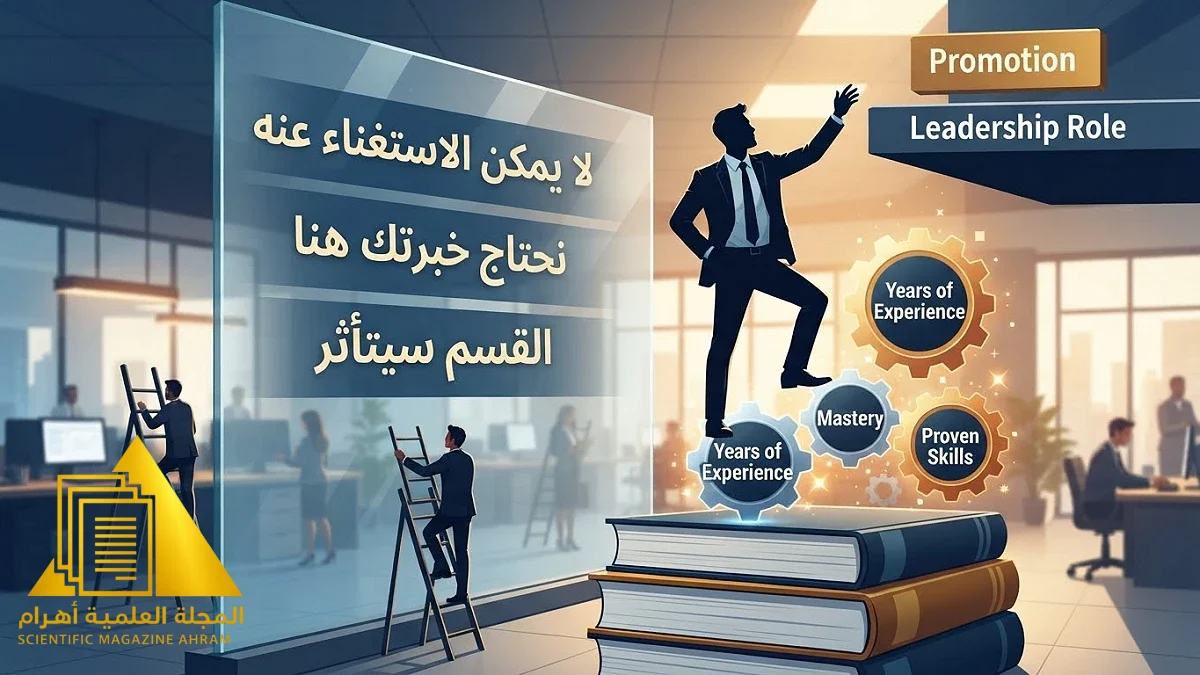
Professional experience is supposed to help employees advance in their careers, turning years of work and mastery into greater opportunities for responsibility and leadership. Yet some organizations create a strange paradox: the more proficient employees become at their jobs, the harder it is to move them to higher positions, not because they are unqualified for promotion, but because organizations fear losing them from their current posts.
Thus competence, which is meant to open doors, turns into an unspoken reason for closing them.
An employee may work for many years in a sensitive department, master its details, understand the problems that do not appear in written procedures, and become a point of reference for colleagues and managers. When a promotion opportunity arises, they discover that their name is not advancing on the list of candidates. They may even hear phrases that appear on the surface to be praise, such as: “We cannot do without him,” “The department will suffer if she leaves,” or “We need his expertise in his current place.”
These phrases may be operationally correct, but they become a management problem when used to keep employees in place at the expense of their future.
When an Organization Punishes Its Outstanding Employee
Organizations need experienced employees, especially in roles that rely on accumulated knowledge and decision-making under pressure. However, retaining expertise should not mean keeping its holder at the same job grade indefinitely.
Promotion is not merely a reward for the past, but a decision concerning an employee’s ability to shoulder new responsibilities. Therefore, their eligibility should be assessed according to the requirements of the higher role, rather than the scale of the disruption that their transition from their current job might cause.
If employees are qualified for leadership, the need for them in their old posts does not prove their unsuitability for new ones. Rather, it may expose an organization’s over-reliance on a single person and its poor readiness for knowledge transfer and preparing backups.
As a result, organizations address organizational problems at the expense of well-deserved career opportunities.
Knowledge That Is Not Transferred Becomes a Risk
In risk management and business continuity, relying on a single person for a vital activity is not considered a healthy situation, even if that person is extremely competent. Employees might fall ill, move to other organizations, retire, or be forced to leave work suddenly.
At that point, management discovers that many operational procedures were not saved in systems, but rather in the memory of a single individual.
Here another paradox appears: the organization that barred employees from promotion because it could not do without them may be the very same one that failed to invest in preparing someone who could take over their responsibilities.
Outstanding employees should be sources for building institutional capability, not turn into sole warehouses of knowledge. Management has a duty to draw on their expertise in training, documentation, and process development, while ensuring at the same time that their knowledge does not become a reason to derail their career paths.
Does a Manager Fear Losing Competence or Losing Control?
Not every case of delayed promotion can be explained by the fear of losing an employee. There may be legitimate considerations concerning the number of available positions, leadership skills, or evaluation results. But the problem begins when these criteria are vague, or when the reasons for excluding employees shift every time one of them is addressed.
In some cases, managers may feel that the departure of outstanding employees will expose team weaknesses or place the responsibility of preparing replacements on them. They may prefer short-term stability at the expense of developing employees.
This behavior, if it occurs, reveals a flaw in managers’ own evaluation systems. Managers whose success is measured solely by the continued performance of their departments may find an interest in keeping their best employees, whereas managers who are also evaluated on their ability to prepare new leaders will be more willing to support their promotions.
Thus the problem is no longer merely an individual decision, but becomes the outcome of how administrative incentives are designed.
How Do We Prevent Expertise from Becoming a Constraint?
Remediation begins by separating two different criteria: an employee’s importance in their current role, and their eligibility for the position they seek. The first relates to operational needs, while the second relates to competence, merit, and readiness to assume new responsibilities.
Next comes the role of succession planning. Organizations should not wait for positions to fall vacant before beginning the search for replacements. It is possible to identify roles dependent on individual expertise, establish cross-training programs, document procedures, and distribute knowledge among multiple employees.
Human resources should also possess clear means to review cases of delayed promotion among outstanding employees, especially when the stated reason is the difficulty of doing without them.
This does not mean every experienced employee automatically deserves a promotion; some leadership roles require different capabilities than technical excellence. But employees have the right to know the criteria by which they are evaluated and to receive fair opportunities to prove their readiness.
It may also be useful to provide career progression pathways for experts who do not wish to go into management. Promotion should not force high performers to turn into managers just to receive career and financial recognition commensurate with their value.
Management Success Shows in Who Advances After Them
A strong organization does not fear promoting an exceptional employee because it has prepared someone who can carry on the work after that employee moves on. It does not view the transfer of knowledge as a personal loss for the manager, but rather as a success in building a team capable of continuing.
Meanwhile, an organization that relies on keeping experienced staff in their positions out of fear of a vacuum postpones addressing its organizational weakness, and pays the price in the form of employee frustration, a decline in motivation, and the possible loss of skilled talent.
Experience should grant its holder broader choices, rather than narrowing their career future.
When an organization says an employee is indispensable, that should be the beginning of an important management question: why have we not prepared someone who can succeed them?
An organization that blocks an employee’s promotion because it needs them may lose them entirely because it did not give them the chance to advance.
About the author:
Abdullah Saeed Al Habsi, MIoL
Emirati writer and researcher in security, heritage, risk management, leadership, and operations rooms.
Member of the Institute of Leadership (UK).
A.S. Alhebsi


Latest video
تابع معنا تحليل قراءة الصحف اليومية مع الكاتب الصحفي Hany Sallam عبر