
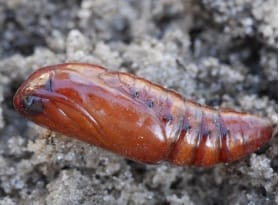

Fall Armyworm
Scientific Name: Spodoptera frugiperda (Lepidoptera: Noctuidae)
Naming:
It is called the fall armyworm because the insect’s behavior involves attacking the host in massive swarms of caterpillars. Once they finish off a host, these swarms move to neighboring fields, and their activity peaks during the autumn season.
Geographical Distribution:
It is found across all continents: in Asia, in India and Yemen; in Europe, in Germany and Slovenia; across most of North, South, and Central America; and in most African countries. This pest is widely distributed in eastern and central North America and in South America, and has invaded Africa since 2016, causing significant damage to corn crops. This pest has great potential for further spread and economic damage. Since its discovery in Africa, it has spread to 28 countries, including Sudan, and the insect was officially recorded in Egypt in May 2019. This worm has spread to many countries around the world through international trade and the movement of its various life stages.
Economic Damage:
The damage caused by this pest depends on several factors, including crop type, cultivated variety, environmental conditions, growing season, soil fertility, the level of attention given to agricultural practices, and farmer awareness.
Studies have shown that the damage resulting from this pest is not devastating, although some studies have indicated that crop loss rates may reach 50%, and field experiments have shown that loss rates did not exceed 20% even during severe infestations that could reach 100%, since the corn plant has the ability to compensate for damage sustained by the leaves, especially under proper irrigation and nutrition. Studies noted that medium densities of 0.2 to 0.8 larvae/plant during the late stage can reduce productivity by 5 to 20%.
Hosts:
This worm infests nearly one hundred plant hosts from the Brassicaceae, Solanaceae, Poaceae, Rutaceae, Cucurbitaceae, and ornamental plant families, and under Egypt’s conditions, it has been recorded primarily on maize.
How to Identify the Fall Armyworm:
The caterpillars are characterized by the presence of a frontal suture in the shape of an inverted Y, four crescent-shaped dots on the segments of the caterpillar’s back, and four black dots forming a square on the second-to-last dorsal segment.
Symptoms of Infestation and Damage:
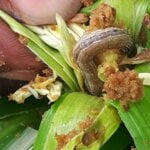
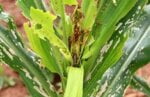
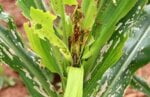

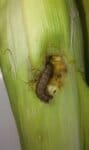

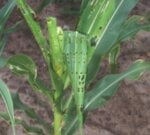



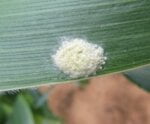
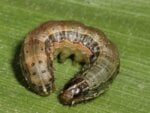
The caterpillars mostly feed on the leaves of the whorl of the corn heart, where they hide inside and chew them. As growth continues, various degrees of missing leaf area appear, which may reach up to half—this is one of the characteristic symptoms of this pest. Sometimes, when the population increases, they cut down the plants. The caterpillars also infest the ears, and this infestation coincides with the European corn borer. Usually, these ears are unfit for human consumption. The direct feeding of the worms does not affect the edibility of the corn ear, but most of the damage comes from making the corn ears more susceptible to mold and the presence of aflatoxins, which are toxic to humans.
The caterpillars cause damage by consuming foliage. Initially, young caterpillars consume leaf tissues from one side, leaving the opposite epidermal layer intact. In the second or third instar, the caterpillars begin to make holes in the leaves, eating from the edge of the leaves inward. Feeding in the whorled corn funnel often results in a characteristic row of holes in the leaves when they unfold. When the infestation is severe, the caterpillar drops and chews the plant above the soil surface, causing it to dry out, resembling the cutworm. Caterpillar density usually drops to 1 or 2 per plant when they feed close to each other, due to cannibalistic behavior; larvae of this pest exhibit this phenomenon, where larvae of the same species attack each other during crowding and food scarcity. The feeding of large caterpillars causes severe damage, often leaving behind only the veins and stalks of the corn plants, and the plant takes on a ragged appearance.
Reasons for the Danger of the Fall Armyworm
*Wide host range (infests about 100 hosts)
*Exceptional reproductive capacity (the female lays 1,500 eggs during her lifespan)
*Ability to hide (caterpillars hide inside the funnel and block it with masses of feces)
*High flight and dispersal capacity (moths are strong fliers that can travel 100 km/night)
*Voracious feeding (feeds on all parts of the plant)
*Ability to develop pesticide-resistant strains
*Short life cycle duration (30 days)
Life Cycle:


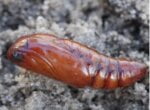
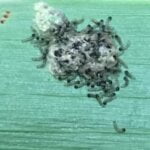
The lifecycle of this insect takes from 30 days during the summer to 60 days during spring and autumn, while this period extends during the winter to reach about 80 to 90 days. The number of generations per year varies depending on the climate, and the female lays about 1,500 eggs during her lifespan. Females prefer to lay eggs on the lower surface of leaves in masses, at the base of the stalk where the leaf connects to the stalk, but in high populations, they place them almost anywhere. The eggs hatch after 2 to 3 days into first-instar larvae that are light-colored with a larger, dark head. As the larval instars grow, they turn brown with longitudinal white stripes, and dark spots appear at the bases of the spines on the dorsal surface. They usually have six larval instars and cannot enter diapause, so they cannot survive in extremely cold temperatures. They are present from April to December, and the population drops significantly in winter. Pupation usually takes place in the soil at a depth of 2 to 8 cm, where the larva spins an oval cocoon 20 to 30 mm long by binding soil particles with silk threads secreted from its mouth.
Integrated Pest Management (IPM) for Fall Armyworm
Early planting, avoiding planting in the Nili season, and avoiding hot summer months.
Growing vigorous hybrids to withstand infestation.
Good soil tillage through deep ploughing to expose the stages present in the soil to natural enemies and environmental conditions.
Leaving distances between rows to allow chemical control in the later stages of plant growth, or planting with a spreading crop such as cucurbits or soybeans, as corn intercropped with soybeans has been found to have lower infestation.
Increasing plant density during planting and disposing of infested plants during thinning.
Collecting egg masses and recent hatches in small areas by inspecting fields twice a week at the beginning of the crop’s life during the vegetative growth stage, and once every week or two during later growth stages.
Collecting larvae by hand and destroying them.
Disposing of previous crop residues.
Disposing of severely infested fields by shredding them and turning them into silage.
Keeping fields clean of weeds.
Not intercropping corn with winter crops that serve as a shelter for the pest during this period, and disposing of them.
Irrigation with solar fuel eliminates a large portion of the stages present in the soil.
Traps equipped with a fall armyworm pheromone capsule can be used to predict the severity of the infestation and prepare to deal with it.
There are many parasites on eggs and larvae, as well as predators of eggs, larvae, and pupae, along with bacterial, fungal, and viral pathogens and predatory nematodes.
Chemical Control Program
The Agricultural Pesticides Committee recommended chemical treatment for the fall armyworm with the following pesticides:
Goldbin 90% SP at a rate of 300 g/feddan.
Vanti 21% SC at a rate of 240 cm3/feddan.
Eizo 30% WG at a rate of 60 g/feddan.
Spido 5.7% WG at a rate of 80 g/feddan.
Coragen 20% SC at a rate of 60 cm3/feddan.
Protecto WP 9.4% at a rate of 400 g/feddan.
Rubic WP 50% at a rate of 100 g/feddan.
Radiant SC 12% at a rate of 65 cm3/feddan.
Octocod SC 9.75% at a rate of 350 cm3/feddan.
Professor Dr. Magdy Farouk El-Samahy
Professor of Nanotechnology and Plant Protection – Plant Protection Research Institute
Scientific Supervisor for the Fall Armyworm in Kafr El-Sheikh Governorate


Latest video
تابع معنا تحليل قراءة الصحف اليومية مع الكاتب الصحفي Hany Sallam عبر