

Written by Sherin Hamdy
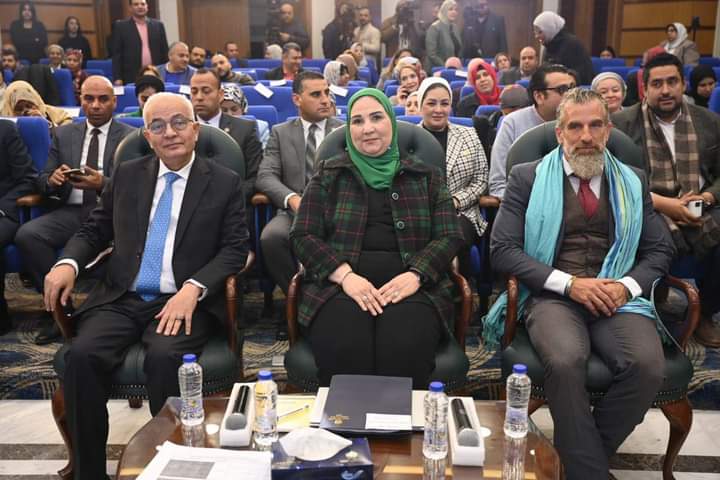
Nevine El-Kabbag, Minister of Social Solidarity, and Dr. Reda Hegazy, Minister of Education and Technical Education, attended a community dialogue held by the National Committee for Positive Parenting under the sponsorship of the Ministry of Social Solidarity to discuss the draft national strategy for positive parenting. The event was attended by Jeremy Hopkins, Representative of the United Nations Children’s Fund (UNICEF), along with representatives from the ministries of health and population, youth and sports, and culture, the National Council for Childhood and Motherhood, the National Center for Social and Criminological Research, Al-Azhar Al-Sharif, the Church, the Coordination of Party Youth and Politicians, and a number of experts and media figures.
The community dialogue aims to build consensus on the main pillars of the national strategy for positive parenting and outline an executive plan that supports positive values within the family, fosters dialogue and participation between spouses, and prevents discrimination among children.
The Minister of Social Solidarity noted that numerous joint files connect the Ministry of Social Solidarity and the Ministry of Education regarding childhood, starting from early childhood and kindergartens to education conditionality for Takaful and Karama, integrating children with disabilities into schools, achieving educational equity, and paying school fees for those unable to afford them. She pointed out that positive parenting provides an integrated framework for raising a child properly, shaping human awareness, and building a positive citizen and sound family that contributes to a strong society.
El-Kabbag added that we are working on a child- and family-centered approach and achieving gender equality in upbringing, noting that studies indicate the first four years shape 60% of a child’s thinking, attitudes, concepts, and behaviors. Therefore, the ministry has focused on developing the nursery curriculum, which will be launched soon and relies on positive upbringing. We are working with the National Council for Childhood and Motherhood and various entities to issue the new Child Law, which emphasizes a balance between rights and duties. We have strong legal backing from the 2014 constitution and Egyptian laws to confront all forms of violence against children, ranging from psychological and verbal abuse to physical violence, especially given the external threats facing family cultural values, alongside multiple forms of violence such as female genital mutilation, early marriage, and child labor.
The Minister of Social Solidarity pointed to a 2021 decree by the Prime Minister forming a national committee for positive parenting that includes various ministries and relevant entities under the chairmanship of the Ministry of Social Solidarity. A positive parenting guide has been prepared, and the ministry has drafted the strategy and put it up for discussion to produce an integrated document addressing the child’s rights across various fields. The strategy reflects the vision of all participating entities, taking into account the Egyptian constitution, international charters, and child rights conventions. In parallel, we focus on upbringing through the “Wai” community development program, which addresses early marriage, illegal migration, and other issues aimed at investing in human capital. Alongside positive parenting, we also run closely related programs such as “Mawadda,” early childhood initiatives, and “2 Kafaya,” while working to reinforce the pivotal role of fathers in positive parenting.
El-Kabbag expressed her gratitude to the President for his sponsorship of the program, noting that he was the first to call for preserving the Egyptian family unit through the Mawadda program, reviewing the Personal Status Law, and amending the Family Insurance System Fund under the umbrella of Nasser Social Bank to provide more resources and services to Egyptian families.
Dr. Reda Hegazy, Minister of Education and Technical Education, stated that sound upbringing is the foundation of education and character building, noting that students’ upbringing is influenced by the school environment and teachers in their personal lives. He said: “If you want to address students’ weaknesses, look for their strengths and work to enhance them so that they develop the desire to overcome their weaknesses, which will fade away and become success stories in their lives.”
The minister explained that early childhood represents the golden years when intelligence develops at its highest rate, emphasizing the need to foster students’ learning motivation and cultivate a love for their studies. He also noted that distinguished and high-achieving students focus on studying and learning without parental intervention, adding that socialization is a collaborative process between the family and the school to shape an exceptional individual who succeeds in society.
The Minister of Education emphasized his keen interest in implementing a training package for social workers and psychologists to support positive parenting among students and spread mental health awareness, in addition to training school principals, noting that implementation will begin with the primary stage.
Dr. Reda Hegazy noted that the evaluation system for the early years of education relies on measuring learning outcomes for updated curricula, with student grades awarded in the form of colors that reflect their acquisition of knowledge and skills.
The minister stressed the need for teachers to identify points of excellence and diagnose weaknesses, and to communicate with parents to understand their children’s levels and participate in all matters related to them.
The minister praised the productive and constructive cooperation with the Ministry of Social Solidarity in numerous initiatives such as Takaful and Karama, and kindergarten, adding that the values and mutual respect curriculum is one of the Ministry of Education’s curricula in the kindergarten stage taught through the primary stage, which includes a set of values that contribute to shaping the child’s personality, namely the values of love, belonging, loyalty, respect for others, tolerance, and perseverance.
The minister also pointed to the presidential initiative “Companions Able Differently,” noting that the ministry has incorporated sign language for the deaf into the values and mutual respect books from the kindergarten stage to the third grade of primary school, particularly the most commonly used signs, pointing out that the ministry has 114,000 integrated children in Ministry of Education classrooms.
The minister continued that the Ministry of Education developed its 2024–2029 strategic plan through three government programs that include building the Egyptian individual, employment and security, and sustainable development goals, emphasizing that the ministry attaches great attention to people with disabilities, women, and children in the strategic plan and addressing challenges, gaps, and priorities, noting that the ministry works through sustainability and collaboration with all other entities and ministries within the government, while giving priority to people with disabilities, children, and women.
Meanwhile, Jeremy Hopkins, UNICEF Representative in Egypt, affirmed that UNICEF is always committed to supporting the Egyptian government in adopting family-friendly policies that are taken into account across all areas, stressing that studies indicate that children who experience positive parenting enjoy warmth, consistent discipline, and non-violent behavior, and develop cognitive skills, communication skills, and self-control better than others who do not grow up under such positive parenting. Furthermore, these children will be able to pass these skills on to future generations, ensuring the continuity of healthy relationships between parents and children across generations, and contributing to reducing multidimensional poverty among children.
For her part, MP Amira El-Adly, a member of the Youth Leaders and Politicians Coordination, thanked the Ministry of Social Solidarity for inviting her to participate in the social dialogue on the draft national strategy for positive parenting, noting that she rarely finds a strategy that has impact measurement, evaluation, and monitoring mechanisms, which is a good indicator for monitoring the strategy’s pillars.
She added that the Supreme Council for Media Regulation can play an important role in the strategy, particularly regarding codes related to drama, awareness campaigns, and dramatic and cultural production, emphasizing that it is important for the council to have a role in the strategy.
El-Adly called for outlining the specific requirements from the legislative environment and laws that need amendment so that the House of Representatives can cooperate in them, requesting the Ministry of Education to work on developing interactive curricula that contain incentives for the child and carry grades.


Latest video
تابع معنا تحليل قراءة الصحف اليومية مع الكاتب الصحفي Hany Sallam عبر