
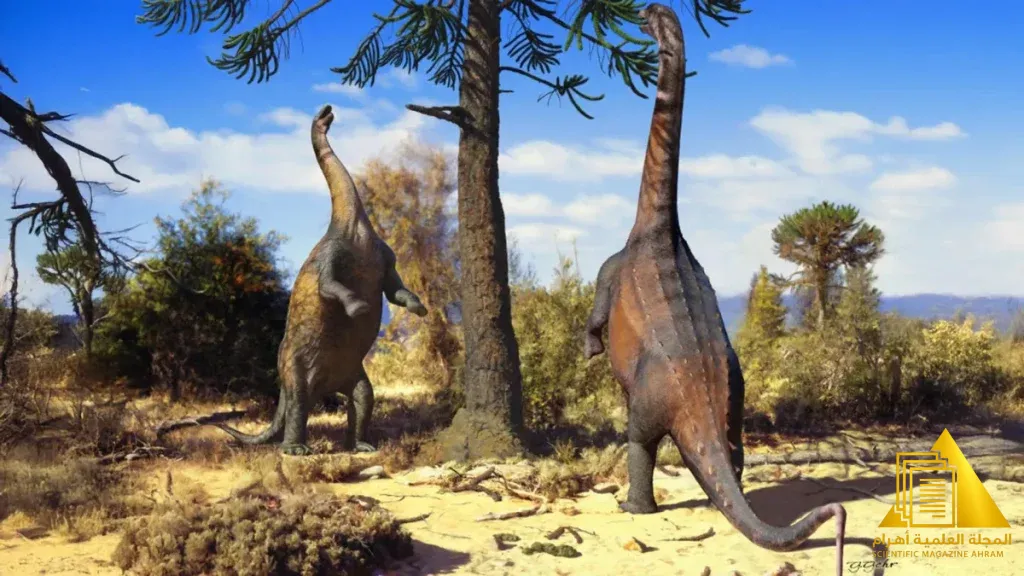

The Mystery of the Two-Legged Giants
We have long associated the image of massive sauropod dinosaurs with a heavy, four-legged gait, roaming the earth slowly thanks to their enormous sizes. However, a recent digital study has turned these concepts upside down, revealing an exceptional ability in these South American creatures to stand on their two hind legs, in a scene very close to human standing, but on a colossal scale.
The Secret of Bone Strength: Stunning Bioengineering
Researchers relied on advanced digital models to simulate the structure of femur bones in these dinosaurs
. The results showed that the femur bones were not merely weight-bearing pillars, but were engineered with precision capable of withstanding immense pressures that older or larger species could not handle. This unique structural strength gave those dinosaurs the agility required to adjust their body posture without their bones breaking under the weight of their mass.
Why Did They Choose to Stand?
Scientists have put forward several hypotheses explaining why these dinosaurs adopted this unique behavior. Standing on two legs was not merely a display of strength, but a vital strategy; it enabled them to reach the tops of tall trees to obtain abundant food away from competitors. It is also believed that this posture was an effective way to scare off predators or even attract the attention of peers during mating seasons.
Challenging Growth and Gravity
What is fascinating about the study is that this ability to stand was linked to the early stages of growth. Once a dinosaur began to gain excessive bulk with age, the laws of physics and gravity became a barrier to adopting this posture. This “motor skill” was an exclusive advantage for juveniles who possessed structural flexibility allowing them to defy gravity, before their giant sizes in adulthood forced them to commit to walking on all fours.
This discovery opens a new window into understanding the nature of dinosaur life, confirming that the natural history of these creatures was much more complex and exciting than we have imagined for decades, leading us to reassess the relationship between bones, environment, and animal behavior in the prehistoric world.
By: Hany Sallam
Source: ScienceDaily


Latest video
تابع معنا تحليل قراءة الصحف اليومية مع الكاتب الصحفي Hany Sallam عبر