
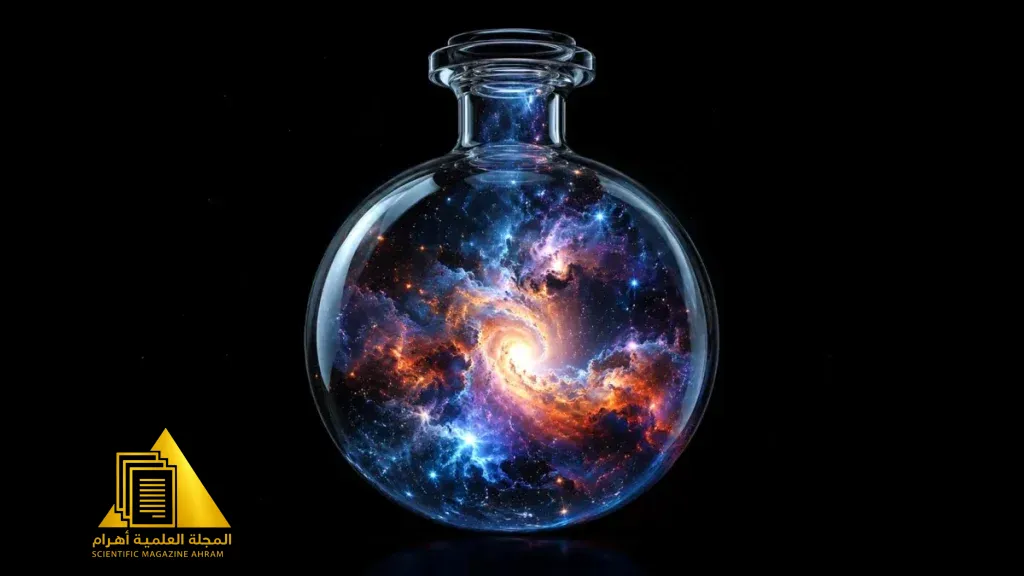

A Journey to the Cradle of Stars Inside the Laboratory
Humans have always looked up at the sky and wondered: How did life begin? Are we alone in this vast universe? Today, the answer is coming one step closer thanks to an astonishing scientific achievement, as researchers have managed to recreate “cosmic dust
” inside laboratory glass tubes, precisely simulating the harsh and fascinating conditions that prevail in deep space.
The Mystery of Complex Molecules
Cosmic dust is not just a collection of random atoms; it is a giant chemical factory. In this pioneering experiment, scientists succeeded in building complex, carbon-rich molecules, which are the fundamental building blocks of life as we know it. What is astonishing is that these laboratory-created materials showed chemical signatures that match exactly those detected by advanced telescopes
from the depths of space, confirming that the simulation brilliantly reflects cosmic reality.
From Space to Earth
These findings open a new window into understanding our origins, as scientists believe that stars do not only produce light and heat, but also act as incubators for organic chemistry. Through collision and accumulation processes, comets and asteroids may have acted as “natural spaceships” that carried these vital ingredients to our planet in its early days, ultimately leading to the emergence of life.
Beyond the Horizons
Studying these samples in the laboratory allows scientists to understand how matter evolves in the environments of young stars. This research not only explains how life began on Earth, but also paves the way for understanding the possibilities of its existence on other planets. If the essential ingredients of life are common in cosmic dust, then the probabilities of life appearing elsewhere in the universe become more logical and closer to scientific reality.
By: Hany Sallam
Source: ScienceDaily


Latest video
تابع معنا تحليل قراءة الصحف اليومية مع الكاتب الصحفي Hany Sallam عبر