
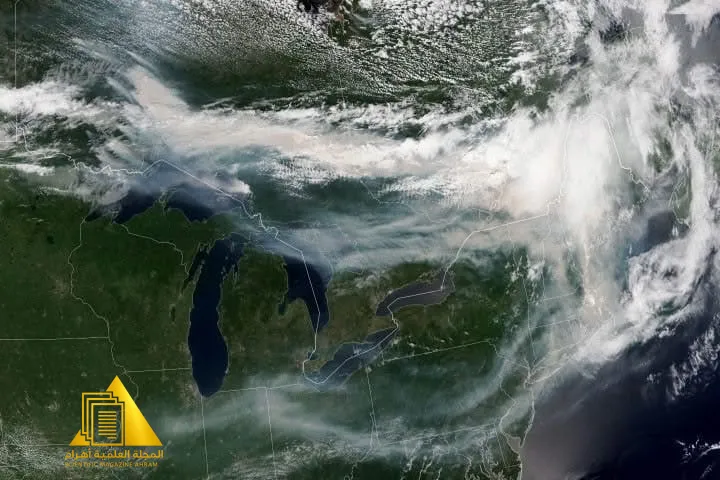

North America is caught in the grip of a severe environmental crisis as recent NASA satellite imagery reveals a breathtaking and formidable sight: giant, gray plumes of smoke cutting across borders to paint a grim picture over vast areas of Canada and the United States. This disaster, which was sparked by the wildfires
raging in Canada’s Ontario province, is no longer a local matter, but has instead turned into a cross-border environmental issue that worries scientists and officials alike.
Space Eye Monitors the Environmental Disaster
Advanced space technology has captured detailed aerial images clearly showing how dense smoke columns from the Ontario fires turned into air currents laden with fine particles. These images were not just a scientific observation, but served as an early warning showing the movement of pollutants through the atmosphere. Pushed by the winds, these smoke clouds crept eastward to completely blanket the sky of the neighboring province of Quebec before continuing their long journey south toward American soil.
The Transcontinental Journey of Smoke
The black cloud
did not stop at political borders, but instead crossed international airspace to reach wide areas of the American Midwest and Northeast. Major cities and distant rural areas suddenly found themselves under a gray cover that blocked direct sunlight, leading to a noticeable temporary drop in surface temperatures and a decline in horizontal visibility. This vast geographical spread proves that climate disasters do not recognize borders, and that what happens in the northern forests can cast a shadow over millions of people thousands of kilometers away.
Health Threats and Doubled Climate Risks
These smoke clouds carry a toxic mix of gases and suspended fine particles (PM2.5), which pose a direct danger to public health. Environmental health experts warn against inhaling this polluted air, which may cause respiratory and heart conditions to worsen, especially among the most vulnerable groups such as children and the elderly. Over the long term, these fires contribute to releasing huge amounts of carbon stored in trees into the atmosphere, which accelerates the pace of global warming and draws the planet into a vicious cycle of drought and successive fires.
An Alarm Bell Calling for Unified Action
What Canada and the United States are witnessing today is not just a passing seasonal incident, but a strong alarm bell reminding us of the consequences of rapid climate change. The continuous rise in global temperatures and long droughts create an ideal environment for such fierce fires to break out and become difficult to control. This worsening situation leaves the international community with a shared responsibility to boost efforts to combat climate change, reduce harmful emissions, and develop regional strategies to face cross-border environmental disasters to protect our planet and the lives of future generations.
By: Hany Sallam
Source: NASA


Latest video
تابع معنا تحليل قراءة الصحف اليومية مع الكاتب الصحفي Hany Sallam عبر