

By Al-Shaimaa Mahmoud Helmy
What Is the Green Economy?
The green economy emerged as a response to multiple global crises. It generally aims to achieve economic development by carrying out environmentally friendly projects and using new technologies in renewable and clean energy. It calls for shifting existing sectors toward a green economy model and changing unsustainable consumption patterns, which creates new jobs aimed at reducing poverty, alongside lowering energy intensity, resource consumption, and production.
Efforts Made Toward the Green Economy:
Egypt is taking successive steps and measures to lead the transition to the green economy across the region. In light of this:
Issuing Green Bonds:
The Egyptian Ministry of Finance issued the Middle East and North Africa’s first sovereign green bond offering in September 2020, worth $750 million with a five-year maturity and a yield of up to 5.25%, helping to put Egypt on the path of sustainable financing. Green bonds are known as debt instruments issued to raise funds dedicated to financing climate- and environment-related projects.
Green Economy Projects:
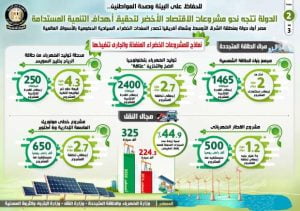
Green economy projects account for 15% of the state’s investment plan for the 2020–2021 fiscal year, while the government aims to reach 30% of green economy projects during the current 2021–2022 fiscal year, with the share rising to about 50% by 2024–2025.
Over the past year, the Egyptian government approved the implementation of 691 eco-friendly projects in the renewable energy, water, and transport sectors, and began issuing Green Star certificates for hotels that apply environmental compliance policies.
The Ministry of International Cooperation worked to align development financing with the 17 Sustainable Development Goals announced by the United Nations. The ministry’s active portfolio includes 372 projects across various state sectors and the private sector, valued at $26.5 billion.
Goal 6, clean water and sanitation, is backed by $5.3 billion in funding—accounting for 20.3% of the active portfolio—across 37 projects in 88 locations in governorates nationwide. Goal 7, affordable and clean energy, has $5.9 billion for 32 projects in 61 locations nationwide, representing 23.2% of total development financing.
It was also announced that 32 projects worth $5.1 billion were launched to contribute to Goal 11: sustainable cities and communities.
To achieve Goal 13, climate action, 12 projects worth $365 million were launched.
Energy Projects:
The renewable energy sector is one of the most important pillars of the government’s strategy to achieve the green transition and combat the negative impacts of climate change. Therefore, the state has developed an integrated strategy to expand renewable energy projects by 2035.
Green Hydrogen:
Egypt has begun entering the green hydrogen production market for power generation to be among the global pioneers in relying on this type of energy, and it also aims to export, after the Ministry of Electricity and Renewable Energy updated Egypt’s energy strategy to include green hydrogen.
March 2021 saw the signing of an agreement between the Ministry of Electricity and Renewable Energy, the Ministry of Petroleum and Mineral Resources, and the Navy with the Belgian company DEME to begin studies for the project to produce and export green hydrogen from Egypt. This is the second agreement of its kind, following the first agreement signed with the German company Siemens to start a pilot project for green hydrogen production in February of the current year.
Prominent Renewable Energy Projects:
《 Benban Station, the World’s Largest Solar Park 》
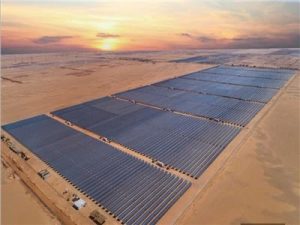
The Benban solar power station project is a unique model of cooperation among relevant parties—the government, the private sector, and international financial institutions—to implement the world’s largest solar park, comprising six million solar panels across an area of 36 km2. It was carried out by more than 40 companies from 12 different countries to generate 1,500 megawatts of power, reinforcing the sustainable energy strategy of the Arab Republic of Egypt, supporting the spread of clean energy, mitigating climate change factors, and reflecting the government’s strong commitment to the transition toward the green economy with the participation of all relevant parties.
The Benban solar park supports the implementation of Sustainable Development Goal 7:
Affordable and clean energy, alongside Goal 8: Decent work and economic growth, and Goal 17: Partnerships for the goals. The project works to reduce emissions of millions of tons of greenhouse gases, creates jobs, and boosts Egypt’s economic growth.
Since the issuance of Renewable Energy Law No. 203 of 2014, the government has begun rolling out incentives for the private sector to enter the renewable energy field to support the country’s green transition strategy. As a result of these efforts, several initiatives have emerged, including the establishment of KarmSolar—the first private sector company specializing in solar energy production in Egypt to receive a license from the relevant authorities—enabling Egypt to secure its position as one of the leading countries in the Middle East and North Africa in renewable energy.
Agriculture and Water Projects:
Projects in this field aim to:
- Achieve sustainable use of natural agricultural materials.
- Focus on integrated agricultural management methods.
- Raise the efficiency of water use in agriculture, improve irrigation and drainage systems, and modify the crop mix in favor of crops that consume less water.
- Reuse agricultural drainage water and sewage.
Prominent water treatment projects in Egypt:
《 El Mahsama Water Plant 》
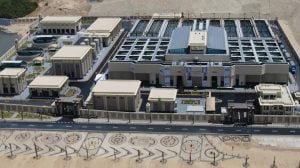
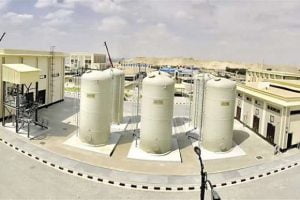
The El Mahsama plant in the Sinai Peninsula is the largest agricultural drainage water treatment plant in the world, enabling the state to irrigate 70,000 feddans of agricultural land through one million cubic meters of water per day, while creating thousands of jobs and boosting community development.
Also:
Institutional Measures and Environmental Legislation for New Companies and Projects:
- Amend environmental legislation and develop environmental management systems.
- Increase the shift toward low-carbon green economic development.
- Complete the institutional framework for managing national efforts to adapt to the impacts of climate change.
- Integrate the environmental dimension into development projects.
- Adopt internal financial policies that incentivize and support eco-friendly facilities, and stiffen penalties for harmful environmental practices.
- The Ministry of Investment’s launch of the Egyptian Corporate Social Responsibility Index for the 100 listed companies on the stock exchange, incorporating the environmental and social aspects undertaken by the company. This will lead indirectly to these companies reducing their greenhouse gas emissions to comply with environmental laws and standards.
References:
- Ministry of Environment
- Information and Decision Support Center of the Cabinet, Egypt Economic Conference 2022 page info@eec2022.gov.eg


Latest video
تابع معنا تحليل قراءة الصحف اليومية مع الكاتب الصحفي Hany Sallam عبر