

The Importance of Using Biofertilizers and Their Impact on Climate Change and the Environment

By: Chemist Mohamed Younis Abdel-Fattah Hassan
Master’s in Microbiology, Wastewater Treatment, and the Production of Agricultural Fertilizers and Biofertilizers Using Microorganisms –
Helwan University.
Water pollution caused by synthetic chemical fertilizers and pesticides is a major and highly dangerous problem in many agricultural regions. Because the use of these materials is banned in organic agriculture, and thanks to the biodiversity relied upon in organic farming—in terms of cultivated varieties, permanent vegetative cover, soil structure enhancement, and good management practices—soils will retain nutrients better, significantly reduce the risk of groundwater pollution, protect the environment from contamination, and incorporate biofertilizers. Furthermore, the excessive use of chemical fertilizers damages soil quality and the environment, threatening the sustainability of crop production systems, polluting groundwater, degrading agricultural soil, and causing other environmental harms. Therefore, in this research and scientific article, I want to present a portion of my master’s thesis entitled “Microbiological Studies in Wastewater Treatment and the Production of Agricultural Fertilizers Using Microorganisms.” The thesis highlights the role of living microorganisms in producing bio-based agricultural fertilizers and soil conditioners useful for increasing agricultural soil fertility, improving soil properties, boosting the yields of various crops, and protecting the environment from pollution. Using biofertilizers also yields numerous other benefits. The research problem lies in the excessive use of chemical fertilizers and pesticides in growing crops, vegetables, and fruits. Accordingly, the research aimed to study the impact of using biofertilizers on productive and economic efficiency compared to chemical fertilizers in the cultivation and production of several crops, such as tomatoes, maize, wheat, sugar beets, potatoes, cucumbers, grapes, bananas, strawberries, and oranges, in comparison with their counterparts grown using chemical fertilizers.

Impact of Biofertilizers on Climate Change and the Environment:
Organic agriculture and the use of biofertilizers reduce energy consumption from non-renewable sources by lowering the need for chemicals whose production requires large amounts of fossil-fuel-based energy. Organic agriculture also helps mitigate greenhouse gas effects through its ability to sequester carbon in agricultural soils and increase the inclusion of nitrogen-fixing legume crops in crop rotations. This helps return carbon to the soil, leading to increased productivity and favorable conditions for carbon storage. Agricultural activities are responsible for one-third of the global warming and climate change experienced by the Earth, with 25 percent of greenhouse gas emissions coming from agricultural sources, particularly deforestation for agricultural expansion. Nearly half of the broad-leaved forests in temperate, tropical, and subtropical regions, and one-third of the grasslands and shrublands in temperate regions—which serve as important habitats for wild origins—have been converted into productive agricultural land. Additionally, half of the world’s wetlands, which are vital environments for aquatic life, have been drained and turned into agricultural areas, alongside emissions from flooded rice paddies and the burning of plant or animal waste.
 .
Impact of Biofertilizers on Biodiversity and the Environment:
The excessive and redundant use of chemical fertilizers negatively affects climate change and poses a serious threat to the environment and biodiversity, while largely ignoring the environment, the integrity of its components, and ecological balance. This results in severe degradation of the environment and its elements, as well as the loss of agricultural soil fertility.
Therefore, we strive to highlight the risks of the excessive and over-use of chemical fertilizers, particularly their impacts on human and animal health, environmental pollution, agricultural degradation, lower crop yields, and groundwater contamination, along with the various environmental and climate changes that follow.
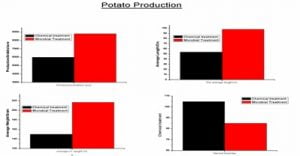
Results and Numbers of Experiments Comparing Chemical and Biofertilizers Across Agricultural Crops
Bio. | Che. | Bio. | Che. | Bio. | Che. | Bio. | Che. | Sugar beet | Sugar beet | Bio. | Che. |
| Wheat | Wheat | Arugula | Arugula | Soybean
| Soybean | Potato | Potato | Sugar beet | Sugar beet | Zea mays | Zea mays |
| 24 Ardab / acre | 19 Ardab / acre | (1600) kgs per acre | (1150) kgs per acre | 8800 kg / acre | 6000 kg / acre
| 50 tons per acre | 42 tons per acre | 20 Ardebs / acre | 17 Ardebs / acre | ||
| Average length of shoot and leaf (cm). | |||||||||||
| (26 cm) | (22 cm) | (18 cm) | (12 cm) | 50 cm | 30 cm | 98 cm | 54 cm | 40 cm | 30 cm | 200 cm | 170 cm |
| Average shoot and leaf weight (gm). | |||||||||||
| 52 gm | 30 gm | 75 gm | 43 gm | 64 gm | 40 gm | 217 gm | 150 gm | 1250 gm | 780 gm
| 500 gm | 350 gm |
| days of greening to harvest time | |||||||||||
| 105 days | 130 days | 20 days | 25 days | 100 days | 120 days | 85 days | 105 days | 160 days | 185 days | 95 days | 115 days |
References:
- Santos VB, Araujo SF, Leite LF, Nunes LA, Melo JW: Soil microbial biomass and organic matter fractions during transition from conventional to organic farming systems. Geoderma 2012, 170:227–231.
- Youssef MMA, Eissa MFM: Biofertilizers and their role in management of plant parasitic nematodes. A review. E3 J Biotechnol. Pharm Res 2014, 5:1–6.
- Raja N: Biopesticides and biofertilizers: ecofriendly sources for sustainable agriculture. J Biofertil Biopestici 2013, 1000e112:1000e112.4. Analytical study on the impact of using biofertilizers on the productive and economic efficiency of wheat and maize crops (a case study in Dakahlia Governorate by Dr. Tarek Mohamed El-Sayed Abou Moussa, Agricultural Economics Research Institute, Agricultural Research Center; and Dr. El-Sayed Abdullah El-Sayed Mesbah, Faculty of Agriculture, Al-Azhar University).
5. Part of a master’s thesis on microbiological studies in wastewater treatment and agricultural fertilizer production, Helwan University


Latest video
تابع معنا تحليل قراءة الصحف اليومية مع الكاتب الصحفي Hany Sallam عبر