
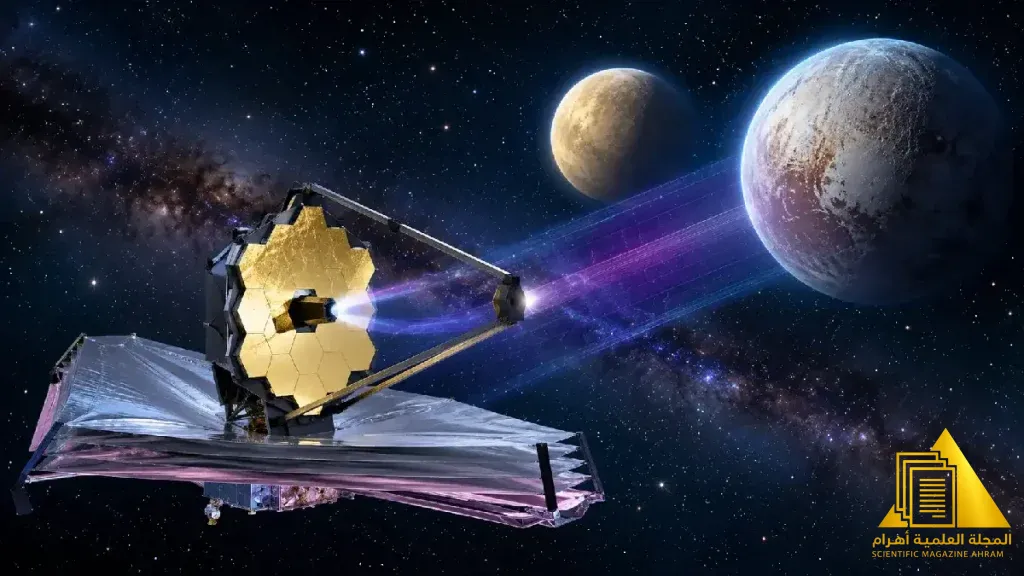

The James Webb Space Telescope continues to fascinate scientists after detecting previously undiscovered material in the atmospheres of two worlds at the edge of the solar system, a step that may help us understand how distant celestial bodies form and evolve over billions of years.
This discovery does not mean there is life beyond Earth, but it gives scientists new information on the chemical composition of these worlds and opens the door to research that may reveal more secrets of the solar system.
What Did James Webb Discover?
Scientists used the capabilities of the James Webb Space Telescope
to analyze the atmospheres of Pluto and Saturn’s moon Titan, detecting material that was not previously known in these environments, which represents a new addition to understanding the nature of distant icy bodies.
Why Is This Discovery Important?
Every material discovered in the atmosphere of any celestial body represents a new piece of the puzzle that scientists are trying to solve, as it helps them learn how these worlds originated and how their components interact with sunlight and the space surrounding them.
These discoveries also help improve the scientific models that researchers use to study planets and moons inside and outside our solar system.
What Distinguishes the James Webb Telescope?
James Webb is the most powerful space telescope
built to date, as it can detect infrared radiation with great precision, allowing it to discover details that traditional telescopes cannot see.
Since the beginning of its operation, it has contributed to dozens of discoveries that have changed scientists’ understanding of stars, galaxies, and planets, and it continues to send new data on an ongoing basis.
What Does This Mean for the Future?
Researchers expect these results to help develop more precise studies on distant icy bodies, and future observations may reveal other materials that have not been observed before, which expands our understanding of the history of the solar system.
This discovery confirms that the role of the James Webb telescope is not limited to observing distant galaxies, but also continues to uncover new secrets within our solar system, making each new observation an additional step toward better understanding the universe.
Hany Sallam


Latest video
تابع معنا تحليل قراءة الصحف اليومية مع الكاتب الصحفي Hany Sallam عبر