
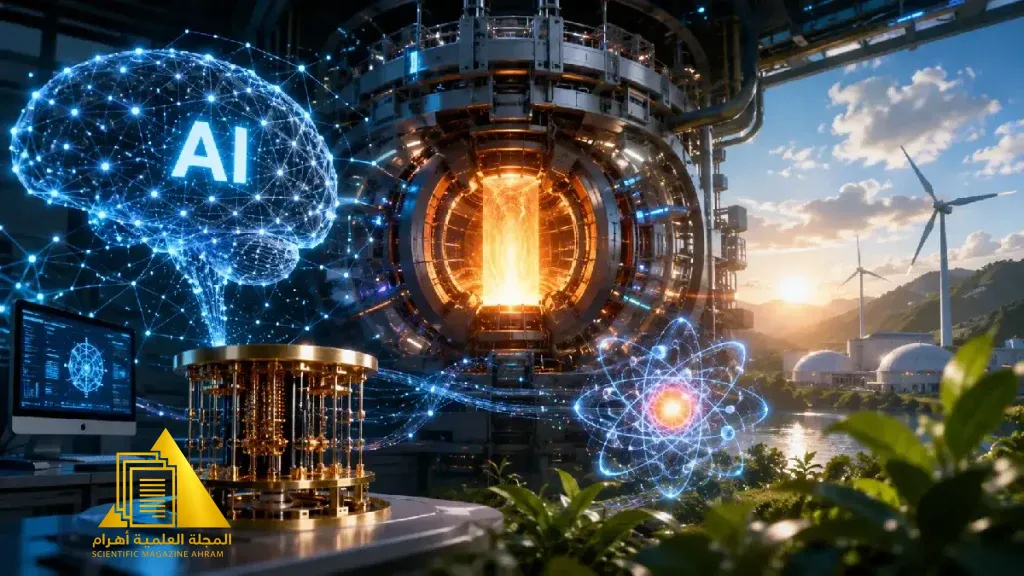

The dream of generating clean energy sufficient for the entire world may come closer to reality after a team of researchers successfully harnessed artificial intelligence and quantum computing to study one of the most complex problems on the path to nuclear fusion, a source scientists describe as the energy of the future.
Although this achievement does not mean producing this energy tomorrow, it represents an important scientific step that may help accelerate research that scientists have been working on for decades.
What Is the Energy of the Future?
Nuclear fusion relies on fusing light atoms to produce massive amounts of energy, the same process that gives the Sun its power. If scientists succeed in controlling it inside reactors, the world could gain a clean and safe energy source in huge quantities with limited carbon emissions.
Where Was the Problem?
Nuclear fusion research faces numerous challenges, including finding suitable materials that can withstand harsh conditions inside reactors, in addition to producing certain elements necessary to operate them efficiently.
Studying these materials requires extremely complex calculations that may take a long time using traditional computers.
How Did Artificial Intelligence Help?
Researchers used artificial intelligence
alongside quantum computing to analyze the properties of candidate materials for use in nuclear fusion reactors. This approach helps reduce the time required to perform complex scientific calculations and allows testing a larger number of possibilities in a shorter time.
Why Is This News Important?
This achievement may not lead to building a nuclear fusion reactor
over the next few years, but it shortens an important part of the journey for scientists and helps them make faster decisions when developing clean energy technologies.
Researchers believe that combining artificial intelligence and quantum computing may open the door to discovering new materials that serve not only nuclear fusion, but also other fields such as medicine, battery design, and advanced industries.
What Does That Mean for the Future?
If this research continues to make progress, the world may move an additional step closer to producing clean, sustainable energy that meets the needs of future generations, reduces reliance on fossil fuels, and supports global efforts to tackle climate change.
Although the road is still long, these results confirm that artificial intelligence is no longer merely a tool for writing texts or creating images, but has become a true partner in solving some of the most complex scientific problems facing humanity.
Hany Sallam


Latest video
تابع معنا تحليل قراءة الصحف اليومية مع الكاتب الصحفي Hany Sallam عبر