
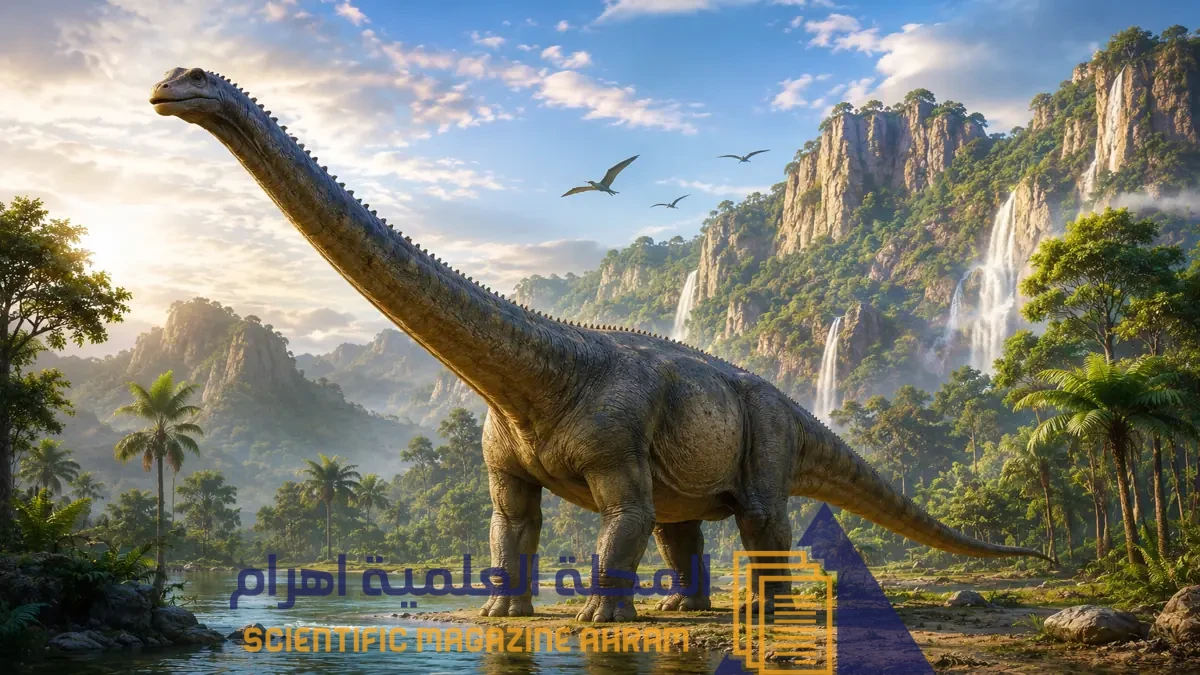

Paleontologists have announced the discovery of a new giant dinosaur species in Thailand, believed to be the largest found to date in Southeast Asia, following years of analyzing fossil remains.
The new dinosaur has been named Nagatitan chaiyaphumensis and belongs to the sauropod family of long-necked, plant-eating dinosaurs renowned for their massive bodies, extended necks, and long tails.
According to the study, the giant creature reached a length of about 27 meters, while its weight ranged between 25 and 28 tons—roughly equivalent to the weight of nine adult Asian elephants. Researchers recovered parts of the backbone, ribs, pelvis, and leg bones, including a massive forelimb bone measuring 1.78 meters in length.
The remains were first discovered by a local resident in Chaiyaphum province, northeastern Thailand, before scientific teams from Thai and British universities and museums launched excavation and analysis operations that lasted for years.
Scientists believe that this dinosaur lived about 113 million years ago during the Cretaceous period in an environment featuring rivers, forests, and warm grasslands, which was also home to crocodiles, fish, flying reptiles, and giant carnivorous dinosaurs.
The researchers noted that its sheer size provided natural protection from most predators, and suggested that it fed on massive amounts of vegetation and tall trees without needing to chew its food heavily.
Scientists believe this discovery opens a new window into understanding the diversity of giant dinosaurs in Asia, especially since the region later underwent major geological changes that turned vast parts of it into shallow seas, making the discovery of newer fossils extremely rare.
Reporting by Hany Sallam


Latest video
تابع معنا تحليل قراءة الصحف اليومية مع الكاتب الصحفي Hany Sallam عبر