
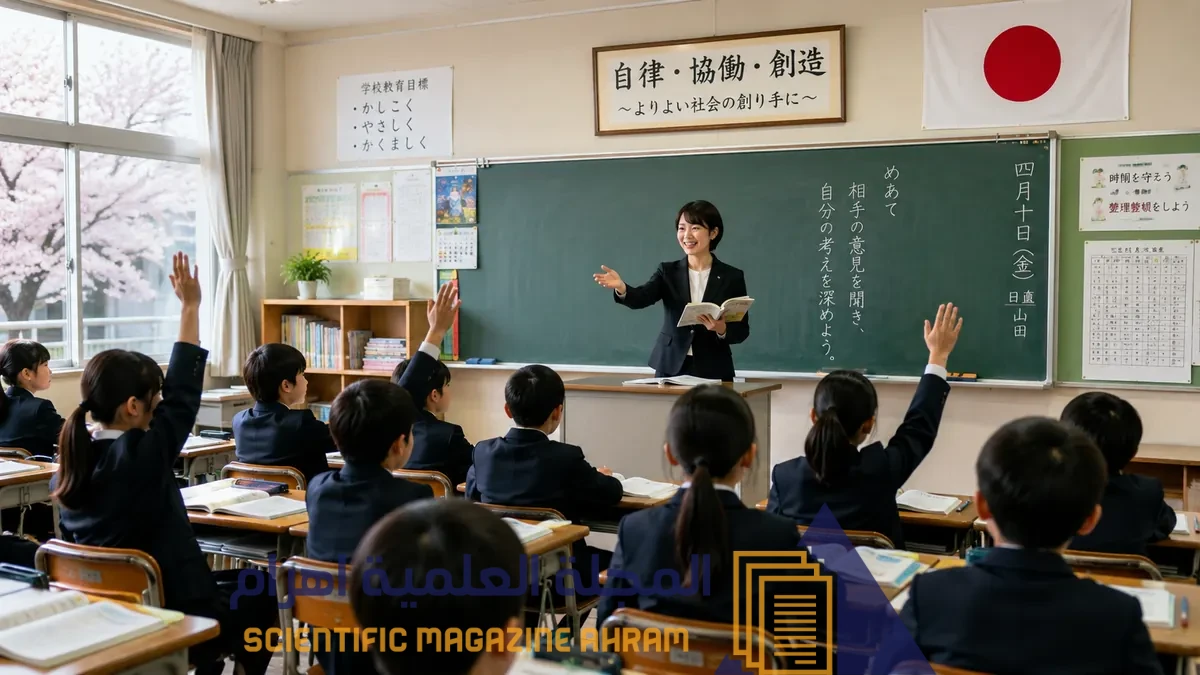

Japan’s education system is seen as one of the most successful and disciplined in the world, not only because of students’ academic excellence, but also because it relies on building character and fostering a sense of responsibility and teamwork from the earliest school years.
The Japanese educational system relies on a structural framework known as the “6-3-3-4” system: six years of elementary school, three of junior high school, three of high school, and then university education, with schooling being compulsory for the first nine years.
Among the most prominent features distinguishing Japanese schools is their strong focus on behavior, discipline, time management, cleanliness, and teamwork, as students take part daily in cleaning classrooms and school corridors themselves, with the goal of instilling a sense of responsibility and self-reliance from a young age.
Japanese schools also allocate classes for moral education alongside academic subjects, in an attempt to build a generation that combines knowledge with social values. Recent educational reports indicate that the Japanese system focuses on cooperation rather than individual competition during the early stages of education.
In recent years, Japan has begun introducing artificial intelligence technologies and digital solutions into schools, alongside expanding the use of tablets and smart educational systems, as part of plans by the Japanese Ministry of Education, Culture, Sports, Science and Technology to develop education and raise the efficiency of digital learning.
Education experts believe that the secret to the success of the Japanese experience relies not only on curricula, but on the societal culture that gives education great value within the family and society, alongside continuous attention to teacher training and the development of the school environment.
Japan is also known for having advanced technical schools and institutes focused on engineering, electronics, and programming, which has helped support Japanese technology industries for decades.
Despite the heavy academic pressures faced by some students due to entrance exams and educational competition, the Japanese system is still considered a global model in discipline and educational quality, and many countries seek to benefit from its elements and apply them within their schools.
Hany Sallam


Latest video
تابع معنا تحليل قراءة الصحف اليومية مع الكاتب الصحفي Hany Sallam عبر