
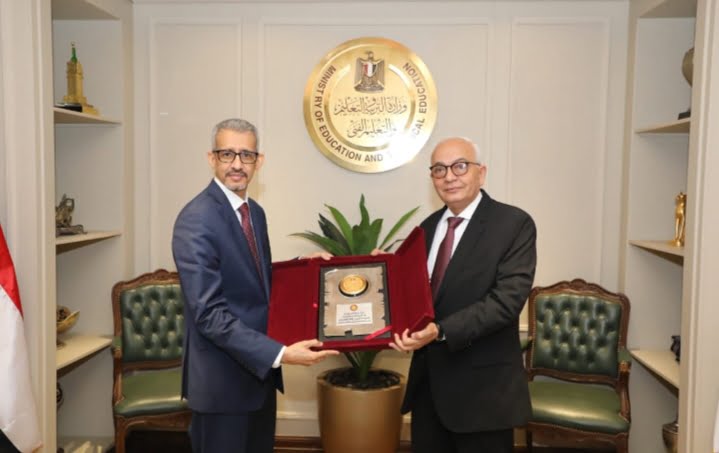

Minister of Education Receives Director-General of ALECSO to Discuss Pre-University Education Development in Egypt
Reporting by Sherine Hamdy
Dr. Reda Hegazy, Minister of Education and Technical Education, received Dr. Mohamed Ould Amar, Director-General of the Arab League Educational, Cultural and Scientific Organization (ALECSO), and his accompanying delegation to discuss ways to cooperate in supporting pre-university education development strategies in Egypt and to enhance the exchange of expertise among member states.
At the start of the meeting, Dr. Reda Hegazy expressed his pleasure at the fruitful and constructive cooperation with the organization, appreciating the role it plays in supporting the efforts of member states in its areas of expertise and its commitment to contributing to the development of educational strategies.
The minister explained that educational reform is a state responsibility, affirming that the Egyptian government is committed to developing the education sector. He noted that the Ministry of Education serves 25.5 million students in Egyptian schools, making it responsible for raising an entire generation and preparing them for the future. He pointed out that career paths are no longer fixed and that some jobs will disappear in the future, which is why the ministry focuses on equipping students with life skills that help them develop themselves and prepare them to seek future job opportunities. The ministry also focuses on social upbringing and the personal development of students, preparing them in their early years, as well as teaching values and behavior.
The minister pointed out that, in light of the future of education under digital transformation and artificial intelligence, the ministry is working to prepare students to produce knowledge amid multiple learning sources by equipping them with core concepts and teaching them through active learning sources and school activities. He added that the role of the teacher is shifting to become an organizer, guide, and evaluator of the educational process, alongside the ministry’s commitment to preserving the human touch in education as well as emotional and moral values.
Dr. Reda Hegazy went on to emphasize the importance of student research projects, which contribute significantly to developing their various capabilities and behaviors such as cooperation, teamwork, problem-solving, critical and creative thinking, presentation skills, identifying problems, working to develop solutions, self-learning, and perseverance. He noted that these skills will remain with students throughout their lives and help them succeed in the future.
Dr. Reda Hegazy reviewed the ministry’s efforts in educational reform in Egypt, affirming that the ministry has made major efforts to develop education. Curricula have been developed from kindergarten year one (KG1) to grade six of primary school, built on core concepts, interdisciplinary curricula, values, respect for others, and the Discover program. He stressed that Egypt has a pioneering experience in educational development and welcomes cooperation with other countries to exchange expertise in this field.
Dr. Reda Hegazy added that preparatory stage curricula have also been developed and will be implemented starting from the upcoming 2024/2025 academic year, stressing that the ultimate goal being focused on is the quality of life for students and their families, with entrepreneurship integrated across all curricula.
The minister added that the ministry is keen to address deficiencies in basic reading and writing skills to reduce educational loss through diagnostic and remedial programs, and is also working to address bilingualism issues when learning the Arabic language.
Dr. Reda Hegazy affirmed that teachers are the driving force of learning, noting the role of the Professional Academy for Teachers in achieving three strategic objectives: teacher promotion methods, coordination between faculties of education and schools, and the accreditation of professional development programs with their three elements—the trainer, the training venue, and the training packages. He pointed out that there is now a precise mechanism for selecting new teachers.
The minister noted the ministry’s commitment to keeping pace with modern technology and utilizing it to develop the educational system as one of the most important mechanisms it focuses on in parallel with developing all other aspects of the system, affirming the ministry’s expertise in digitizing exams and question banks.
The Minister of Education also reviewed the mechanisms adopted by the ministry to provide an integrated system of services for people with disabilities and to provide all means of support for them, including the Rehabilitation Center for People with Disabilities in the city of 10th of Ramadan, which meets all international standards. The ministry is working on developing an operational plan to expand the scope of the services it provides so that its services reach the Middle East region.
The minister also affirmed that all schools in Egypt are inclusive, meaning that every student with a disability has a place in Egypt’s schools. He added that classrooms have been allocated for multiple and dual disabilities, teachers have been trained in this field, and several ministerial decisions have been issued to support students’ educational pathways, alongside the preparation of new curricula to help integrate them further into society.
Turning to illiteracy in Egypt, the Minister emphasized that a strong link exists between levels of education, fertility, and population growth, noting that higher education helps curb population growth. He also pointed to the role of the Regional Center for Adult Education in Sers El-Layan—a UNESCO Category 2 center and one of only 12 accredited centers worldwide—through which the Ministry works to provide activities serving the entire region.
The Minister added that a General Administration for Support and Communication has been established to raise awareness of the Ministry’s efforts and correct the course in various sectors.
During the meeting, the Minister confirmed that the Ministry is ready to share its expertise in pre-university education with other countries.
For his part, Dr. Mohamed Ould Amar, Director-General of the Arab League Educational, Cultural and Scientific Organization (ALECSO), expressed his pleasure at the meeting and the fruitful, multifaceted cooperation with the Egyptian Ministry of Education. He praised the Egyptian education system, asserting that Egypt’s experience in education must lead the Arab world given its capabilities and expertise in this field.
Dr. Mohamed Ould Amar affirmed the organization’s keenness to continue fruitful cooperation with Egypt in education, culture, and science, noting that ALECSO is primarily concerned with advancing Arab culture by developing education, culture, and science at both regional and national levels, and by coordinating among member Arab states.
He noted that the organization’s priorities at this stage involve shaping a generation that looks toward the future, and working to increase allocations for this sector to develop human resources and build that generation—especially since children today spend most of their time online, unlike the previous generation, whose sources of information were limited to the teacher and the school.
Dr. Mohamed Ould Amar also stressed the importance of coordinating with member states to unify visions, achieve convergence regarding science and mathematics curricula, and exchange expertise to benefit the younger generation across Arab countries.
Dr. Mohamed Ould Amar continued by emphasizing the importance of tackling illiteracy in various Arab countries, alongside digital illiteracy, expressing the organization’s eagerness to cooperate with the Egyptian Ministry of Education in this regard due to Egypt’s extensive expertise and significant efforts.
The meeting was attended from the ALECSO delegation by Dr. Sami Al-Zyood, Director of Administrative and Financial Affairs; Dr. Ramy Iskander, Director of Education; Dr. Mohamed Kamal, Director of the Institute of Research and Arab Studies; Ms. Nisreen Ghoneim, External Relations Officer; and Ms. Dina El-Kelany from the Director-General’s Office.
Attending from the Egyptian National Commission for Education, Science and Culture was Dr. Sherif Saleh, Secretary-General of the Commission.
Representing the Ministry were Dr. Shereen Hamdy, Advisor to the Minister for International Relations and Agreements and Supervisor of the Central Administration for the Minister’s Office; Dr. Eid Abdel Wahed, Head of the Executive Authority for Adult Education and Illiteracy Eradication; Dr. Akram Hassan, Head of the Central Administration for Curriculum Development; Dr. Hala Abdel Salam, Head of the Central Administration for Basic Education; Dr. Mohamed El-Kady, Director of the Regional Center for Adult Education in Sers El-Layan; and Dr. Mahmoud Haggag, Director-General of the Support and Communication Administration.


Latest video
تابع معنا تحليل قراءة الصحف اليومية مع الكاتب الصحفي Hany Sallam عبر